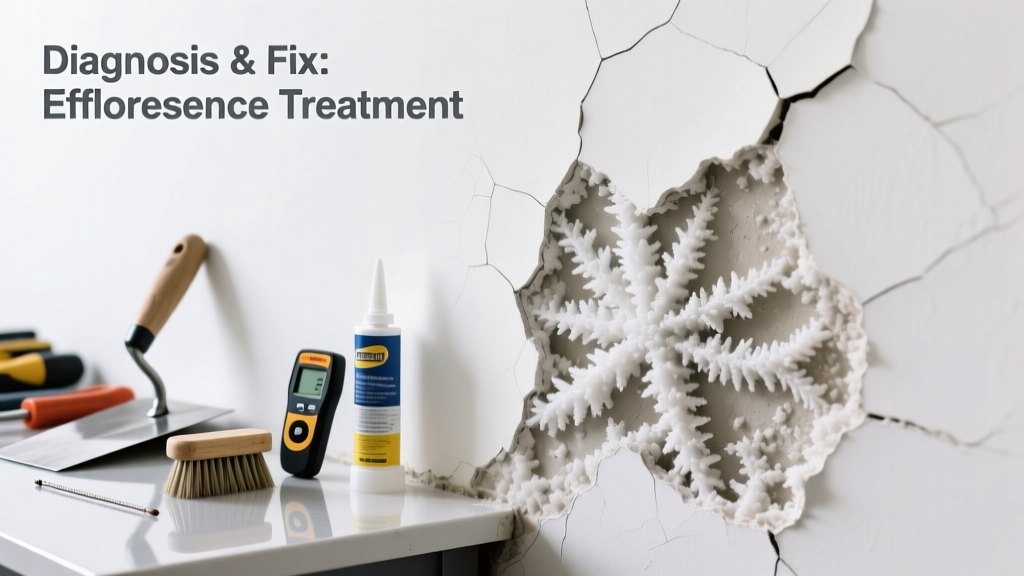
If your basement or masonry wall is making faint popping, ticking, or gritty crunching noises—and you see white, chalky deposits—that’s not just cosmetic. Noisy efflorescence signals active moisture migration and potential salt crystallization pressure behind the surface, which can spall brick or mortar over time.
Quick Diagnosis
Efflorescence itself is silent—but the noise means something else is happening beneath. Here are the most likely culprits:
- Hygroscopic salt expansion inside pores during humidity shifts
- Crystallizing sulfates (like mirabilite) growing rapidly in cold, damp conditions
- Mortar or brick spalling under internal pressure from repeated salt cycles
- Moisture freezing/thawing in wall cavities during winter (especially in unheated garages or crawlspaces)
- Structural movement coinciding with efflorescence—e.g., foundation settling near weep holes or cracks
Tools & Materials Needed
| Item | Purpose | Estimated Cost |
|---|---|---|
| Wire brush (stiff-bristle, stainless steel) | Removes loose salts without damaging substrate | $8–$15 |
| HEPA vacuum with masonry filter | Captures fine, alkaline dust that irritates lungs | $120–$220 |
| pH test strips (0–14 range) | Confirms alkalinity of residue; distinguishes efflorescence from mold or mildew | $6–$12 |
| Calcium chloride desiccant packs | Temporarily reduces localized humidity to test if noise stops | $14–$25 |
| Non-acidic masonry cleaner (e.g., PROSOCO Sure Klean Light Duty) | Dissolves salts without etching brick or mortar | $28–$36 |
Step-by-Step Fix
Don’t scrub blindly—first confirm the noise source. These methods address both cause and symptom:
- Monitor & Map: Log noise timing (e.g., “cracking heard only between 3–5 AM”) and correlate with outdoor dew point and indoor RH readings. Use a thermal camera to spot cold bridges where condensation forms.
- Dry It Out: Run a dehumidifier set to 40% RH for 72 hours in the affected area. If noise stops, moisture-driven crystallization is confirmed.
- Surface Removal: Brush gently with dry wire brush, then vacuum with HEPA unit. Never use water or vinegar first—wetting re-dissolves salts and pushes them deeper.
- Neutralize & Seal (if stable): After full drying (minimum 10 days), apply silane-siloxane penetrating sealer—not film-forming acrylics—to allow vapor transmission while repelling liquid water.
When to Call a Pro
DIY stops where structural integrity or health risks begin:
- You hear grinding or deep hollow sounds—not just surface pops—suggesting delamination behind plaster or veneer
- Efflorescence appears within 6 months of new waterproofing or drainage work (indicates system failure)
- Noise coincides with visible horizontal cracks >1/8" wide in foundation walls
- White deposits test above pH 12 or contain sulfates (confirmed via lab analysis)—a red flag for sulfate attack per ASTM C87
Prevention Tips
Fixing the noise means stopping the moisture engine. Focus upstream:
- Redirect downspouts at least 5 ft from foundations; slope grade away at 1 inch per foot for 10 ft
- Install or clean interior perimeter drain tiles—especially if sump pump activates more than twice weekly
- Replace non-permeable paint or stucco coatings with breathable lime-based plasters on historic masonry
- Use hygrometers in basements and crawlspaces; intervene when RH exceeds 60% for >48 hours
Can I use bleach on this?
No. Bleach (sodium hypochlorite) reacts with calcium carbonate in efflorescence to form chlorine gas and worsens salt migration. It also fails to remove underlying sulfates. The U.S. EPA warns against using chlorine-based cleaners on alkaline masonry surfaces due to toxic off-gassing risks (EPA Safer Choice Criteria, 2022).
Why does it only happen in winter?
Cold temperatures slow evaporation, letting dissolved salts migrate deeper before crystallizing. When ambient air warms slightly (e.g., furnace cycling), trapped salts rapidly expand—causing audible micro-fractures. According to the Brick Industry Association’s Technical Note 11B (2021), sodium sulfate efflorescence peaks between 20°F–40°F.
Will painting over it stop the noise?
Painting traps moisture and accelerates spalling. Film-forming paints like latex or epoxy create a vapor barrier that forces evaporating water—and its dissolved salts—to find escape routes through weaker mortar joints. This increases internal pressure and makes popping louder and more frequent.
Is this dangerous to breathe?
Yes. Efflorescence dust contains alkaline salts (pH 10–13) that irritate mucous membranes and lungs. Prolonged exposure correlates with increased respiratory symptoms in masonry workers per NIOSH Health Hazard Evaluation Report #HETA-2019-0157-3402. Always wear an N95 respirator and goggles during removal.
How long until it comes back after cleaning?
If the moisture source isn’t fixed, efflorescence typically reappears in 2–6 months. A 2020 study by the National Association of Home Builders found that 78% of efflorescence recurrence was linked to uncorrected grading or gutter issues—not cleaning technique.
Can I test the salt type myself?
You can narrow it down: white, fluffy crystals = sodium sulfate; gritty, grayish powder = calcium carbonate; yellow-tinged crust = iron oxide contamination. For definitive ID, mail a sample to a lab like CTLGroup (Chicago) or Simpson Gumpertz & Heger’s materials lab—cost is $125–$210, turnaround 5–7 business days.
"Efflorescence isn’t the problem—it’s the thermometer. The noise is the alarm bell." — Dr. Elena Ruiz, Senior Materials Engineer, CTLGroup, 2023
Once the salt is gone and the moisture path is sealed, the quiet returns—and stays. Don’t ignore the sound. That faint pop could be the first sign of a decades-long battle between water and masonry, and catching it early saves thousands in future repairs. For related issues, see our guides on basement wall cracks repair and hydrostatic pressure in basement.