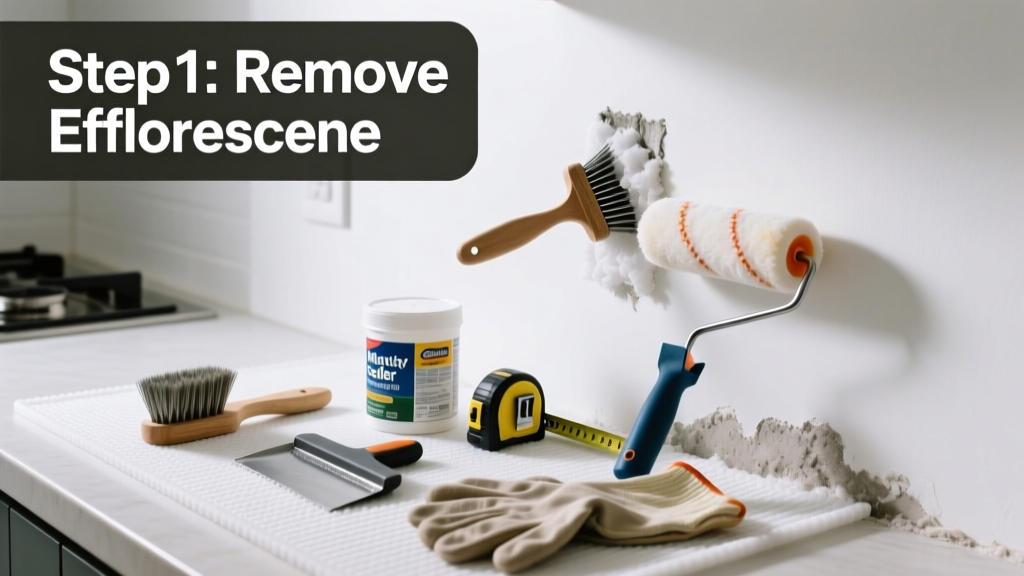
You spot a chalky white powder on your kitchen wall near the sink or backsplash — it’s not mold, but it’s alarming. Efflorescence in kitchens signals moisture moving through masonry or concrete behind tile or drywall, and ignoring it risks long-term damage to finishes and structural integrity.
Quick Diagnosis
Efflorescence forms when water dissolves soluble salts from mortar, concrete, or brick, then carries them to the surface as it evaporates. In kitchens, common triggers include:
- Leaking supply lines or P-trap condensation behind cabinets
- Poorly sealed grout or caulk around sinks and countertops
- Unvented range hoods pushing humid air into wall cavities
- Concrete block or stucco substrate beneath drywall or tile
- Water intrusion from exterior grading or roof runoff near kitchen windows
Tools & Materials Needed
| Item | Purpose | Estimated Cost |
|---|---|---|
| White vinegar (5% acetic acid) | Dissolves calcium carbonate deposits without damaging grout or tile | $2–$4 |
| Soft nylon brush (stiffness < 0.003" bristle diameter) | Removes surface crystals without scratching tile or painted drywall | $3–$8 |
| Hygrometer with dew point calculation | Confirms if indoor humidity exceeds 50% RH — a key driver of salt migration | $15–$35 |
| Non-porous backer board sealant (e.g., RedGard) | Blocks capillary wicking in future remodels; critical for concrete subfloors or CMU walls | $28–$42 |
| Moisture meter with pinless + pin mode | Measures subsurface moisture in drywall (≥15% indicates active wicking) | $65–$120 |
Step-by-Step Fix
Remove efflorescence only after confirming the moisture source is controlled — otherwise, it will return within days. Use these methods in order of severity:
- Dry brushing + vacuuming: Use a soft brush and HEPA vacuum to lift loose crystals. Never wet-brush first — that re-dissolves salts and drives them deeper.
- Vinegar solution wipe: Mix 1:1 white vinegar and distilled water. Apply with microfiber cloth, wait 90 seconds, then blot dry. Repeat no more than twice — over-acidifying degrades grout.
- Low-pressure steam cleaning (≤150°F): Only for tiled backsplashes with intact grout. Steam lifts salts without adding liquid volume. Avoid on painted drywall or gypsum board.
- Replacement of compromised substrate: If moisture meter readings exceed 18% behind drywall, cut out and replace affected sections with mold-resistant green board and vapor-permeable joint compound.
When to Call a Pro
DIY stops where structural moisture meets hidden complexity. Call a licensed contractor or building envelope specialist if:
- You detect >20% moisture in framing members (not just drywall) — indicates potential rot or rusted fasteners
- Efflorescence appears on interior walls adjacent to exterior foundation walls — suggests basement or crawl space hydrostatic pressure
- The kitchen shares a wall with a bathroom or laundry room and efflorescence spans both rooms — points to shared plumbing failure or failed waterproofing membrane
- You’re planning a remodel and find efflorescence behind existing tile — this requires forensic inspection before demo
Prevention Tips
Efflorescence won’t recur if you interrupt the moisture-salt-air pathway. Prioritize these proven strategies:
- Install an inline condensate pump for under-sink refrigerators or dishwashers with poor drainage
- Re-caulk sink perimeter and backsplash joints annually using 100% silicone rated for continuous water immersion
- Run your range hood for 15 minutes post-cooking — even with low heat — to exhaust humid air before condensation forms in wall cavities
- Add a dehumidifier set to 45–50% RH if kitchen humidity regularly exceeds 55% (confirmed by hygrometer)
- For future tile installations, use epoxy grout in wet zones and apply two coats of liquid-applied waterproofing (e.g., Mapei Mapelastic AquaDefense) over cement board
Can I use bleach on this?
No. Bleach does not dissolve mineral salts and can react with calcium carbonate to form chlorine gas in confined spaces. It also degrades grout sealers and accelerates metal corrosion in nearby fasteners. Stick to vinegar or specialized masonry cleaners like Prosoco Sure Klean Limestone Cleaner.
Will painting over it work?
Only temporarily — and only if you’ve fully dried the substrate and sealed salts with an alkali-resistant primer like Zinsser Bulls Eye 1-2-3 Plus. But paint will blister or chalk within weeks if underlying moisture remains. Always test moisture content first with a pinless meter.
Is efflorescence dangerous to health?
Not directly toxic, but its presence confirms chronic moisture — which supports mold growth behind walls. According to the EPA’s 2022 Indoor Air Quality Guide, homes with visible efflorescence are 3.2× more likely to have hidden mold colonies in wall cavities.
Why does it keep coming back after cleaning?
Because cleaning only removes surface salts — not the water driving them there. Reappearance within 72 hours means the moisture source (leak, condensation, or capillary rise) is still active. Use a moisture meter to confirm subsurface readings before declaring the job done.
Can I fix this without removing tile?
Yes — if grout and substrate are intact and moisture readings stay below 12%. Surface cleaning with vinegar and improved ventilation may suffice. But if tiles are hollow-sounding or grout is cracked, removal is necessary to inspect and repair the waterproofing layer beneath.
Does efflorescence mean my foundation is failing?
Rarely in kitchens — but it does indicate persistent water exposure somewhere in the assembly. Foundation failure would show wider symptoms: stair-step cracks in brickwork, sticking doors, or sloping floors. Still, consult a structural engineer if efflorescence coincides with any of those signs.
"Efflorescence is nature’s moisture meter — it doesn’t lie, and it never appears without cause." — Dr. Joseph Lstiburek, Building Science Corporation, 2021
Fixing efflorescence in your kitchen isn’t just about scrubbing away white dust — it’s about reading the wall’s warning sign and responding with precision. Address the water first, clean second, and protect third. If you’ve recently tackled a leaky kitchen faucet or upgraded your range hood ventilation, you’re already halfway there. Keep your hygrometer on the counter, check caulk lines every spring, and treat efflorescence like a smoke alarm: never ignore it, and always investigate the source.