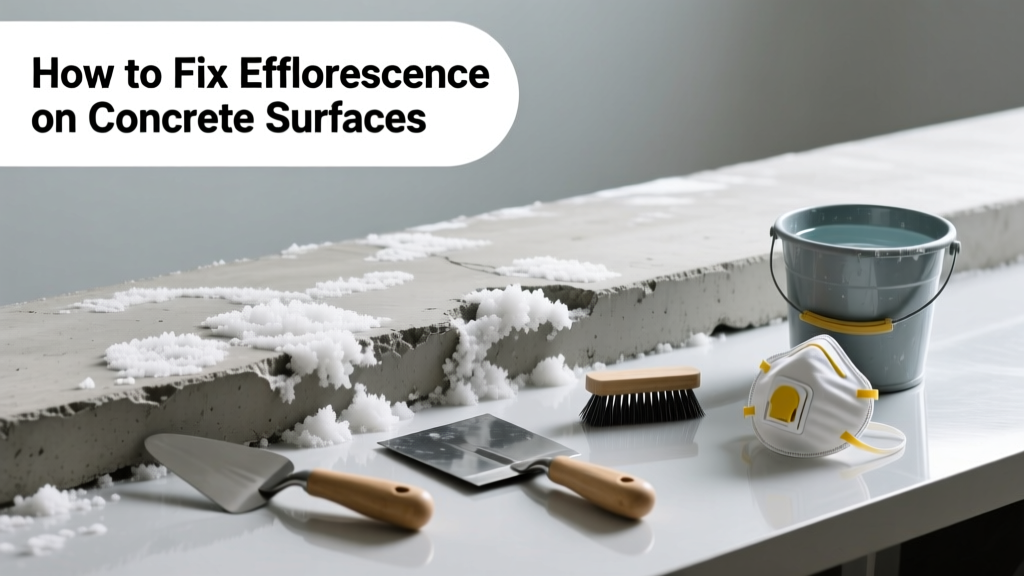
You spot that chalky white powder on your basement floor, garage slab, or patio — it’s not mold, and it’s not dirt. It’s efflorescence: soluble salts migrating to the surface as water evaporates. While harmless to structural integrity, it’s unsightly and signals underlying moisture issues you can’t ignore.
Quick Diagnosis
Efflorescence forms when three conditions align: soluble salts in the concrete or masonry, water movement through the material, and evaporation at the surface. Common root causes include:
- Poor site drainage directing water toward foundations
- Lack of or failed vapor barrier beneath slabs (especially in basements and garages)
- High groundwater or seasonal hydrostatic pressure
- Use of salt-based deicers on exterior concrete in winter
- Improper curing during concrete placement, leaving excess water and unhydrated cement compounds
Tools & Materials Needed
| Item | Purpose | Estimated Cost |
|---|---|---|
| White vinegar (5% acetic acid) or muriatic acid (10–15% solution) | Dissolves calcium carbonate deposits; vinegar for light cases, acid for stubborn buildup | $3–$12 |
| Stiff nylon or fiber brush (non-metallic) | Scrubbing without scratching or damaging concrete surface | $8–$15 |
| Shop vacuum with HEPA filter | Removes dry powder safely before wet cleaning; prevents inhalation of fine particulates | $80–$160 |
| Concrete sealer (silane/siloxane or acrylic) | Blocks capillary water migration post-cleaning; critical for long-term prevention | $30–$75 per 5-gallon pail |
| N95 respirator and chemical-resistant gloves | Protects lungs and skin during acid application and dust removal | $12–$25 |
Step-by-Step Fix
Efflorescence isn’t cured by wiping—it must be dissolved, removed, and the moisture source addressed. Here are four proven methods, ranked by severity:
- Dry brushing + vacuuming: For light, powdery deposits, sweep with a stiff brush and vacuum thoroughly. This works only on *surface bloom*—not the underlying cause.
- Vinegar rinse: Mix equal parts white vinegar and water. Apply with a spray bottle, scrub gently, then rinse with clean water. Let dry fully before sealing. Effective for early-stage efflorescence (per concrete cleaning safety guidelines).
- Muriatic acid wash: Dilute 1 part acid to 10 parts water. Apply with a plastic sprayer, scrub with non-metal brush, wait 5 minutes, then neutralize with baking soda/water mix (1 cup baking soda per gallon). Rinse thoroughly. Never mix acid with bleach.
- Pressure washing (low PSI only): Use ≤1,500 PSI with fan tip—high pressure etches concrete and worsens future salt migration. Always test in an inconspicuous area first.
When to Call a Pro
DIY is safe for surface-level efflorescence on stable, dry slabs. But call a licensed foundation contractor or waterproofing specialist if you see any of these:
- Efflorescence returning within 2–3 weeks after thorough cleaning and sealing
- Cracks wider than 1/8 inch accompanied by dampness or musty odors in basements
- Efflorescence concentrated near wall-floor joints or along cold joints—signs of hydrostatic pressure
- White deposits mixed with dark staining or rust-colored streaks (indicating iron oxidation or rebar corrosion)
According to the American Concrete Institute’s ACI 222R-22 Guide to Protection of Metals in Concrete, persistent efflorescence combined with cracking or spalling may signal chloride-induced reinforcement corrosion—a structural risk requiring engineering evaluation.
Prevention Tips
Fixing efflorescence without addressing moisture is like mopping a flooded floor. Focus on stopping water at the source:
- Grade soil away from foundations at 1 inch per foot for at least 6 feet
- Install or clean footing drains and downspout extensions (minimum 5 feet from foundation)
- Apply penetrating silane/siloxane sealer—not film-forming acrylic—to exterior slabs every 3–5 years
- Avoid deicing salts on concrete less than 12 months old; use calcium magnesium acetate (CMA) instead
- In basements, run a dehumidifier year-round to maintain RH below 50% (U.S. EPA recommends this for moisture control)
Can I use bleach on this?
No. Bleach does not dissolve calcium carbonate—the primary compound in efflorescence—and can react dangerously with residual muriatic acid if used in sequence. It also offers zero moisture-control benefit and may degrade sealers.
Will sealing stop efflorescence permanently?
Only if applied *after* the slab is fully dry and the moisture source is controlled. Sealing a wet slab traps vapor pressure and can cause blistering, delamination, or worse efflorescence downstream. Wait until relative humidity readings (via in-slab probes) stay below 75% for 72 hours before sealing.
Is efflorescence a sign of foundation failure?
Not directly—but it’s a red flag for chronic moisture intrusion. The Insurance Institute for Business & Home Safety’s 2023 report found that 68% of foundation repairs involved untreated efflorescence observed 1–3 years prior to cracking or settlement.
Why does efflorescence appear more in spring and fall?
These seasons bring frequent temperature swings and high humidity, slowing evaporation and allowing dissolved salts to migrate farther before crystallizing at the surface. Cold concrete surfaces also condense ambient moisture, feeding the cycle.
Can I paint over efflorescence?
Never. Paint will blister and peel as salts continue migrating. Remove all deposits, test for residual alkalinity with pH paper (should read ≤9.5), and allow full drying before priming. Use only alkali-resistant masonry primer like Sherwin-Williams Loxon Concrete & Masonry Primer.
Does efflorescence damage concrete?
Not chemically—but repeated cycles of salt crystallization in pores (called crypto-florescence) can contribute to surface dusting and scaling over decades. More urgently, it reveals moisture that *does* accelerate freeze-thaw damage and rebar corrosion.
Efflorescence is nature’s moisture meter—subtle, persistent, and impossible to ignore once you know what it means. Tackle the salt bloom, yes, but invest equal energy in redirecting water away from your concrete. That’s where real longevity begins—and where most DIYers skip ahead to their own regret.