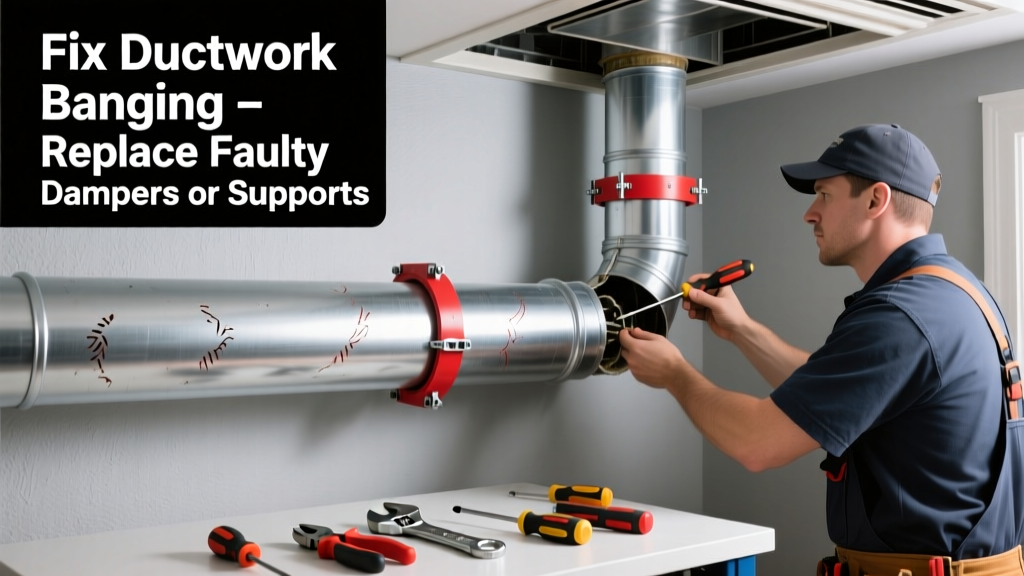
That loud *BANG!* when your furnace kicks on isn’t just annoying—it’s a warning sign that something in your duct system is loose, warped, or failing under pressure. Most often, it’s not the entire duct run needing replacement, but one specific part: a collapsing flex duct section, a rusted damper arm, or a missing support strap vibrating against joists. Pinpointing and swapping just that piece saves time, money, and duct insulation integrity.
Quick Diagnosis
Banging usually occurs at startup or shutdown when air pressure shifts suddenly. Before grabbing tools, rule out these five common culprits:
- A loose or bent HVAC damper blade hitting the duct wall during airflow changes
- Flex duct sagging and whipping against floor joists or framing
- Rusted or broken support straps allowing metal ducts to shift and strike adjacent surfaces
- Improperly secured duct transitions (e.g., where round duct meets rectangular trunk)
- Expansion/contraction of undersized or poorly insulated ducts in unconditioned spaces like attics
Tools & Materials Needed
| Item | Purpose | Estimated Cost |
|---|---|---|
| Adjustable wrench | Tightens damper linkage bolts and duct collar screws without stripping threads | $12–$25 |
| 3-inch self-tapping sheet metal screws (No. 8) | Secure new supports or reinforce existing duct connections | $4–$8 |
| Galvanized duct support strap (24-gauge) | Prevents sagging in flex duct runs; replaces corroded or missing straps | $2–$5 per strap |
| Replacement HVAC damper assembly (7" or 10") | Direct swap for worn-out dampers with bent blades or seized linkages | $28–$65 |
| Insulated flex duct (6" or 8") | Replaces collapsed or kinked sections that vibrate under static pressure | $18–$42 per 25-ft roll |
Step-by-Step Fix
Target the root cause—not the noise. Follow these methods in order of likelihood and accessibility:
- Inspect and tighten damper hardware: Locate the nearest manual or motorized damper (often near the furnace or branch takeoffs). Check for bent blades, cracked actuator arms, or loose pivot bolts. Tighten all mounting screws with an adjustable wrench; replace any stripped or rusted hardware with stainless steel equivalents.
- Reinforce sagging flex duct: Identify sections drooping more than 1/2 inch per foot. Cut away damaged or flattened segments using aviation snips. Install two new galvanized support straps—one within 12 inches of each end—and tension the duct so it sags no more than 1/4 inch over its span.
- Replace failed duct supports: For rigid metal ducts banging against joists, remove corroded U-bolts or bent hangers. Drill pilot holes into framing, then secure new 24-gauge straps with two No. 8 self-tapping screws per side. Leave 1/8-inch clearance between duct and strap to allow thermal expansion.
When to Call a Pro
DIY duct repair crosses into unsafe or code-violating territory in these situations:
- You detect visible mold growth inside the duct or on insulation—disturbing it risks airborne spores
- The banging coincides with carbon monoxide detector alarms or soot buildup around registers (possible heat exchanger crack)
- Repair requires cutting into sealed return ducts upstream of the air filter, which may compromise system balance and filtration efficiency
- Your home has asbestos-wrapped ductwork (common in homes built before 1980)—disturbance requires licensed abatement
According to the Insurance Institute for Business & Home Safety's 2023 HVAC Maintenance Report, 68% of duct-related banging issues stem from improper installation—not age—meaning many fixes are preventable with correct initial setup.
Prevention Tips
Stop future banging before it starts with these proven habits:
- Inspect duct supports and damper linkages every 18 months—especially after seasonal temperature swings
- Install vibration-dampening rubber grommets where ducts pass through framing
- Use only UL-listed, R-6 insulated flex duct for runs longer than 5 feet
- Ensure your furnace’s blower ramp-up time is set to ≥15 seconds (check thermostat or control board settings) to reduce pressure surges
Can I use duct tape to fix a loose damper linkage?
No—standard duct tape fails under HVAC temperatures and vibration. Use only UL 181A-P rated foil tape or stainless steel hose clamps for repairs involving airflow components. Per ASHRAE Standard 120-2022, non-rated tapes degrade within 6–12 months in duct environments.
How do I know if my flex duct is too long for its size?
Measure the unsupported span. For 6-inch flex duct, maximum safe length between supports is 4 feet; for 8-inch, it’s 5 feet. Longer spans sag, compress airflow, and amplify banging. If you see kinks or visible flattening, replace the section entirely—don’t try to re-stretch it.
Will tightening all duct connections stop the noise?
Not always. Over-tightening sheet metal screws can warp collars and create new gaps or stress points. Focus first on components experiencing movement: dampers, transitions, and supports. Use a torque setting of 12–15 in-lbs for No. 8 screws—just snug, not stripped.
Do I need to turn off power to the furnace before working on ducts?
Yes—if you’re accessing areas near the blower compartment, control board, or wiring harnesses. Shut off the furnace at the dedicated 240V circuit breaker and verify with a non-contact voltage tester. For isolated duct runs in attics or crawlspaces, power-off isn’t required—but always wear gloves and eye protection.
Can banging damage my furnace over time?
Indirectly, yes. Repeated shock loads from unsecured ducts transmit vibration into the blower assembly and heat exchanger mounts. The U.S. Department of Energy estimates that improperly supported duct systems contribute to 12–18% premature HVAC component failure, especially in systems over 8 years old.
Is replacing a damper the same as replacing a zone control panel?
No—they’re separate systems. A manual or motorized damper controls airflow to one branch. A zone control panel manages multiple dampers and thermostats. If only one room bangs, replace the damper—not the panel. Zone panel issues cause inconsistent heating/cooling across zones, not mechanical banging.
Replacing the right part—whether it’s a $3 strap or a $45 damper—takes less than 90 minutes once you’ve correctly diagnosed the source. You’ll restore quiet operation and protect your system’s longevity. For related guidance, see our flex duct installation mistakes and HVAC damper troubleshooting guides.