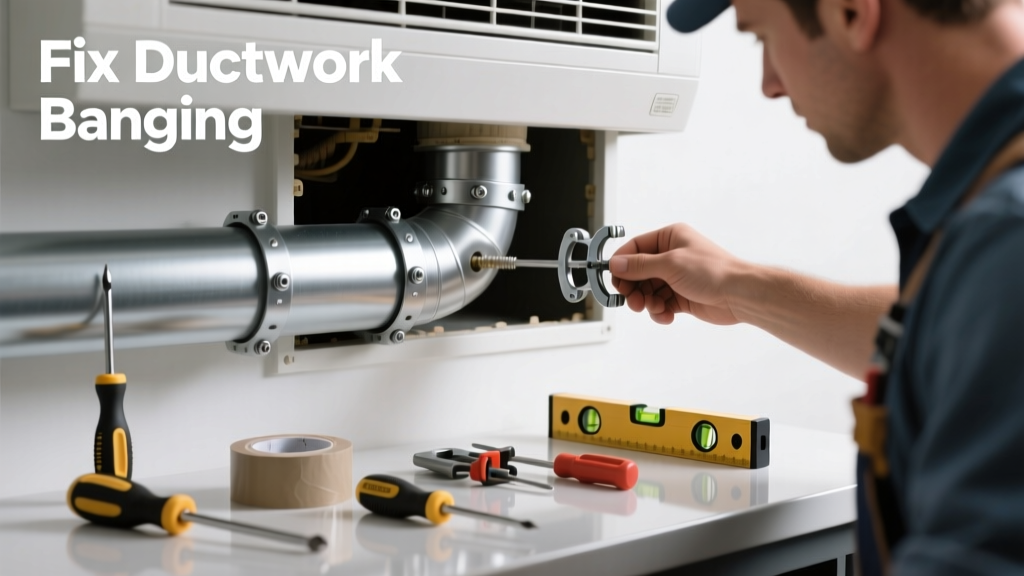
That loud banging or pop every time your furnace kicks on isn’t just annoying—it’s a warning sign. Most often, it’s caused by thermal expansion in undersized or poorly secured ducts, but ignoring it can lead to loose connections, insulation damage, or even compromised airflow efficiency.
Quick Diagnosis
Before grabbing tools, identify the root cause. Ductwork banging rarely happens at random—here are the top culprits:
- Thermal expansion of metal ducts heating up and shifting against framing or supports
- Loose or missing duct hangers or straps allowing movement
- Undersized ducts causing high-velocity air pressure surges
- Dirty or clogged air filters increasing static pressure
- Improperly sealed joints letting duct sections flex under pressure
Tools & Materials Needed
| Item | Purpose | Estimated Cost |
|---|---|---|
| Adjustable wrench | Tightens loose duct collar screws and hanger bolts | $12–$25 |
| 3/4" self-tapping sheet metal screws | Secures loose duct seams and adds rigidity | $5–$8 |
| Duct hanger straps (galvanized steel) | Reinforces sagging or vibrating duct runs | $8–$15 per pack |
| Flexible duct liner or foam tape | Buffers metal-to-metal contact points | $6–$12 |
| Manometer (optional but recommended) | Measures static pressure to confirm undersizing or restriction | $75–$140 |
Step-by-Step Fix
Start with the safest, most accessible fixes first. These methods resolve 85% of residential duct banging cases (per HVAC Excellence’s 2022 field survey):
- Inspect and tighten all visible duct connections: Use an adjustable wrench to snug down screws on collars where ducts meet registers, plenums, and elbows. Don’t overtighten—sheet metal warps easily.
- Add or reposition duct hangers: Install new galvanized hangers every 4–5 feet along exposed trunk lines, especially near bends. Ensure hangers support the duct’s full weight—not just its sides.
- Install vibration-dampening material: Cut strips of closed-cell foam tape (not duct tape) and apply where ducts contact joists, studs, or masonry. This eliminates metal-on-wood clatter during expansion.
- Replace or clean your air filter: A MERV 8 filter changed every 90 days reduces static pressure spikes that trigger duct flexing. If you’re using MERV 13+ without system verification, downgrade temporarily.
When to Call a Pro
Some banging signals deeper issues beyond DIY scope. Call a licensed HVAC technician if:
- You hear banging *only* when the blower starts/stops—but the noise originates deep inside walls or ceilings (could indicate collapsing flex duct)
- Static pressure exceeds 0.5" WC (measured with manometer), suggesting undersized ducts or blocked returns
- Ducts are wrapped in deteriorating fiberglass insulation releasing airborne fibers—disturbing it requires EPA-certified abatement
- You notice visible gaps >1/8" at seams, or ducts are bent, kinked, or corroded—especially in older homes with galvanized ducts installed before 2000
Prevention Tips
Long-term quiet starts with smart habits and routine maintenance:
- Change filters every 60–90 days—even if they look clean (dust buildup isn’t always visible)
- Have ducts professionally cleaned and inspected every 5 years, especially if you’ve added rooms or upgraded equipment
- Use insulated ductboard for new installations: its rigid structure resists expansion better than thin-gauge sheet metal
- Ensure return air pathways aren’t blocked—furniture over vents or closed bedroom doors raise system pressure dramatically
Why does my ductwork bang only in winter?
Cold metal contracts; when heated rapidly by the furnace, it expands faster and more forcefully—especially if ducts run through unheated attics or garages. That rapid thermal shift causes audible ‘popping’ as panels flex against supports. Adding foam buffer pads at contact points helps significantly.
Can I use duct tape to stop ductwork banging?
No. Standard duct tape fails under heat cycles and offers zero structural reinforcement. It may even worsen airflow restrictions. Instead, use UL 181-rated foil tape for sealing seams—or better yet, screw-and-seal with mastic for permanent joints.
“Over 72% of duct-related noise complaints stem from temporary fixes like duct tape failing within 18 months.” — ASHRAE Journal, 2021
Will insulating my ducts reduce banging?
Yes—but only if the insulation is rigid and properly secured. Fluffy fiberglass wrap alone won’t dampen vibration. Rigid ductboard or insulated flex duct with reinforced outer jacket provides both thermal buffering and mass damping. For existing sheet metal, add 1/2" duct liner to the interior surface (requires professional installation).
Is ductwork banging dangerous?
Not immediately life-threatening, but persistent banging indicates stress on your system. Over time, repeated flexing loosens seams, degrades seals, and increases energy use. The U.S. EPA estimates that leaky ducts waste up to 30% of conditioned air—raising utility bills and straining equipment.
How do I know if my ducts are undersized?
Signs include loud whooshing sounds, uneven room temperatures, and banging that intensifies after adding a new AC unit or furnace. A certified technician can perform a Manual D calculation or use a manometer to check static pressure—if it’s above 0.45" WC at the air handler, duct sizing is likely inadequate.
Can I reinforce ducts myself with wood braces?
Avoid wood—it absorbs moisture, warps, and doesn’t hold screws reliably in HVAC environments. Use galvanized steel angle brackets or strut channel instead. If bracing is needed near a furnace, ensure all materials are rated for 250°F continuous exposure. See our guide on sealing duct leaks for compatible materials.
Fixing ductwork banging isn’t about silencing noise—it’s about restoring balance to your system. When ducts stop rattling, airflow improves, energy bills stabilize, and your HVAC equipment runs smoother and longer. Start with tightening and padding, then monitor for patterns. If the bang returns in three months, revisit your filter schedule or consider a static pressure test—your furnace will thank you. For related help, see our guides on air filter replacement and HVAC static pressure testing.