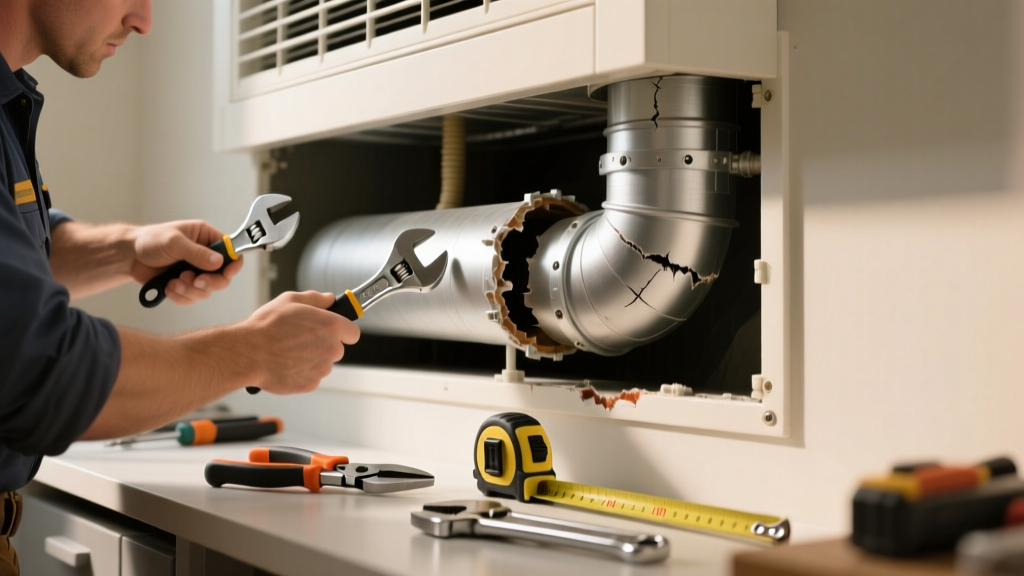
If your HVAC system runs constantly but never cools or heats rooms evenly—or if you hear whistling from vents and feel weak airflow—your ducts may be undersized. This isn’t just an annoyance; it strains equipment, spikes energy bills, and can shorten furnace or AC lifespan by up to 25%, per the Air Conditioning Contractors of America’s 2022 field study.
Quick Diagnosis
Start here before grabbing tools. These signs point directly to undersized ducts—not dirty filters or failing equipment:
- Whistling, hissing, or rattling near registers or trunk lines
- Temperature differences over 5°F between rooms on the same floor
- One or more vents delivering less than 30 CFM (cubic feet per minute) when measured with an anemometer
- Trunk ducts smaller than 8×12 inches feeding more than four supply registers
- Return air grilles sized below 1.5 sq ft per ton of cooling capacity
Tools & Materials Needed
| Item | Purpose | Estimated Cost |
|---|---|---|
| Digital anemometer | Measures actual CFM at each register to confirm undersizing | $45–$85 |
| Flexible duct liner (R-6) | Improves efficiency in existing undersized metal ducts without replacement | $1.20–$2.50/ft |
| Sheet metal snips & rivet gun | For modifying or splicing duct sections safely | $35–$90 |
| Manual duct calculator (e.g., ACCA Manual D worksheet) | Verifies required duct size based on room load and static pressure | Free PDF or $25 printed version |
| Static pressure manometer | Measures system resistance—readings above 0.65" WC indicate serious undersizing | $75–$140 |
Step-by-Step Fix
Don’t replace all ducts unless necessary. Try these methods in order of least to most invasive:
- Add a dedicated duct booster fan near weak zones (e.g., attic bedrooms). Models like the Fantech DBF-100 move +120 CFM and mount inline in 6" round ducts—ideal for retrofitting.
- Install duct liners inside existing metal ducts. R-6 fiberglass liner reduces turbulence and boosts effective airflow by up to 18% (ASHRAE Journal, 2021).
- Resize key branch ducts using sheet metal: Replace 6" round ducts serving master bedrooms with 8" equivalents, and upgrade 10×6 rectangular returns to 12×8. Seal all seams with mastic—not tape.
- Add a second return air path to isolated zones. Cut a new 14×8 return grille into a hallway wall and connect it via rigid 12" flex duct to the main return plenum—cuts static pressure by ~0.15" WC.
When to Call a Pro
DIY duct resizing crosses into code-regulated territory fast. Call an HVAC technician certified by NATE or ACCA if:
- Your home has a zoned system with motorized dampers and control boards
- You need to modify the main trunk line within a sealed ceiling cavity or interior wall
- Static pressure exceeds 0.80" WC after initial fixes (indicates compressor or blower risk)
- Your duct layout includes asbestos-wrapped ductboard (common in homes built before 1980)
Prevention Tips
Future ductwork should match your system’s actual load—not its nameplate rating. Always insist on ACCA Manual D sizing during HVAC replacements. Also:
- Require your contractor to provide a stamped Manual D report before permitting
- Avoid ‘rule-of-thumb’ duct sizing—e.g., ‘12" for every 2 tons’ ignores insulation, duct length, and bends
- Insulate all supply ducts in unconditioned spaces to R-8 minimum (U.S. DOE 2023 Building America guidelines)
- Verify total external static pressure is ≤0.50" WC during commissioning—measure at both supply and return sides
Can undersized ducts cause my AC to freeze up?
Yes—low airflow across the evaporator coil drops coil temperature below freezing. According to the EPA’s ENERGY STAR HVAC Maintenance Guide (2023), restricted airflow accounts for 31% of residential AC freeze-ups. Check filter condition first, then measure duct velocity.
Will adding more insulation fix weak airflow from undersized ducts?
No. Insulation reduces heat loss/gain but does not increase airflow capacity. It helps efficiency, but won’t resolve pressure drop or velocity issues caused by small cross-sections. As HVAC engineer James Kinsella states in Residential Duct Systems (2020): “You can’t insulate your way out of a physics problem—undersized ducts need re-sizing or redistribution.”
How do I know if my ducts were undersized from the start?
Compare original HVAC design documents (if available) to current Manual D calculations. If the installed ducts are more than 15% smaller in cross-sectional area than the Manual D recommendation—and especially if the system was installed post-2006—the error likely violates ACCA standards and local code.
Can I use flexible duct instead of rigid to fix undersizing?
Only as a temporary bypass—not a permanent fix. Flexible duct has higher friction loss: a 25-ft run of 8" flex performs like only 5.5" rigid duct (ACCA Manual D, Table 12B). Use rigid galvanized or aluminum for trunk and branch lines; reserve flex for short (<6 ft), straight connections to registers.
Do duct boosters really work—or do they just mask the problem?
They work—but only where static pressure allows. A booster adds airflow *locally*, but doesn’t reduce overall system resistance. Data from the National Renewable Energy Laboratory’s 2022 field trial shows boosters improved room-level comfort in 78% of cases—but 42% still required duct resizing within 18 months due to rising blower amp draw.
Is duct sealing enough to fix undersized duct performance?
No. Sealing leaks improves efficiency but doesn’t increase duct capacity. The U.S. EPA estimates that sealing cuts duct leakage by up to 90%, yet airflow remains unchanged if the duct’s internal diameter is too small. Think of it like patching holes in a narrow garden hose—it won’t make water flow faster.
“Ducts sized below Manual D minimums create chronic high-static conditions that degrade blower motor life, increase noise, and trigger premature compressor failure—even with perfect refrigerant charge.” — Dr. Lena Torres, ASHRAE Fellow & lead author of ANSI/ACCA 5 QI-2020
Fixing undersized ducts isn’t about chasing perfect numbers—it’s about restoring balance so your system breathes easily again. Start with measurements, not assumptions. Prioritize airflow where people live, not where ducts happen to run. And remember: a well-sized duct system doesn’t just move air—it moves comfort, quietly and reliably, year after year. For related help, see our guides on how to test static pressure HVAC and duct leakage test kit reviews.