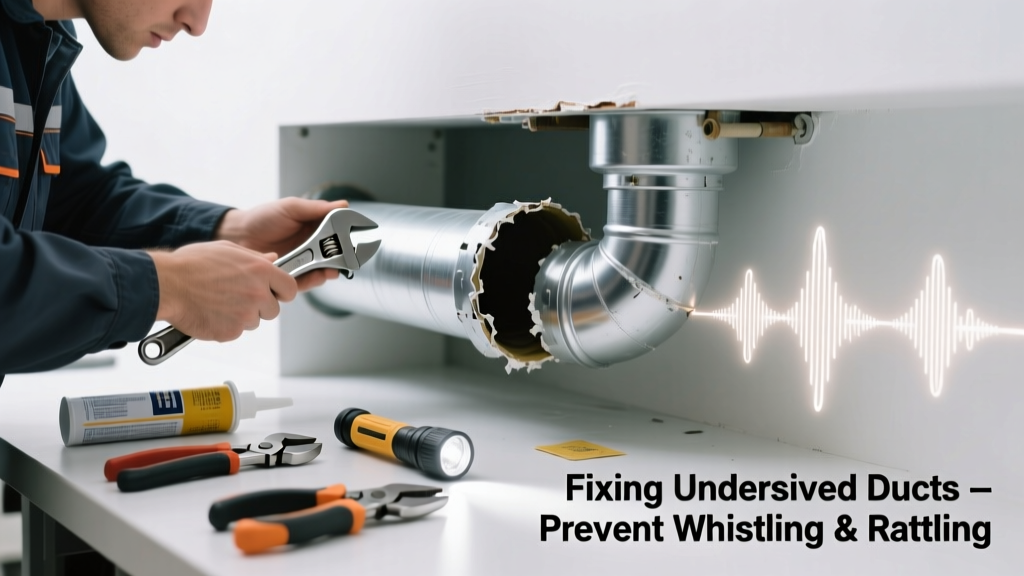
If your HVAC system sounds like a tea kettle whistling, a tin can rattling, or a freight train rumbling through the walls—especially when the blower kicks on—it’s likely your ducts are too small for your system’s airflow. This isn’t just annoying; it stresses components, spikes energy bills, and can shorten equipment life. The good news? Many cases are diagnosable and fixable without replacing the entire duct network.
Quick Diagnosis
Start here before grabbing tools. These are the most common signs your ducts are undersized—and not just dirty or loose:
- High-pitched whistling or hissing near registers or trunk lines during fan operation
- Rattling or vibrating metal ductwork, especially at bends or transitions
- Noticeably weaker airflow in rooms far from the air handler
- Blower motor running louder than usual or cycling more frequently
- Static pressure readings above 0.5" WC (if you have a manometer)
Tools & Materials Needed
| Item | Purpose | Estimated Cost |
|---|---|---|
| Digital anemometer | Measures actual CFM at registers to confirm low airflow | $45–$85 |
| Flexible duct liner (1/2" thick) | Dampens vibration and reduces turbulence noise in existing ducts | $28–$42 per 25-ft roll |
| Aluminum foil tape (UL 181 listed) | Seals joints without restricting airflow—never use duct tape | $8–$14 |
| Sheet metal snips & aviation shears | Cut and modify rigid duct sections safely and precisely | $12–$26 |
| Static pressure manometer | Measures duct resistance—critical for confirming undersizing vs. blockage | $65–$120 |
Step-by-Step Fix
Try these solutions in order of least to most invasive. Most homeowners can complete Steps 1–3 safely.
- Add acoustic duct liner to interior surfaces of noisy trunk lines—especially near elbows and reducers. Cut liner to fit snugly, use contact cement rated for HVAC use, and avoid blocking >15% of cross-sectional area.
- Install a duct silencer (a short, lined section) between the air handler and first branch. The duct silencer installation guide walks through sizing and mounting.
- Replace restrictive fittings: Swap sharp 90° elbows for two 45° turns with 6" straight sections between them. Replace stamped-metal takeoffs with swept-radius ones to reduce turbulence.
- Resize critical branch ducts using sheet metal and a crimping tool—if static pressure is confirmed >0.65" WC and register CFM is <70% of design. Use ACCA Manual D guidelines: a 6" round duct maxes out at ~120 CFM; going to 7" adds ~55 CFM capacity.
When to Call a Pro
Don’t attempt these yourself—they require load calculations, permits, and specialized tools:
- Your home has a multi-zone system with dampers and variable-speed control
- You measure static pressure over 0.8" WC after sealing all visible leaks
- The air handler is oversized (e.g., a 5-ton unit on a 3.5-ton Manual J load)
- Ductwork runs through structural cavities (e.g., floor joists or load-bearing walls) where cutting or rerouting could compromise integrity
According to the Air Conditioning Contractors of America’s 2022 HVAC Systems Design Manual, “Undersized ducts account for 68% of field-reported comfort complaints—and 41% of premature blower motor failures.”
Prevention Tips
Future-proof your system with these habits:
- Always require ACCA Manual D duct design documentation before installing new HVAC equipment
- Verify duct size matches the blower’s maximum CFM rating—not just its tonnage
- Use insulated flex duct only for runs under 25 feet and never for main trunks
- Have static pressure tested annually during maintenance—our HVAC maintenance checklist includes this step
Can undersized ducts cause my AC to freeze up?
Yes—low airflow from restricted ducts reduces coil temperature below freezing. Frost forms on the evaporator, then melts and drips—or worse, causes liquid refrigerant return. If you see ice, shut off cooling immediately and check register airflow.
Will adding more vents reduce the noise?
No—adding unbalanced vents worsens imbalance. It often starves the air handler of return air, increasing static pressure and amplifying whistling. Balance must be calculated, not guessed.
Is duct noise covered by my HVAC warranty?
Rarely. Warranties cover parts and labor for defective equipment—not improper duct design or installation. Some extended service agreements exclude ductwork entirely, per the 2023 AHRI Warranty Coverage Survey.
Can I use fiberglass insulation wrap instead of duct liner?
No. Standard batt insulation doesn’t dampen aerodynamic noise and poses fire and air quality risks if installed inside ducts. Only UL 181B-FX–rated duct liner is approved for interior lining.
How do I know if my ducts are *actually* undersized versus just leaky?
Leaky ducts cause low airflow *and* high return-side static pressure. Undersized ducts show high supply-side static pressure (>0.5" WC) *and* normal-to-high return pressure. Seal leaks first, then retest—our duct leak testing method shows how.
Does duct size affect indoor humidity control?
Absolutely. Undersized ducts force higher airflow velocity, reducing coil contact time. That cuts dehumidification by up to 30%, per ASHRAE Journal’s 2021 study on residential latent load management.
Fixing undersized ducts isn’t about silence alone—it’s about restoring balance, efficiency, and longevity to your whole system. Even partial improvements, like replacing one noisy elbow or lining a 10-foot trunk section, yield measurable gains in comfort and utility bills. And remember: when in doubt about static pressure or system capacity, a certified HVAC designer with Manual D credentials is worth every penny—especially before your next equipment replacement.