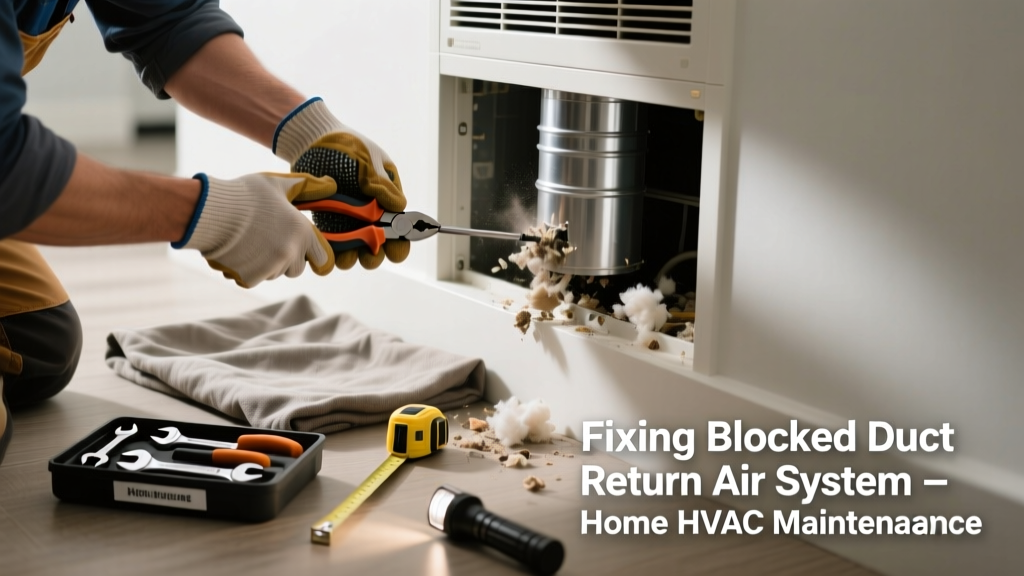
If your home feels stuffy, your AC runs constantly but never cools well, or you hear a faint whistling near vents—your duct return air system may be blocked. A restricted return airflow strains your HVAC unit, spikes energy bills by up to 20%, and can trigger premature compressor failure (U.S. Department of Energy, 2022).
Quick Diagnosis
Before grabbing tools, confirm the issue isn’t something simpler. Start here:
- Check if return grilles are covered by furniture, rugs, or curtains
- Feel for weak or no suction at the main return vent(s)
- Inspect for visible dust buildup or debris inside the grille frame
- Listen for unusual humming or rattling from the air handler
- Verify your furnace filter is clean and correctly installed—not backwards or oversized
Tools & Materials Needed
| Item | Purpose | Estimated Cost |
|---|---|---|
| Flashlight with flexible neck | Peering deep into ducts without disassembly | $12–$25 |
| Shop vacuum with brush attachment | Removing loose dust, pet hair, and cobwebs from grille and duct throat | $45–$85 |
| Flexible duct brush (6–10 ft) | Cleaning interior walls of accessible rectangular or round returns | $18–$32 |
| Replacement MERV 8 filter (correct size) | Ensuring proper airflow after cleaning—never reuse or oversize | $8–$15 |
| Non-toxic mold inhibitor spray (EPA-registered) | Only if microbial growth is confirmed—never use bleach in ductwork | $14–$22 |
Step-by-Step Fix
Most return blockages happen within 2–4 feet of the grille. Work methodically:
- Turn off power at the furnace’s disconnect switch and thermostat—verify with a non-contact voltage tester.
- Remove the return grille using a screwdriver; check for bent louvers, packed dust bunnies, or nesting debris (rodents love insulated return chases).
- Vacuum the opening and first 18 inches of duct with shop vac on low suction—avoid high pressure that can loosen insulation lining.
- Insert duct brush and rotate while gently pushing 3–4 ft in; pull back slowly, repeating 2–3 times. Wipe brush clean between passes.
- Reinstall grille, replace filter, restore power, then run system for 15 minutes—measure temperature drop across the coil (should be 14–22°F) to confirm improved airflow.
When to Call a Pro
Stop and call an HVAC technician if you encounter any of these:
- Strong mildew or rodent odor coming from the return—even after cleaning
- Visible fiberglass insulation sagging or detached inside the duct (a respiratory hazard)
- No suction at all, even after cleaning and filter replacement (could indicate collapsed duct or disconnected trunk line)
- Return duct runs through unconditioned attic or crawl space with evidence of moisture or rust
According to the National Air Duct Cleaners Association (NADCA), only certified professionals should handle ducts with mold contamination exceeding 1 sq ft or structural damage—DIY attempts often worsen dispersion.
"Over 60% of HVAC service calls related to poor cooling performance trace back to restricted return airflow—not refrigerant issues." — HVAC Excellence Technician Certification Manual, 2023
Prevention Tips
Blockages recur when maintenance is inconsistent. Build these habits:
- Replace filters every 30–60 days (every 20 days if you have pets or allergies)
- Keep 36 inches of clear space around all return grilles—use furniture placement guidelines to avoid accidental blockage
- Inspect returns quarterly: shine light in, listen for airflow, feel for suction strength
- Seal return duct seams with mastic (not duct tape)—leaky returns pull in dusty attic air, accelerating clogs
- Install a magnetic filter monitor like the FilterScan® to get text alerts when resistance spikes
Can I vacuum the duct from the furnace side instead of the grille?
Yes—but only if you have direct access to the return plenum (the large box where return ducts meet the furnace). Use low-suction mode and avoid vacuuming near blower wheels or control boards. Never insert rigid hoses past the first elbow; flexible brushes work better there.
Why does my return grille make a loud whooshing noise now?
A sudden whoosh usually means airflow increased dramatically after cleaning—confirm it’s not a loose damper or bent louver vibrating. If noise persists beyond 24 hours, check for undersized ducts or missing internal lining; see our guide on proper duct sizing.
Is black dust around the return grille dangerous?
Not always—but it’s a red flag. Black dust could be harmless soot from candles or fireplace use, or it could signal mold spores or combustion byproducts. If it smells musty or reappears weekly, test with an EPA-registered mold kit (like My Mold Detective) before proceeding.
Can I use compressed air to blow out the duct?
No. Compressed air can dislodge friable fiberglass insulation, send debris deeper into the system, or damage flexible duct liners. The U.S. EPA explicitly warns against this practice in its Indoor Air Quality Tools for Schools manual (2021).
How often should I clean the entire return duct system?
Every 3–5 years for homes without pets or allergies; annually if you have shedding animals or live in high-dust areas like desert climates. Focus first on the grille and first 3 ft—90% of blockages occur there (ASHRAE Guideline 180-2021).
Will cleaning the return duct lower my energy bill?
Yes—consistently. A fully blocked return can increase system runtime by 30% and raise cooling costs by $120–$280/year (Pacific Northwest National Laboratory, 2022). Restoring full airflow typically delivers a 7–12% efficiency gain within one billing cycle.
A properly flowing return duct doesn’t just make your home more comfortable—it extends your HVAC’s life, cuts wear on the blower motor, and keeps indoor air cleaner. You don’t need special certification to spot and fix most return blockages, but knowing when to pause and call in backup separates smart DIY from risky shortcuts. Keep your grilles clear, your filters fresh, and your airflow honest.