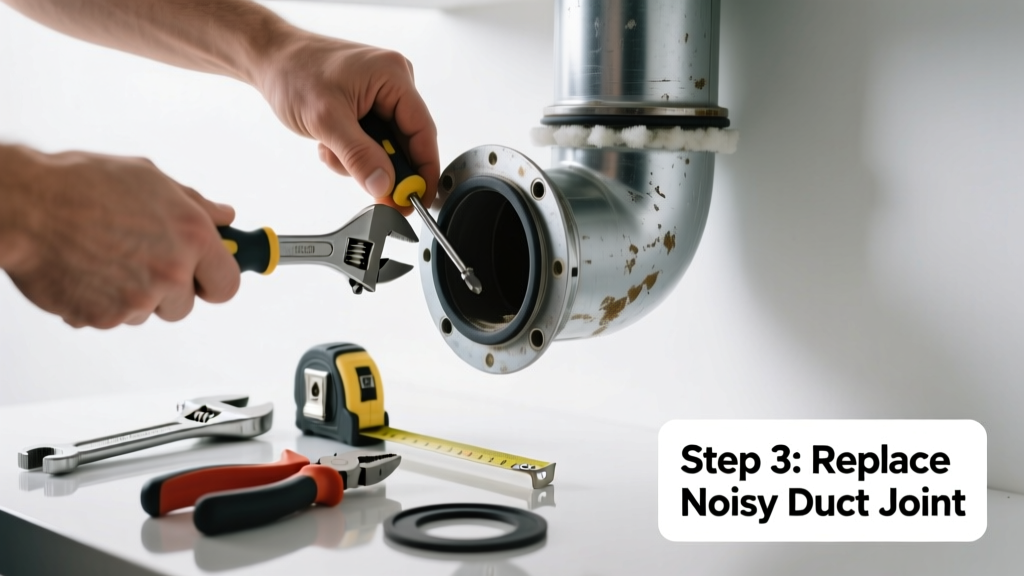
If your HVAC system sounds like a freight train rattling through your attic—or if you hear banging, whistling, or popping every time the fan kicks on—it’s likely not the furnace or AC unit itself. More often than not, the culprit is a loose, damaged, or improperly sized duct component that vibrates, flexes, or leaks air under pressure.
Quick Diagnosis
Before grabbing tools, confirm which part is failing. Most noisy duct issues stem from one of these:
- Loose or disconnected duct collar at the air handler or register
- Collapsed or dented flexible duct (especially near bends or supports)
- Missing or degraded duct insulation causing metal-on-metal resonance
- Undersized branch duct causing high-velocity airflow and whistling
- Faulty or worn-out damper motor or linkage in a zone-controlled system
Tools & Materials Needed
| Item | Purpose | Estimated Cost |
|---|---|---|
| 10-ft roll of UL 181-rated foil tape | Seals joints without cracking or off-gassing; required for code compliance | $8–$12 |
| 3/4" self-tapping sheet metal screws (20-pack) | Secures loose collars and stiffens flanged connections | $5–$7 |
| Duct insulation wrap (R-6, 2" thick) | Dampens vibration and reduces airborne noise transmission | $22–$34 |
| Needle-nose pliers & screwdriver set | Adjusts damper linkages and tightens small fasteners in tight spaces | $14–$28 |
| Manometer or anemometer (optional but recommended) | Verifies static pressure and airflow velocity before/after repair | $45–$120 |
Step-by-Step Fix
Start with the most common failure points. Prioritize safety: turn off power at the breaker and shut off gas supply if working near the furnace.
- Inspect and tighten all duct connections: Use needle-nose pliers to squeeze loose clamps and reinforce with two 3/4" self-tapping screws per collar joint—never just tape over movement.
- Replace collapsed flex duct: Cut out the damaged 24–36" section using aviation snips; install new R-6 insulated flex duct with proper support spacing (max 48" between straps) and seal ends with UL 181 tape—not duct mastic or zip ties.
- Add mass-loaded insulation: Wrap noisy 6–12" sections of rigid duct with R-6 fiberglass + vapor barrier facing outward, then secure with stainless steel banding—not staples or adhesive alone.
- Test damper operation: If noise occurs only in specific zones, manually cycle dampers while listening for grinding or sticking; replace motorized actuators if response is sluggish or inconsistent.
When to Call a Pro
DIY stops where safety or system integrity begins. Call an HVAC technician certified by NATE or ACCA if you encounter any of these:
- Air handler static pressure exceeds 0.5" WC (measured with manometer)
- Noise originates inside the air handler cabinet—could indicate blower wheel imbalance or bearing failure
- You find mold growth inside ductwork or evidence of combustion gas leakage (soot, yellow flame, CO detector alarm)
- The duct layout requires redesign due to chronic undersizing—e.g., 6" duct feeding a 12' x 15' bedroom
"Over 62% of duct-related HVAC complaints stem from improper installation—not age. A single unsealed joint can leak up to 30 CFM of conditioned air." — ACCA Manual D, 2022 Edition
Prevention Tips
Maintain quiet ducts year after year with these habits:
- Inspect accessible duct joints every 6 months—look for tape lifting or screw heads backing out
- Replace flex duct every 10 years, even if it looks intact; internal liner degrades and causes turbulence
- Install acoustic duct liners in return air paths near bedrooms or home offices
- Use variable-speed blowers instead of fixed-speed when replacing equipment—they reduce peak airflow velocity by up to 40%
Can I use regular duct tape instead of UL 181 tape?
No. Standard duct tape fails under HVAC temperatures and humidity within 6–18 months, leaving gaps that worsen noise and efficiency. UL 181 tape is tested to withstand 200°F+ and repeated thermal cycling. For a permanent fix, always use UL 181-approved foil tape.
Why does my duct pop when the system turns on or off?
That’s thermal expansion noise—usually caused by oversized ducts with insufficient support or poor hanger spacing. As metal heats or cools rapidly, it contracts or expands against framing or insulation. Secure loose runs with additional 16-gauge strapping every 36", and add rubber isolation grommets where ducts penetrate walls.
Will adding more insulation stop the whistling sound?
Not if the whistle comes from high-velocity airflow. Whistling means air is moving faster than 900 FPM—often due to an undersized duct, closed damper, or dirty filter. Insulation dampens structure-borne noise, not aerodynamic noise. First, check your airflow problems and clean or replace filters.
How do I know if the noise is coming from the duct or the blower motor?
Turn the fan to "on" (not "auto") at the thermostat—bypassing the heating/cooling cycle. If noise persists without temperature change, it’s duct-related. If it only happens during heat/cool cycles, suspect blower wheel imbalance or capacitor failure. Listen closely near the air handler access panel with a mechanic’s stethoscope.
Can I replace just one section of rigid duct, or do I need to redo the whole run?
You can replace isolated sections—but only if the cut ends are square and mating flanges align precisely. Mismatched gauges (e.g., 26-gauge duct joined to 24-gauge) cause vibration. Always use matching gauge and seam type (S-lock vs. drive-lock), and seal with mastic plus tape. For best results, see our guide on rigid duct repair techniques.
Is duct noise covered under my HVAC warranty?
Rarely. Most manufacturer warranties cover parts *inside* the air handler or condenser—not field-installed ductwork. However, if the noise began within 90 days of professional installation, contact the contractor—their workmanship warranty may apply. Keep all invoices and photos of the original install.
Fixing a noisy duct isn’t about silencing sound—it’s about restoring balance: proper sizing, secure connections, and controlled airflow. When done right, the result isn’t just quiet—it’s lower energy bills, longer equipment life, and air that moves smoothly, not forcefully. Revisit your duct system every heating season, and treat each rattle or whistle as early warning—not background noise.