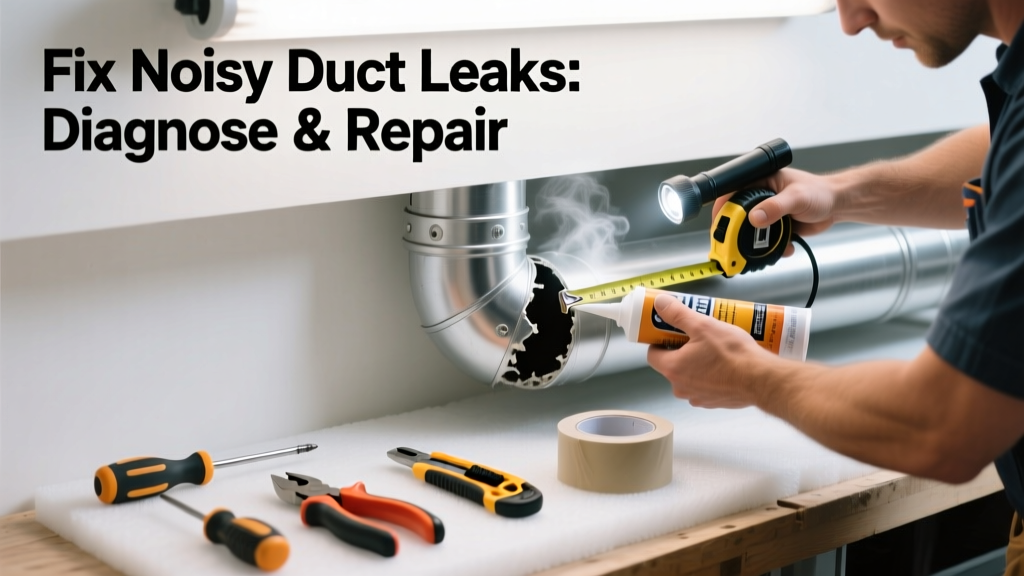
If your HVAC system suddenly starts whistling, rattling, or hissing—especially when the blower kicks on—it’s likely a duct leak letting air escape under pressure. These noises aren’t just annoying; they signal energy loss, reduced airflow, and potential moisture or dust infiltration. Ignoring them can raise utility bills by up to 20% and strain your furnace or air handler.
Quick Diagnosis
Start by listening closely and tracing the sound:
- High-pitched whistling near registers or seams → small gap or loose connection
- Banging or popping when system cycles on/off → expanding/contracting metal ducts with loose supports or oversized ducts
- Hissing near joints or boots → significant seam separation or damaged tape
- Rattling in walls or ceilings → disconnected flex duct or loose insulation vibrating inside rigid duct
Tools & Materials Needed
| Item | Purpose | Estimated Cost |
|---|---|---|
| Aluminum foil tape (UL 181-rated) | Seals seams permanently—unlike duct tape, which dries out and fails | $8–$15 |
| Insulated flex duct connector | Replaces brittle or kinked connections that vibrate and leak | $12–$25 |
| Sheet metal screws & screwdriver | Secures loose duct sections and prevents movement-induced noise | $5–$10 |
| Flashlight & mirror on extendable handle | Views hidden joints behind drywall or in tight attic spaces | $10–$22 |
| Smoke pencil or incense stick | Visually confirms airflow leakage at suspected points | $6–$14 |
Step-by-Step Fix
- Turn off power at the furnace disconnect switch and circuit breaker—never work on live HVAC components.
- Locate the leak source: Run the blower on fan-only mode, hold incense near duct seams, and watch for smoke deflection. Mark each leak with painter’s tape.
- Clean and prep surfaces: Wipe seams with isopropyl alcohol to remove dust, grease, and old adhesive residue—critical for tape adhesion.
- Seal with UL 181 aluminum tape: Apply overlapping 2-inch strips over seams and joints; avoid stretching tape—it loses tack if over-tensioned. Do not use standard duct tape.
- Reinforce weak points: Add sheet metal screws every 6 inches along disconnected collar boots or sagging flex duct ends, then wrap with tape over screw heads.
When to Call a Pro
Some duct issues require licensed expertise—not just tools:
- Ductwork located inside sealed wall cavities or concrete slabs where access requires demolition
- Leakage near gas furnace heat exchangers or flue connections—carbon monoxide risk exists if improperly sealed
- Multiple leaks across trunk lines with visible corrosion, rust-through, or collapsed sections
- Noise persists after sealing—and coincides with uneven room temperatures or short-cycling—indicating static pressure imbalance needing professional balancing
"Over 30% of duct systems in homes built before 2000 leak more than 20% of conditioned air—most of it audible as whistles or whooshes." — U.S. Department of Energy, Residential Energy Efficiency Report, 2022
Prevention Tips
Maintain quiet, efficient ducts year-round:
- Inspect accessible duct joints every fall before heating season begins
- Replace fiberglass ductboard insulation every 15 years—it compresses and cracks, exposing seams
- Install vibration-dampening rubber grommets where ducts pass through floor joists or framing
- Ensure your air filter is changed every 60 days—clogged filters increase static pressure, amplifying leak noise
Can I use regular duct tape to seal the leak?
No—standard gray duct tape fails within 6–12 months in HVAC environments due to heat cycling and UV exposure. Its rubber-based adhesive dries out and peels, worsening leaks. Always use UL 181A-P or UL 181B-FX listed aluminum foil tape, which withstands temperatures up to 250°F and resists UV degradation. For more on proper sealing materials, see our guide on duct sealing materials.
Why does the noise only happen when the AC runs—not the heat?
AC mode typically runs the blower at higher CFM (often 400+ cfm/ton) than heating (350 cfm/ton), increasing air velocity and pressure in the ducts. A marginal leak that’s silent during heating becomes audible under AC pressure. Also, refrigerant line vibration can transmit into nearby ductwork—check for contact between copper lines and ducts in the attic.
Will sealing the leak reduce my energy bill?
Yes—leaky ducts waste 20–30% of heated or cooled air, according to the U.S. EPA’s ENERGY STAR program. Sealing even one major joint can cut duct leakage by 10–15%, lowering monthly bills by $15–$40 depending on climate and system size. See real-world savings in our HVAC energy savings calculator.
Is the banging sound dangerous?
Occasional thermal “pinging” from sheet metal expansion is normal—but rhythmic banging synced with blower startup may indicate undersized ducts or a failing blower motor bearing. If banging intensifies or is accompanied by burning smells or tripped breakers, shut off the system immediately and contact an HVAC technician.
How do I know if the noise is coming from ducts—or the furnace itself?
Turn the thermostat to “fan only” mode (no heating or cooling). If the noise continues, it’s duct-related. If it stops, the issue is likely internal to the furnace—such as a worn blower wheel, loose squirrel cage, or failing capacitor. For help distinguishing furnace noises, refer to our furnace noise troubleshooting guide.
Can duct leaks cause poor indoor air quality?
Absolutely. Leaks in return ducts can draw in attic dust, insulation fibers, or garage fumes—then circulate them through your home. Supply-side leaks in crawlspaces or garages introduce humidity and mold spores. The American Lung Association notes that unsealed ducts contribute to elevated PM2.5 and VOC levels indoors, especially in older homes.
Fixing noisy duct leaks isn’t just about silencing the racket—it’s about restoring system balance, cutting energy waste, and protecting your indoor environment. With careful diagnosis and the right materials, most common duct noises resolve in under two hours. But remember: if you hear grinding, screeching, or smell ozone near the air handler, stop and call a licensed HVAC technician—those sounds point to electrical or mechanical failure beyond simple sealing.