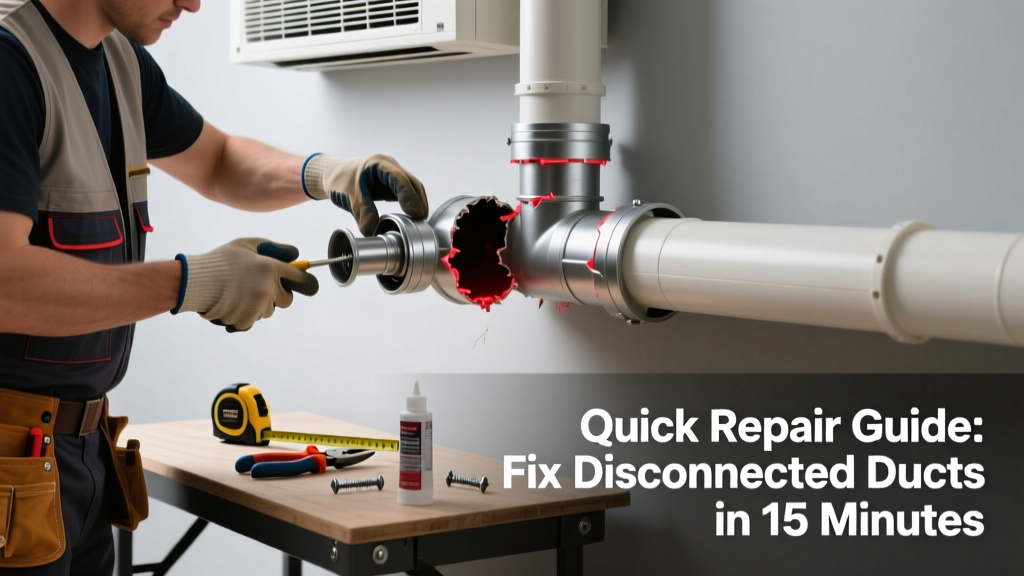
If your HVAC system is blowing weak air, making rattling noises, or failing to heat or cool certain rooms, a disconnected duct is often the culprit — especially near registers, plenums, or where ducts pass through walls or attics. This isn’t just an annoyance: the U.S. EPA estimates that 20–30% of conditioned air escapes through leaks and disconnections in typical duct systems, driving up energy bills by 20% or more.
Quick Diagnosis
Before grabbing tools, confirm the issue isn’t something else. A disconnected duct usually presents with these telltale signs:
- Noticeable airflow drop from one or more vents (especially after recent attic work or home remodeling)
- Hissing, whistling, or flapping sounds near duct runs or ceiling/wall registers
- Dust buildup around vent frames or visible gaps at duct-to-register or duct-to-plenum connections
- Cold spots in summer or warm spots in winter despite thermostat settings
- Increased utility bills without changes in usage
Tools & Materials Needed
| Item | Purpose | Estimated Cost |
|---|---|---|
| Flashlight or headlamp | Illuminate dark attic, crawlspace, or wall cavities where ducts run | $12–$25 |
| Flexible inspection mirror | View tight angles behind furnaces or inside duct boots without disassembly | $8–$15 |
| Heavy-duty foil tape (UL 181A-P rated) | Seal metal duct joints — duct mastic or cloth-backed tape won’t hold long-term | $10–$18 |
| Sheet metal screws (6–10 gauge, 1/2"–1") | Re-secure loose collars or boot connections that have pulled away | $5–$9 |
| Insulated duct wrap (R-4 or higher) | Insulate repaired sections to prevent condensation and improve efficiency | $15–$30 per 25-ft roll |
Step-by-Step Fix
Most duct disconnections occur at three locations: register boots, main trunk line connections, and flexible duct transitions. Use this sequence:
- Locate the disconnect: Start at the furnace or air handler and follow the main supply duct into the attic or basement. Look for collapsed flex duct, loose collars, or gaps between rigid metal ducts. Shine light along seams — even a 1/8" gap can leak 25 CFM of air (ASHRAE Handbook, 2022).
- Reconnect rigid ducts: If two metal duct sections have separated, reposition them fully, then secure with at least three sheet metal screws per joint. Tighten evenly — don’t overtighten and warp the flange.
- Reattach flex duct: Cut away frayed or kinked ends using aviation snips. Slide the undamaged flex over the collar until the inner liner reaches the collar’s lip, then clamp with two corrosion-resistant hose clamps (not zip ties). Seal the outer jacket seam with UL 181A-P foil tape.
- Seal all joints: Apply foil tape over every screw seam and connection point — overlapping edges by 1 inch. Avoid duct tape; it dries out and fails within 6–12 months (National Renewable Energy Laboratory, 2021).
When to Call a Pro
Some duct issues go beyond simple reconnection and require licensed expertise:
- Ducts disconnected inside sealed wall cavities or concrete slabs — cutting access risks structural integrity or asbestos exposure
- Multiple disconnections across the system, indicating undersized ductwork or improper static pressure design
- Signs of mold growth inside ducts (musty odor, black specks on insulation) — requires containment and NADCA-certified cleaning
- Disconnection paired with furnace short-cycling or error codes — may indicate blower motor strain or pressure switch failure
Prevention Tips
Proper installation and routine checks stop future disconnects:
- Inspect duct connections annually — especially before peak heating and cooling seasons
- Secure flexible duct runs with straps every 4–5 feet to prevent sagging and tension at joints
- Use rigid metal ducts instead of flex for trunk lines longer than 5 feet — they resist vibration and thermal expansion better
- Label all duct zones near the air handler so future homeowners or contractors know where each branch goes
Can I use duct tape to fix a disconnected duct?
No — standard duct tape fails under temperature swings and airflow pressure. According to the Sheet Metal and Air Conditioning Contractors’ National Association (SMACNA), only UL 181A-P–rated foil tape or duct mastic meets code for permanent sealing. Duct tape’s rubber adhesive degrades in under a year, leaving gaps that worsen over time.
How do I know if my duct is disconnected or just clogged?
A clog typically affects only one vent and may produce a faint burning smell when the system first starts. A disconnect causes broader symptoms — like multiple weak vents or audible air leaks — and often shows visible separation. Try holding a tissue near the vent: if it flutters weakly *and* you hear hissing nearby, it’s likely a disconnect, not a clog.
Is it safe to repair ducts in the attic during summer?
Yes — but only during cooler parts of the day (early morning or evening) and with proper hydration and ventilation. Attic temperatures regularly exceed 140°F in July/August (U.S. Department of Energy, 2023), increasing heat exhaustion risk. Wear light, breathable clothing and bring a thermometer — stop work if ambient temps top 95°F.
Will fixing a disconnected duct lower my energy bill?
Yes — consistently. The U.S. EPA estimates that sealing duct leaks can reduce heating and cooling costs by 15–20%, especially in older homes with unsealed ductwork. One homeowner in Austin reported a $47 monthly reduction after repairing four major disconnects in their attic supply lines.
Can disconnected ducts cause carbon monoxide buildup?
Not directly — but yes, indirectly. If a disconnected return duct pulls air from a garage or utility room, it can draw combustion gases toward the furnace intake. That’s why the International Mechanical Code requires return ducts to be sealed and located away from potential CO sources. Always verify return duct integrity when fixing supply-side disconnections.
Do I need a permit to repair disconnected ducts?
Generally no — minor repairs like reconnecting and sealing are exempt under most local building codes (IRC M1601.2). However, if your repair involves rerouting ducts, adding new branches, or modifying the air handler’s duct collar, a mechanical permit and inspection are required in 42 states (ICC 2021 Uniform Mechanical Code).
"Every 1% of duct leakage above 10% increases HVAC runtime by roughly 1.5%. In a 2,200 sq ft home, that’s an extra 120 hours of blower operation per cooling season." — Building America Best Practices Series, U.S. Department of Energy, 2022
Once you’ve reconnected and sealed the duct, turn the system on and check airflow at each vent with an anemometer or simple tissue test. If one room still feels off, double-check for hidden kinks in flex duct or blocked dampers in the main trunk. And remember: a well-sealed duct system doesn’t just fix comfort — it extends equipment life, reduces dust, and cuts down on allergens circulating through your HVAC coils and air filter. Keep a small roll of foil tape and screws in your utility closet — it’ll pay for itself in one season’s energy savings.