If your HVAC system is blowing weak air, making rattling noises, or you spot visible gaps near duct joints, you likely have a disconnected duct requiring a replacement part—not just tape or clamps. This isn’t always a loose screw; sometimes the connector, collar, or flex duct end has degraded, cracked, or corroded beyond repair. Acting quickly prevents energy loss, dust infiltration, and strain on your blower motor.
Quick Diagnosis
Before assuming it’s a simple reconnection, rule out these common root causes:
- Cracked or split metal duct collar where the branch duct meets the main trunk
- Collapsed or kinked flexible duct section with internal wire helix broken
- Rusted or stripped sheet metal screws securing a register boot to drywall or framing
- Deteriorated rubber gasket or foam seal inside a plenum adapter
- Missing or warped duct hanger bracket causing sag and separation under vibration
Tools & Materials Needed
| Item | Purpose | Estimated Cost |
|---|---|---|
| 10-in. aviation snips | Cuts clean edges on sheet metal ducts for precise fit | $12–$22 |
| Duct collar (4"–8", galvanized) | Replaces rusted or bent collars connecting branch to trunk | $8–$18 |
| UL 181B-FX mastic sealant + brush | Air-tight, code-compliant seal for metal-to-metal joints | $14–$26 |
| 3/4" self-tapping sheet metal screws (10-pack) | Secure collars and boots without pre-drilling | $5–$9 |
| Flexible duct replacement (6" or 8" diameter) | Used when inner liner is torn or outer jacket frayed | $25–$45 per 25-ft length |
Step-by-Step Fix
Follow these methods in order—start with the least invasive solution first:
- Inspect and isolate the failure point: Turn off power at the breaker, remove register cover and insulation wrap, then trace airflow path until you locate the exact break or deformation.
- Remove damaged component: Unscrew corroded collar or cut out collapsed flex duct using snips; leave 1" of undamaged duct on each side for overlap.
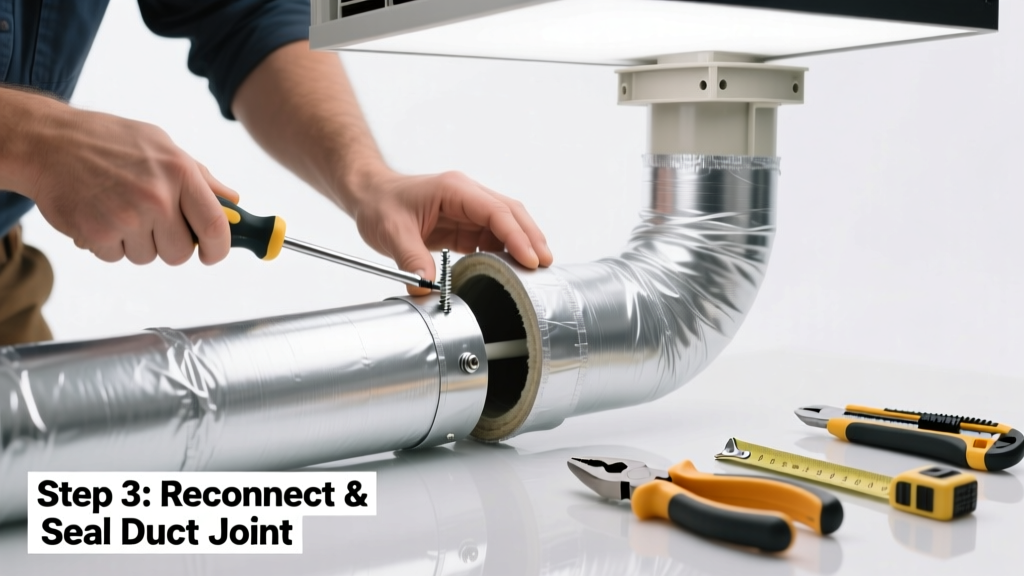
- Install replacement part: Slide new collar over trunk duct, align with branch duct, and secure with 3–4 screws spaced evenly. For flex duct, attach with UL-listed clamps and mastic—not duct tape.
- Seal and test: Apply mastic over all seams and screw heads. Wait 2 hours before restoring power. Run system for 15 minutes and check for air leaks with incense or tissue paper.
When to Call a Pro
DIY stops where safety, code, or system integrity begin. Call an HVAC technician if:
- The disconnect occurs inside a sealed wall cavity or attic access is blocked or hazardous
- You find evidence of mold growth inside the ductwork (visible black specks or musty odor)
- The main trunk line has multiple disconnections or visible corrosion over 12+ inches
- Your home uses asbestos-wrapped ducts (common in homes built before 1980)
"Over 60% of duct-related HVAC inefficiencies stem from improper or temporary repairs—especially duct tape and unsealed collars." — ACCA Manual D, 2022 Edition
Prevention Tips
Maintain duct integrity year-round with these habits:
- Inspect accessible duct connections every 6 months—look for rust, gaps, or screw looseness
- Replace fiberglass duct insulation sleeves every 10 years; compression reduces thermal resistance
- Install vibration-dampening hangers every 4 feet on exposed runs to reduce fatigue stress
- Use only UL 181B-FX mastic or foil-backed tape rated for HVAC use—not generic duct tape
Can I reuse the old duct collar if it’s only slightly bent?
No—bent collars rarely seat flat against both duct surfaces, creating micro-gaps that leak up to 20% of conditioned air. According to the U.S. EPA, duct leaks account for 20–30% of HVAC energy loss in typical homes. Always replace with a new galvanized collar sized precisely to your duct diameter.
Is aluminum foil tape acceptable for sealing a replacement collar?
Only if it’s UL 181A-P or UL 181B-FX listed—and even then, it’s best used as a secondary seal over mastic, not the primary barrier. Mastic provides superior adhesion, flexibility, and longevity. Foil tape fails under temperature cycling and humidity, especially near furnaces.
How do I know if my flex duct needs full replacement vs. just a connector?
Check the inner liner: if it’s torn, wrinkled, or detached from the wire helix, or if the outer jacket shows UV cracking or deep abrasions, replace the entire run. A connector alone won’t fix airflow restriction or contamination risk. See our flex duct replacement guide for sizing and installation specs.
What’s the difference between a duct collar and a register boot?
A duct collar is a short, cylindrical ring that connects round branch ducts to rectangular trunks. A register boot mounts directly to the wall/floor and transitions from duct to grille—it includes flanges and often built-in dampers. Confusing them leads to poor fit and leakage. Refer to our register boot installation article for alignment tips.
Can I use PVC pipe as a duct connector replacement?
No—PVC is not approved for HVAC ducting by the International Mechanical Code (IMC 2021, Section 603.3). It off-gasses volatile organic compounds when heated, warps above 140°F, and lacks fire-resistance ratings. Always use galvanized steel, aluminum, or UL-listed flexible duct components.
How tight should the sheet metal screws be when securing a new collar?
Tighten until the screw head just indents the metal—no deeper. Over-torquing strips threads or punctures thin-gauge duct (typically 28–30 gauge). Use a #2 Phillips bit and stop when resistance increases sharply. For reference, HVAC screw torque guidelines recommend 12–15 in-lbs for 3/4" self-tappers.
Replacing a failed duct component isn’t glamorous—but it’s one of the highest-impact, lowest-cost HVAC fixes you can do. Done right, it restores airflow balance, cuts utility bills, and extends equipment life. Keep spare collars and mastic in your garage, and treat every duct inspection like a mini tune-up—not just a troubleshooting chore.