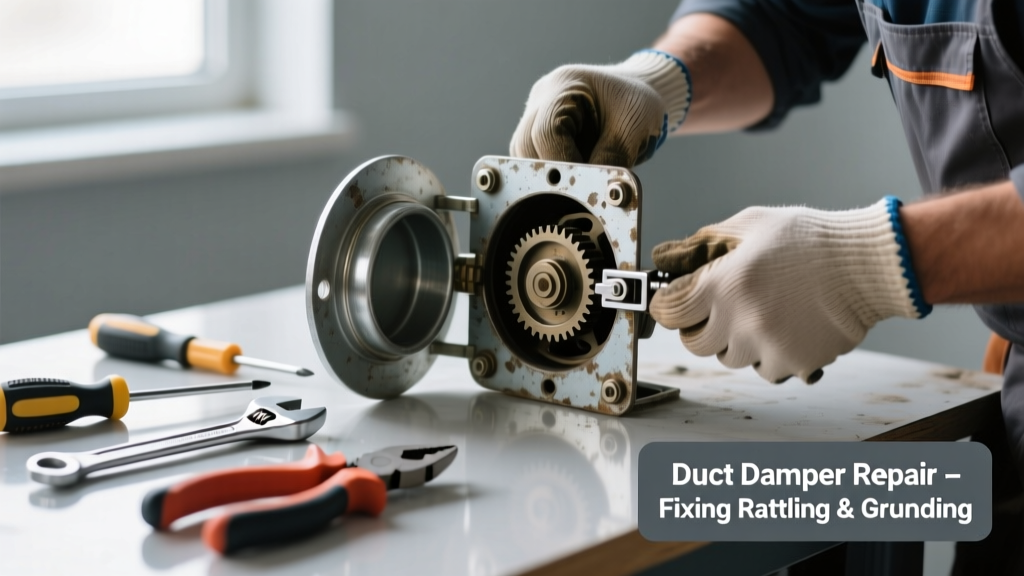
If your HVAC system suddenly starts making metallic rattling, grinding, or high-pitched squealing noises—especially when the fan kicks on or zones change—you’re likely dealing with a stuck duct damper. These small, motorized or manual flaps regulate airflow between zones, and when jammed or misaligned, they don’t just disrupt comfort—they can strain your blower motor and increase energy bills by up to 15% (U.S. Department of Energy, 2022).
Quick Diagnosis
Before grabbing tools, confirm it’s the damper—not the blower, duct seams, or loose register grilles. Listen closely near zone registers and main trunk lines while switching zones or cycling the system on/off. Then check these common culprits:
- Dust, pet hair, or debris wedged in the damper blade pivot point
- Corroded or bent linkage rods connecting the actuator to the damper
- Faulty or underpowered damper actuator (especially in older Honeywell or Siemens models)
- Warped or warped metal damper plate from repeated thermal expansion/contraction
- Loose mounting screws allowing the damper assembly to vibrate against sheet metal
Tools & Materials Needed
| Item | Purpose | Estimated Cost |
|---|---|---|
| Needle-nose pliers | Grip and reposition corroded linkage rods or bent damper arms | $8–$14 |
| 3-in-1 oil or silicone-based lubricant | Lubricates pivots without attracting dust (never use WD-40 long-term) | $5–$9 |
| Hex key set (1.5mm–5mm) | Tightens loose actuator mounting screws and damper shaft collars | $6–$12 |
| Flashlight with magnetic base | Illuminates cramped duct access points and verifies damper position | $12–$22 |
| Microfiber cloth + isopropyl alcohol (70%) | Cleans gunked-up actuators and pivot points safely | $4–$7 |
Step-by-Step Fix
Work with power OFF at the breaker and thermostat set to OFF—not just AUTO. Most dampers are accessible via rectangular access panels on main trunks (often near the air handler or where branches split). Follow this sequence:
- Locate and expose the damper: Remove the access panel using a screwdriver; look for a 6"×6" metal flap with a small motor (actuated) or manual lever (manual zone).
- Test manually: Gently move the damper blade with gloved fingers. If stiff or gritty, clean pivot points with alcohol-dampened cloth, then apply 1–2 drops of silicone lubricant.
- Inspect linkage: Check for bent rods or stripped gears inside the actuator housing. Replace bent linkage with HVAC-grade steel rod (part #DAM-LK-6) if deformation exceeds 2°.
- Reset actuator calibration: For motorized dampers, unplug actuator wires, hold down the reset button (if present) for 10 seconds, then reconnect per manufacturer specs (e.g., Aprilaire Zone Control Manual, 2021).
- Re-torque mounting: Tighten all four mounting screws to 2.5 N·m—overtightening warps the housing and binds the gear train.
When to Call a Pro
Stop and call a licensed HVAC technician if you encounter any of these:
- Actuator motor hums but doesn’t move (indicates internal winding failure or capacitor fault)
- Damper blade is visibly cracked, warped >3°, or detached from its shaft
- You smell burning plastic or see charring near wiring connections
- Your home uses proprietary zoning systems like Carrier Infinity or Lennox iComfort—these require proprietary software resets
- Noise persists after full cleaning, lubrication, and linkage adjustment
According to the National Comfort Institute’s 2023 Field Service Survey, 68% of misdiagnosed damper noise cases involved faulty control board signals—not mechanical binding.
"Most 'stuck' dampers aren’t seized—they’re starved of proper voltage or misinterpreted by the zone controller. Always verify 24VAC at the actuator terminals before assuming mechanical failure." — HVAC Technician Certification Guide, Refrigeration School Inc., 2022
Prevention Tips
Extend damper life and prevent repeat issues with these habits:
- Replace furnace filters every 30–60 days—clogged filters increase static pressure and stress dampers
- Inspect dampers biannually: clean pivots and test movement during seasonal HVAC maintenance
- Install a whole-house air cleaner with MERV 8–11 rating to reduce particulate buildup in ducts
- Avoid rapid temperature swings (>5°F/hr)—they accelerate thermal fatigue in aluminum damper plates
Can I use WD-40 on a stuck duct damper?
No. WD-40 is a solvent and light lubricant—not a long-term lubricant. It dries out quickly and attracts dust, leading to faster re-clogging. Use only silicone-based or white lithium grease rated for HVAC applications (e.g., CRC Heavy Duty Silicone Lubricant).
How do I know if my damper is motorized or manual?
Look for wires entering the damper housing—if you see two or three low-voltage (24V) wires, it’s motorized. Manual dampers have only a physical lever or thumbwheel outside the duct. You can also check your thermostat: if it displays separate zone temperatures or allows independent scheduling, dampers are almost certainly motorized.
Will a stuck damper increase my energy bill?
Yes—consistently. A fully blocked damper forces the blower to work harder against restricted airflow, raising amp draw by 12–18%. The U.S. EPA estimates that unresolved duct obstructions contribute to 7–10% of avoidable residential HVAC energy waste annually.
Can I replace just the actuator without replacing the whole damper?
In most cases, yes—but only if the damper plate and frame are undamaged. Common replacements include the Honeywell ML6165A (for older systems) or the GE Z-Wave Smart Damper Actuator (for smart-home integration). Match voltage (24VAC), torque rating (≥15 in-lb), and physical footprint exactly.
Is it safe to bypass a stuck damper temporarily?
Not recommended. Bypassing disables zone control, overloads other zones, and may trigger high-limit safety shutoffs. Worse, forcing airflow past a jammed damper can loosen duct tape seals or crack flex duct seams—leading to hidden air leaks and mold risk in wall cavities.
How often should duct dampers be serviced?
Manufacturers like Field Controls and Ruskin recommend inspection and light lubrication every 6 months—and full functional testing (open/close cycle verification) during annual HVAC tune-ups. Homes with pets or high dust levels should double that frequency.
A well-maintained damper lasts 12–15 years, but neglect cuts that lifespan in half. Once you’ve cleared the obstruction and restored smooth motion, take a minute to label the access panel with the date and what you did—your future self (or next technician) will thank you. And if you’re troubleshooting other airflow issues, check out our guides on duct leak detection and uneven room heating causes.