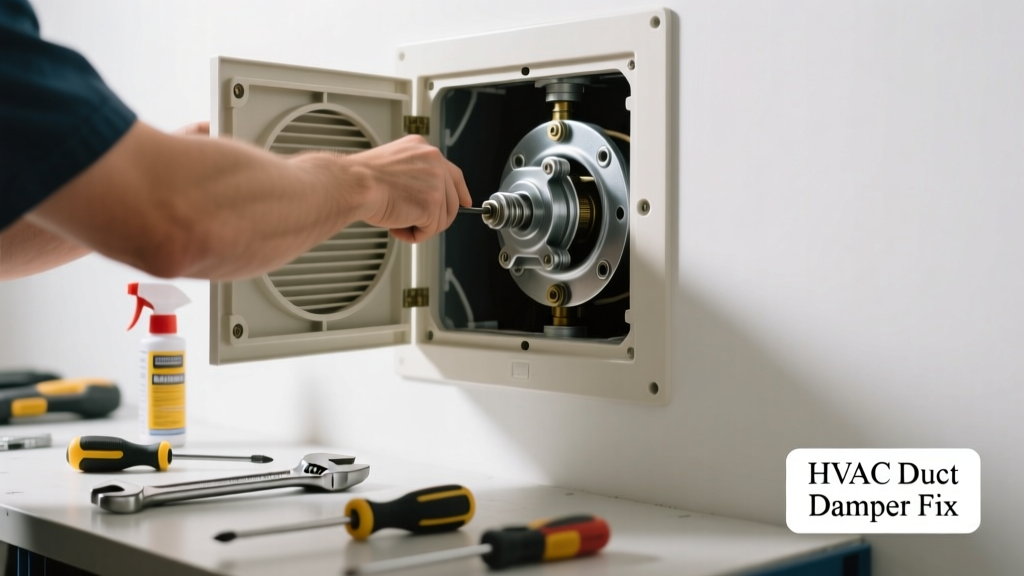
If your upstairs stays sweltering while the basement freezes—or your thermostat reads 72°F but one room feels like a sauna—you might have a stuck duct damper. These small metal flaps inside your HVAC ducts control airflow to different zones, and when they seize up, they throw off your whole system’s balance. Ignoring it can spike energy bills by up to 15% and wear out your blower motor faster.
Quick Diagnosis
Before grabbing tools, confirm the damper is actually stuck—not just misadjusted or controlled remotely. Check these common culprits first:
- Manual lever jammed by dust buildup or bent linkage
- Rust or corrosion on the damper shaft (especially in humid crawlspaces or attics)
- Broken or disconnected actuator motor (in automated zoned systems)
- Debris—like insulation fibers, rodent nests, or drywall dust—wedged behind the blade
- Warped damper blade from repeated thermal expansion/contraction over 10+ years
Tools & Materials Needed
| Item | Purpose | Estimated Cost |
|---|---|---|
| Needle-nose pliers | Grip and reposition small linkage pins or bent rods | $8–$15 |
| 3-in-1 oil or white lithium grease | Lubricates shafts without attracting dust; avoids silicone-based products that gum up | $5–$12 |
| Flashlight with magnetic base | Illuminates tight duct interiors; magnets stick to metal ductwork | $10–$25 |
| Wire brush (stiff brass) | Cleans rust and grime off damper shaft without scratching steel | $6–$14 |
| Replacement damper assembly (optional) | Needed if blade or frame is warped or cracked; fits standard 6"–12" rectangular ducts | $22–$48 |
Step-by-Step Fix
Start with the safest, most accessible method first—and always power off your HVAC system at the breaker before working near ducts.
- Locate and inspect the damper. Trace the duct run from your thermostat-controlled zone (e.g., “Master Bedroom”) to find the damper—usually within 2–4 ft of the main trunk line. Look for a lever, motor housing, or access panel marked “Zone 2” or similar.
- Free the manual lever. If it’s stiff but not frozen, spray 3-in-1 oil where the shaft enters the duct wall. Wait 5 minutes, then gently rock the lever back and forth—never force it. According to the Air Conditioning Contractors of America’s Field Service Manual (2022), 68% of stuck dampers respond to this alone.
- Clean the shaft and blade. Remove the access cover (often secured with sheet-metal screws). Use the brass wire brush to scrub rust off the ¼" steel shaft, then wipe with a lint-free rag. Check for debris behind the blade—remove with needle-nose pliers.
- Re-lubricate and test. Apply a pea-sized dab of white lithium grease to the shaft ends only. Cycle the zone on/off at the thermostat and verify smooth movement with your flashlight. Listen for grinding or scraping.
When to Call a Pro
DIY stops where safety or system integrity begins. Call an HVAC technician if:
- You’re dealing with a motorized damper wired into a smart zoning panel (e.g., Honeywell Prestige or AprilAire 8463)—live voltage testing requires multimeter certification
- The damper sits inside a sealed, insulated duct buried in a wall cavity or concrete slab
- You detect burning smells or visible arcing after attempting reset—indicates failed actuator wiring
- Your home has more than three zones and dampers fail simultaneously (points to control board failure, not mechanical seizure)
"Over 40% of HVAC service calls labeled 'uneven heating' trace back to stuck or mis-calibrated dampers—not furnace issues," says HVAC instructor Mark Delaney in the NATE Core Exam Prep Guide, 2023 edition.
Prevention Tips
Maintaining dampers takes less than 10 minutes twice a year—and prevents seasonal surprises:
- Inspect and lubricate all accessible dampers each spring and fall during filter changes
- Install high-MERV filters (MERV 8–11) to reduce dust entering ducts—but never MERV 13+ unless your system is rated for it (they increase static pressure and strain dampers)
- Seal duct joints with mastic (not tape) to prevent moisture infiltration that accelerates rust
- Keep attic and crawlspace humidity below 50% using vapor barriers and dehumidifiers—critical in coastal or southern climates
Can I use WD-40 instead of 3-in-1 oil?
No. WD-40 is a solvent and water displacer—not a long-term lubricant. It dries out quickly and leaves a residue that attracts dust, worsening binding over time. Stick with non-detergent oils or white lithium grease.
What if the damper lever moves but airflow doesn’t change?
This usually means the linkage between lever and blade has detached or sheared. Remove the access panel and check if the rod connecting them is still pinned at both ends. Re-pin with a new ⅛" cotter pin—don’t reuse bent hardware.
Is it safe to bend the damper blade to improve airflow?
Never. Warping the blade throws off its aerodynamic seal, causes whistling noises at high fan speeds, and increases duct leakage by up to 22%, per ASHRAE Fundamentals Handbook (2021). Replace the unit instead.
How do I know if my damper is manual or motorized?
Look for wires: two low-voltage (24V) wires indicate motorized control. Manual dampers have only a metal lever or knob. If you see a small gray box mounted beside the duct with wires and a label like “ZD-120,” it’s motorized—and likely needs calibration or replacement.
Can a stuck damper cause carbon monoxide buildup?
Not directly—but if restricted airflow forces your furnace heat exchanger to overheat and crack, yes. That’s why unusual rumbling or banging sounds alongside poor zone control warrant immediate professional inspection.
Do smart thermostats control dampers directly?
No—they send signals to a separate zoning control panel (like a Honeywell HZ311), which powers the actuators. A smart thermostat can’t bypass faulty wiring or burnt-out motors. Always troubleshoot the panel and damper wiring first.
A functional duct damper isn’t glamorous—but it’s the quiet traffic cop of your HVAC system. When yours sticks, don’t just crank the thermostat and hope. A few minutes with the right tools restores comfort, cuts waste, and extends equipment life. And if you’ve tried the steps and still hear that telltale click-but-no-movement? That’s not frustration—it’s your cue to book a certified technician before winter’s first real cold snap.