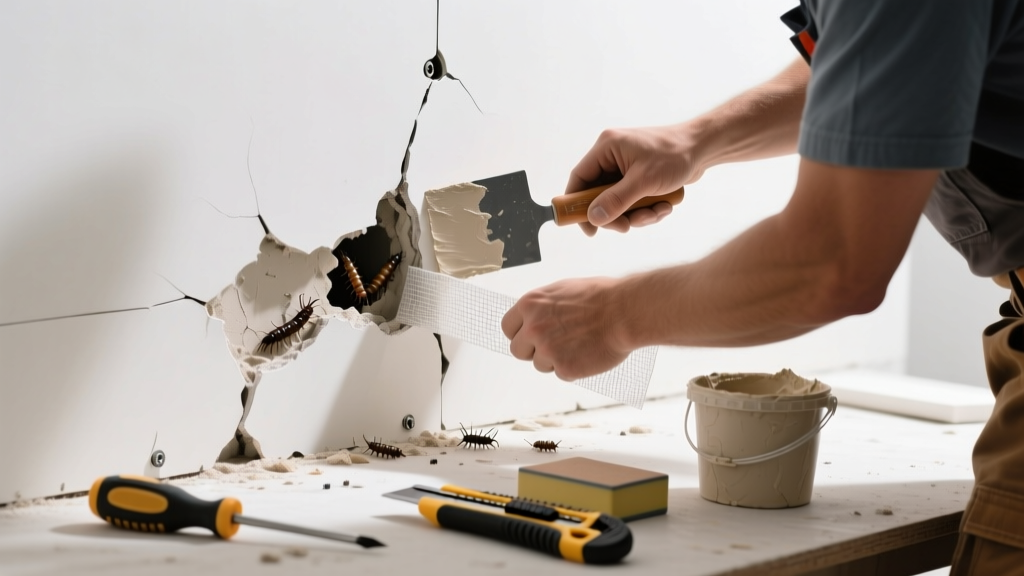
If you patched termite-damaged drywall only to watch screws pop, mud crack, or the whole section sag within weeks, you’re not alone—and it’s not hopeless. The issue isn’t always the patch itself; it’s often what’s hiding behind it: compromised framing, residual insect activity, or moisture that keeps the damage alive. Let’s get it right this time.
Quick Diagnosis
Before grabbing tools, confirm why your repair failed. Most failures trace back to one (or more) of these root causes:
- Undetected active termites still feeding on wall studs or top/bottom plates
- Structural framing weakened beyond safe load-bearing capacity
- Moisture trapped behind drywall from leaks or poor ventilation
- Using standard drywall compound over untreated, porous termite-ravaged substrate
- Skipping backing support—like furring strips or sistered studs—over hollow, damaged zones
Tools & Materials Needed
| Item | Purpose | Estimated Cost |
|---|---|---|
| 16-inch stud finder with AC detection | Finds live wires *and* locates remaining solid wood behind compromised drywall | $25–$45 |
| Borate-based wood preservative (e.g., Bora-Care) | Kills termites on contact and prevents reinfestation in framing | $40–$65 per gallon |
| 1/4" plywood or 1x3 furring strips | Provides rigid backing where studs are too soft or missing | $12–$22 per sheet/8-ft board |
| Hot-dipped galvanized screws (2-1/2") | Corrosion-resistant fasteners that grip compromised wood better than drywall screws | $8–$15 per box |
| Setting-type joint compound (e.g., Durabond 45) | Shrinks less and bonds stronger than premixed mud—critical over uneven, degraded surfaces | $12–$18 per 25-lb bag |
Step-by-Step Fix
Don’t just cover it up—rebuild the integrity. Here are three targeted approaches, depending on severity:
- Surface-Level Patch (minor surface tunnels, solid framing): Scrape away loose paper and crumbling gypsum. Apply borate solution to exposed wood edges. Use setting-type compound over fiberglass mesh tape—no paper tape—then sand smooth after full cure (45+ minutes).
- Backing Reinforcement (soft or hollow-sounding studs): Cut out drywall down to bare framing. Install 1x3 furring strips vertically every 12" using hot-dipped screws into solid wood. Screw new 1/2" drywall directly to furring—never to compromised studs.
- Framing Replacement (spongy, crumbly, or collapsed studs): Shut off power. Remove drywall and cut out damaged 2x4s. Sister a new pressure-treated 2x4 alongside each compromised stud, securing with 3" structural screws every 6". Flash with peel-and-stick membrane at bottom plate if moisture is suspected.
When to Call a Pro
DIY stops where safety and code compliance begin. Call a licensed pest control specialist *and* a structural contractor if you find any of these:
- More than two consecutive studs with >40% cross-sectional loss (measured with calipers)
- Termite swarmers, mud tubes, or frass inside interior walls—not just near foundations
- Visible sagging of ceiling drywall above the damaged wall section
- Electrical wiring embedded in or running through visibly damaged framing
According to the National Pest Management Association’s 2023 Termite Control Guidelines, 68% of failed DIY drywall repairs occurred because underlying infestation was misdiagnosed as 'past' activity—when in fact subterranean colonies remained active within 6 inches of the work site.
Prevention Tips
Stop recurrence before it starts. These aren’t optional extras—they’re the difference between a 5-year fix and a 5-month repeat:
- Install dehumidifiers in basements and crawlspaces—termites need >20% wood moisture content to thrive
- Keep soil at least 6 inches below exterior siding and slope grade away from foundation
- Replace cellulose insulation near foundations with closed-cell spray foam—it’s not food and resists moisture
- Schedule annual inspections with a WDO-certified inspector (required for FHA loans in high-risk zones)
Can I use bleach to kill termites behind drywall?
No. Bleach has zero penetration into wood and evaporates before reaching deeper galleries. It also damages drywall paper and framing adhesives. Use borate solutions instead—they diffuse into wood fibers and remain active for years. Borate treatment for drywood termites is far more effective and code-compliant.
Why does my drywall mud keep cracking over repaired areas?
Crazing happens when mud dries too fast over an unstable substrate—or when you’re using lightweight all-purpose compound over porous, degraded gypsum. Switch to setting-type compound (like Durabond 90), apply in thin layers, and prime with oil-based primer before painting. Drywall mud cracking reasons and fixes covers humidity and application errors too.
Do I need to replace the entire wall if termites ate one stud?
Not necessarily—but you must assess adjacent framing. Termites rarely stop at one stud. Use a screwdriver to probe every stud within 3 feet. If two or more show softness, assume systemic damage and consult a structural engineer. The U.S. Forest Service estimates that 73% of localized termite damage spreads undetected to adjacent framing within 8–12 months.
Can I paint over termite-damaged drywall without repair?
You can—but it’s like putting lipstick on a cracked foundation. Paint hides nothing. Underneath, moisture and insects continue degrading structure. Within months, you’ll see bubbling, bulging, or new exit holes. Always remove compromised material first. For minor surface etching, see our guide on drywall surface repair before painting.
How long after treatment can I reinstall drywall?
Wait until borate solution has fully dried (typically 48–72 hours in low-humidity conditions) AND moisture readings on framing stay below 15% for 48 consecutive hours. Use a pinless moisture meter—don’t guess. Rushing leads to mold under new drywall and premature adhesive failure.
Is expanding foam OK to fill termite-damaged voids behind drywall?
No. Most aerosol foams shrink over time, create thermal bridges, and provide no structural support. Worse, they trap moisture against framing. Use rigid insulation boards or properly secured furring strips instead. For sealing small gaps, choose low-expansion, water-resistant polyurethane foam rated for structural applications.
A proper drywall termite repair isn’t about speed—it’s about respecting what’s hidden. Every screw you drive, every coat of mud you trowel, and every inch of framing you inspect builds real resilience. Get the substrate right, and your finish will last. Skip it, and you’re just buying time—not peace of mind.