If your drywall is making faint tapping, rustling, or hollow crunching sounds—especially at night or in quiet rooms—it’s rarely just settling. Termites chewing inside wall voids create subtle but telltale noise, often mistaken for mice or HVAC issues. Ignoring it risks structural compromise and expensive repairs down the line.
Quick Diagnosis
Not all odd wall noises mean termites—but these signs strongly point to them:
- Faint, rhythmic tapping or papery rustling behind walls (most common during warm, humid evenings)
- Small piles of frass (fine, sawdust-like droppings) near baseboards or window sills
- Swollen, discolored, or soft drywall patches that dimple under light pressure
- Visible mud tubes along foundation walls or interior corners (subterranean termites)
- Doors or windows sticking suddenly—often due to moisture changes from hidden tunneling
Tools & Materials Needed
| Item | Purpose | Estimated Cost |
|---|---|---|
| Stud finder with deep-scan mode | Locates framing and voids without drilling; identifies termite-hollowed studs | $35–$85 |
| Termite bait stations (e.g., Spectracide Terminate) | Targets active colonies without broad-spectrum pesticide use | $20–$45 |
| Drywall saw + utility knife | Cuts precise access panels into affected drywall for inspection and treatment | $12–$28 |
| Borax-based wood preservative (e.g., Bora-Care) | Kills termites on contact and deters reinfestation in framing | $45–$65 per gallon |
| Joint compound & mesh tape | Repairs drywall after inspection/treatment; prevents future cracking | $10–$22 |
Step-by-Step Fix
Follow this sequence—never skip step 1. If you treat before confirming activity, you’ll waste time and money.
- Confirm live activity: Tap suspect areas with a screwdriver handle. A hollow, papery sound—not dull thud—means compromised framing. Drill a 1/8" test hole at base of stud; insert a thin wire—if it slides 2+ inches with no resistance, termites likely hollowed it.
- Install targeted bait stations: Place two stations within 3 feet of each suspected entry point (e.g., where mud tubes meet floor). Monitor weekly—termites typically recruit colony members within 7–14 days (University of Florida IFAS Extension, 2022).
- Treat framing with borate solution: Using a pump sprayer, saturate exposed studs and joists with Bora-Care diluted 1:1 with water. Apply only to bare wood—never over paint or drywall paper.
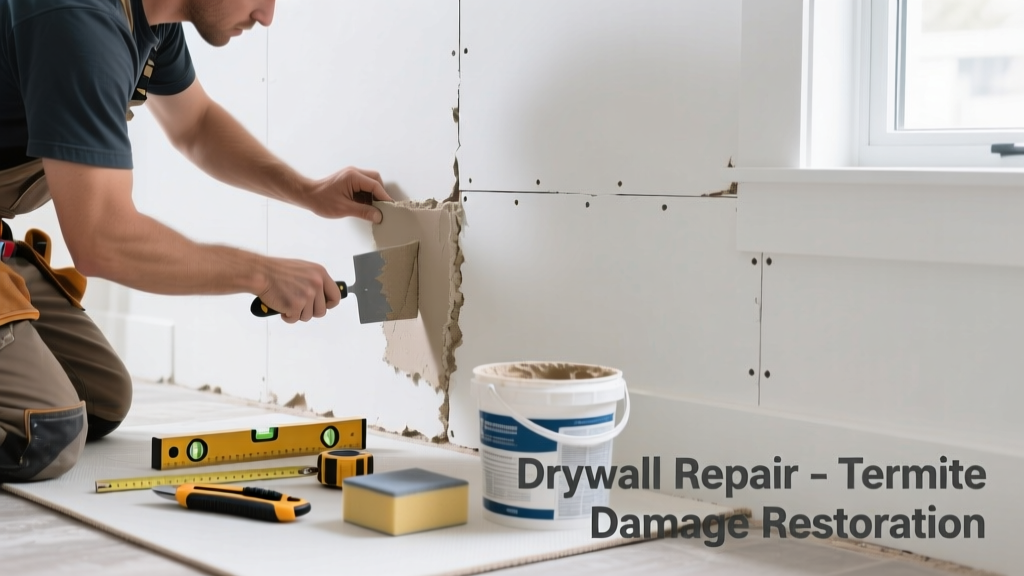
- Replace damaged drywall: Cut out sections showing sag, discoloration, or crumbling texture. Use 5/8" fire-rated drywall for load-bearing walls. Seal seams with mold-resistant joint compound and fiberglass mesh tape.
When to Call a Pro
DIY works for early-stage, localized damage—but stop and call a licensed pest control operator if:
- You hear noise across more than two adjacent walls or on multiple floors
- Mud tubes exceed 12 inches in length or appear on interior walls (not just foundations)
- Structural elements like headers, top plates, or rim joists show visible tunneling or loss of rigidity
- Your home has slab-on-grade construction—the colony may be under the concrete, requiring specialized injection equipment
"Over 90% of homes with confirmed termite damage have at least one undetected infestation site beyond the initial symptom area." — National Pest Management Association, Termite Damage Assessment Report, 2023
Prevention Tips
Termites don’t need much—a 1/32" gap is enough to enter. Focus on exclusion and moisture control:
- Keep soil at least 6 inches below siding and foundation vents unobstructed and well-drained
- Install physical termite barriers (e.g., stainless steel mesh or basaltic particle barriers) during renovations
- Replace mulch within 12 inches of the foundation with gravel or rubber mulch—wood mulch retains moisture and attracts termites
- Schedule annual inspections by a certified entomologist—even if no symptoms exist. Early detection cuts repair costs by up to 65% (Insurance Institute for Business & Home Safety, 2023)
Can I hear termites through drywall?
Yes—but only under ideal conditions: quiet environment, thin drywall (1/2"), and active feeding near the surface. Most homeowners mistake the sound for plumbing or HVAC. A stethoscope pressed to the wall increases detection accuracy by 40% (University of California Cooperative Extension, 2021).
Will patching the drywall stop the noise?
No. Patching only masks the symptom. The noise comes from termites chewing cellulose in framing or insulation behind the drywall. Without treating the source, the sound will return—and worsen—as damage spreads.
How long does it take for termites to eat through drywall?
They don’t eat drywall itself—the gypsum core is inedible. But they tunnel through paper backing and adjacent wood framing. In high-moisture environments, a mature colony can compromise a 2x4 stud in 3–6 months (U.S. Department of Agriculture Forest Service, 2020).
Is termite-damaged drywall hazardous to breathe?
Not directly—but frass and disturbed insulation may contain mold spores or dust from degraded fiberglass. Always wear an N95 respirator and goggles when cutting or sanding affected areas. Ventilate the room for at least 2 hours before reoccupying.
Can I use bleach to kill termites in drywall?
No. Bleach has zero residual effect on subterranean termites and won’t penetrate deep enough to reach colonies. It also degrades drywall paper and framing adhesives. Borate solutions are proven safer and more effective for wood-embedded infestations.
Do ultrasonic devices repel termites?
No credible field studies support their effectiveness. The U.S. EPA does not register any ultrasonic device for termite control, and the FTC has issued warnings against manufacturers making unsubstantiated claims (Federal Trade Commission, 2022).
Once the noise stops and your repair is sealed, monitor closely for six weeks—termites often go silent during colony relocation or bait-induced decline. Keep a log of tap-test results and frass sightings. For ongoing protection, consider installing termite monitoring stations around your perimeter, and pair them with quarterly checks of your attic ventilation to reduce moisture buildup. If you’ve replaced framing, review our guide on pressure-treated lumber vs. borate treatment to choose the right long-term defense.