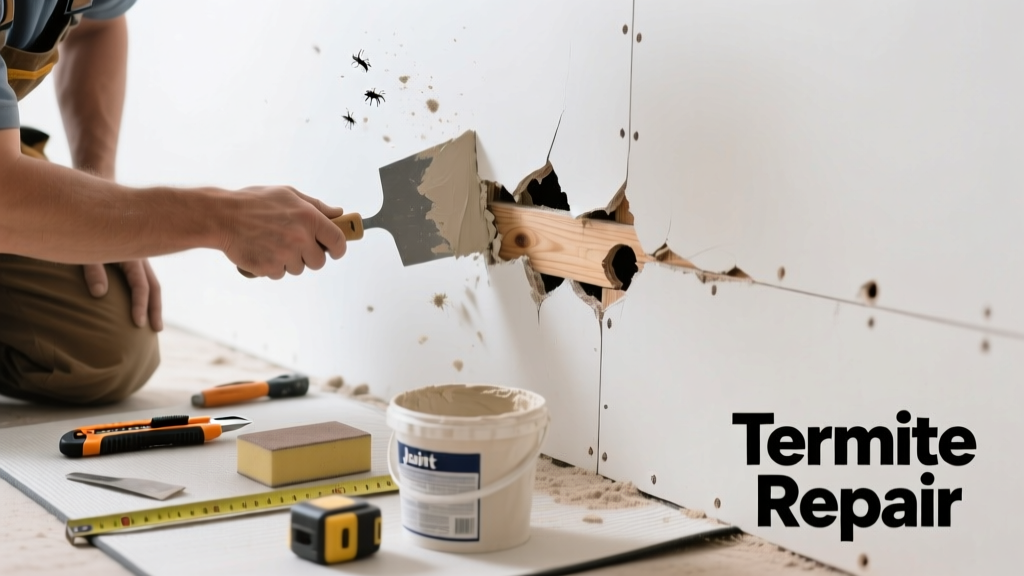
If you’ve spotted sagging, bubbled, or crumbling drywall near your kitchen cabinets, sink base, or pantry wall, termites may already be feeding behind the surface. Unlike water damage, termite damage often hides until it’s structurally compromised—especially where plumbing lines meet framing or where drywall meets flooring. Catching it early saves time, money, and prevents infestation spread to adjacent rooms.
Quick Diagnosis
Kitchen-specific signs point to hidden activity—not just surface flaws. Termites love warm, humid, undisturbed zones with cellulose access (drywall paper, wood framing, or cabinet backing). Confirm before cutting:
- Pinhole-sized exit holes or mud tubes along baseboards or behind appliances
- Soft, hollow-sounding drywall when tapped—especially near plumbing chases or soffits
- Faint rustling or clicking sounds inside walls (rare but possible during swarm season)
- Swarmers (winged termites) near windowsills or light fixtures in spring
- Crumbly drywall paper that flakes off easily, revealing intact gypsum core beneath
Tools & Materials Needed
| Item | Purpose | Estimated Cost |
|---|---|---|
| Utility knife with fresh blades | Cuts clean edges around damaged drywall without crushing paper layer | $8–$15 |
| 1/4"-thick moisture-resistant drywall (green board) | Resists humidity from dishwashers, sinks, and steam; required by IRC for kitchen walls near wet areas | $12–$18 per sheet |
| Termite-killing borate spray (e.g., Bora-Care) | Penetrates wood framing to kill live termites and prevent reinfestation | $45–$65 per quart |
| Construction adhesive (waterproof) | Bonds drywall to framing where screws can’t reach compromised studs | $7–$12 per tube |
| 3" corrosion-resistant drywall screws | Secure patch to framing without splitting weakened wood | $5–$9 per box |
Step-by-Step Fix
Repair must address both structural loss and active infestation. Don’t skip the borate treatment—even if you see no live insects. Subterranean termites work silently in colonies of 60,000+.
- Isolate and inspect: Turn off power to nearby outlets and switches. Remove base cabinets or toe-kick panels to expose framing. Use a flashlight and small mirror to check stud cavities for mud tubes or frass (termite droppings).
- Treat framing first: Spray borate solution onto exposed studs, plates, and blocking—saturating all wood surfaces. Let dry 24 hours. According to the U.S. Forest Service’s Wood Protection Guide 2022, borate-treated wood resists termite feeding for 10+ years when not exposed to direct rain.
- Cut and replace drywall: Score and remove damaged drywall using a utility knife and keyhole saw. Cut back to the center of intact studs—never leave unsupported edges. Install new green-board with construction adhesive and screws spaced 6" on edges, 12" in field.
- Seal and finish: Apply mesh tape and setting-type joint compound (not premixed) over seams. Sand smooth, prime with oil-based primer (blocks tannin bleed from treated wood), then paint.
When to Call a Pro
DIY fails fast when structural integrity is compromised—or when termites have breached load-bearing elements. Call immediately if:
- You find more than three consecutive studs with >30% cross-sectional loss (measured with calipers)
- Damage extends above the countertop into ceiling joists or cabinet mounting rails
- Mud tubes run vertically >4 feet or connect to exterior soil—indicating an active colony entry point
- Your home has slab-on-grade foundation with interior damage: termites may be tunneling through concrete cracks or expansion joints
"In kitchens, termite damage is rarely isolated—it's usually the tip of a larger infestation. A licensed inspector should assess within 48 hours of discovery." — Dr. Sarah Lin, Entomologist, University of Florida IFAS Extension, 2023
Prevention Tips
Kitchens are high-risk zones due to plumbing leaks, condensation, and stored cardboard boxes. Stop recurrence with these targeted actions:
- Install dehumidifiers under sinks and near dishwashers—maintain RH below 55% (termites avoid dry air)
- Seal all gaps >1/8" around pipes, vents, and electrical penetrations with copper mesh + acoustical sealant
- Replace cardboard food storage boxes with plastic bins—termites feed on starch-based adhesives in box glue
- Schedule annual termite inspections—especially if your home is >15 years old or built on untreated wood sill plates
Can I use bleach on this?
No. Bleach kills surface mold but does nothing to termites, their eggs, or damaged wood fibers. It also weakens drywall paper and reacts poorly with borate treatments. Skip disinfectants—focus on removal and borate barrier application instead.
Do I need to replace the entire wall?
Not unless >40% of the wall area shows structural compromise or you discover active tunnels spanning multiple bays. Most kitchen repairs involve localized patches—especially when damage clusters near plumbing rough-ins or cabinet cutouts.
Will painting over the patch hide the problem?
Temporarily—but not safely. Paint won’t stop termites from feeding behind the surface. If you skip borate treatment and framing inspection, the infestation will return in 3–6 months. Always treat before finishing.
Can I reuse the old drywall screws?
Avoid it. Compromised studs lose holding power. Reusing screws risks pull-out, especially near cabinets or appliance mounts. Use new corrosion-resistant screws sized for your drywall thickness and stud depth.
Is green board enough protection against future termites?
No—moisture resistance doesn’t equal termite resistance. Green board only slows water absorption; it still contains cellulose-rich paper facing. Pair it with borate-treated framing and physical barriers like stainless steel mesh behind base cabinets.
How long does the repair take?
Small patches (under 4 sq ft) take one full day including drying time for compound and primer. Larger sections (2+ sheets) require 3 days minimum—especially if framing needs sistering or replacement. Factor in 24 hours for borate to cure before drywall installation.
Termites don’t wait for perfect weather or convenient schedules—and neither should your repair plan. Address kitchen drywall damage the same day you spot it: treat the wood, replace the wall, and lock out future entry points at every seam and penetration. For ongoing protection, pair your fix with our termite inspection checklist and consider adding exhaust fan upgrades to reduce humidity buildup near vulnerable zones. If you’ve patched one section, inspect all perimeter walls—including behind the refrigerator and inside pantry soffits—within the same week.