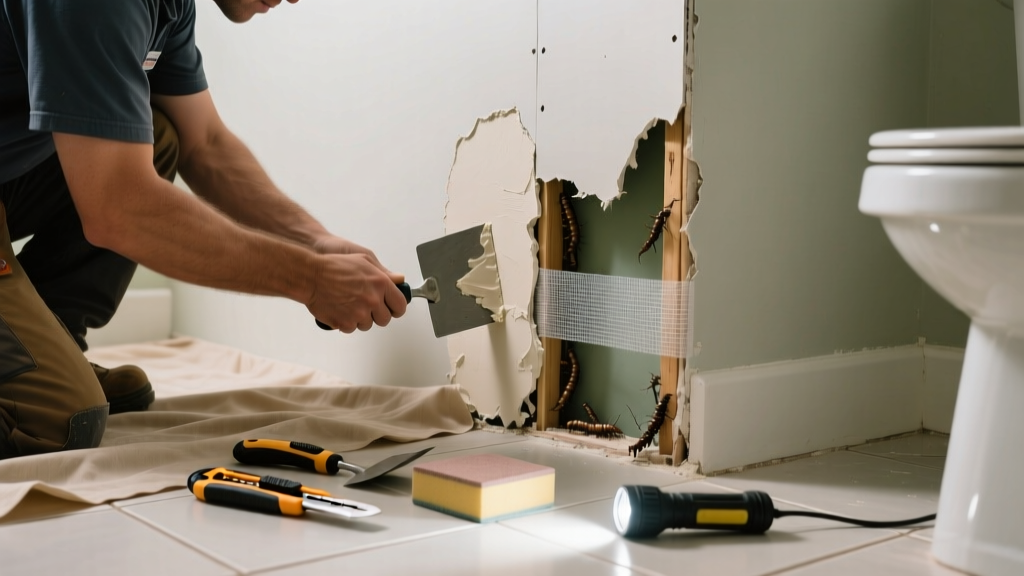
If you’ve spotted bubbling paint, sagging drywall, or tiny mud tubes behind your bathroom vanity or shower base, termites may already be feeding on moisture-damaged drywall. Unlike attic or basement infestations, bathroom termite damage hides behind tile, under sinks, and inside walls where humidity lingers — making early detection tough and repairs urgent.
Quick Diagnosis
Bathroom drywall termite damage rarely appears out of nowhere. It’s almost always the result of a chain reaction:
- Persistent plumbing leaks (e.g., supply line seepage under the sink)
- Poor ventilation leading to condensation buildup behind walls
- Non-moisture-resistant drywall (regular greenboard instead of cement board or mold-resistant Type X)
- Wood framing or backing installed directly against damp drywall
- Previous water damage left unrepaired for >48 hours
Tools & Materials Needed
| Item | Purpose | Estimated Cost |
|---|---|---|
| Moisture meter (pin-type) | Confirms active moisture in substrate before cutting; prevents premature drywall replacement | $45–$85 |
| Mold-resistant drywall (1/2" or 5/8") | Required by IRC R320.2 for wet areas; resists fungal growth and termite attraction | $12–$18 per sheet |
| Termite-killed framing lumber (or borate-treated 2x4s) | Replaces compromised studs/joists; borate treatment deters future infestation | $3.50–$6.25 per linear foot |
| Hydrostatic sealant (e.g., RedGard) | Creates waterproof barrier over new drywall seams and fasteners in wet zones | $28–$34 per gallon |
| Stainless steel drywall screws | Corrosion-resistant fasteners essential in high-humidity environments | $8–$12 per box of 250 |
Step-by-Step Fix
- Shut off water and power: Turn off supply lines to sinks, toilets, and showers. Shut off the circuit breaker for any GFCI outlets or lights in the affected zone.
- Remove damaged drywall and inspect framing: Cut back to sound material using a utility knife—minimum 6 inches beyond visible damage. Check studs, top/bottom plates, and blocking with a screwdriver; soft, crumbly wood means termite activity has spread into framing.
- Treat and replace compromised framing: Spray borate solution (e.g., Bora-Care) on exposed framing per label instructions. Replace any structurally unsound members with pressure-treated or borate-impregnated lumber.
- Install mold-resistant drywall with proper spacing: Leave 1/8-inch gap at floor (use tile or baseboard to cover), 1/4-inch gap at ceiling, and seal all seams with RedGard before tiling or painting. Fasten every 7 inches along edges, 12 inches in field.
- Verify ventilation and fix root cause: Confirm exhaust fan moves ≥50 CFM and vents outside—not into attic. Repair leaking faucets, reseal tub/shower caulk, and check grout integrity.
When to Call a Pro
DIY is unsafe or insufficient when:
- More than two adjacent studs show structural compromise (i.e., >25% depth loss)
- Damage extends above the ceiling into joists or roof sheathing
- You find live termites in wall cavities or evidence of subterranean colony entry (mud tubes wider than 1/4")
- The bathroom shares a wall with a load-bearing partition or HVAC duct chase
According to the National Pest Management Association’s 2022 Termite Infestation Report, 68% of bathroom-related termite claims involved secondary structural compromise missed during initial visual inspection — underscoring why licensed pest inspectors and structural contractors should assess anything beyond surface-level drywall replacement.
"In bathrooms, termites don’t eat drywall for its gypsum — they’re after the paper facing and the cellulose-laced glue behind tile backer board. Once moisture invites them in, they’ll follow the path of least resistance straight into framing." — Dr. Lena Cho, Entomologist, University of Florida IFAS Extension, 2021
Prevention Tips
Stop recurrence with these proven strategies:
- Run your bathroom exhaust fan for 20 minutes after every shower — use a timer switch if needed
- Replace standard greenboard with 5/8" mold-resistant Type X drywall in all wet zones (per IRC R320.2)
- Install a humidity sensor (e.g., AcuRite 01512) that alerts you when RH exceeds 60% for >2 hours
- Seal all pipe penetrations with non-shrinking hydraulic cement, not caulk alone
- Schedule annual inspections of vanity cabinets and toe-kick areas — termites often enter through gaps behind baseboards
Can I patch just the bubbled area with joint compound?
No. Joint compound seals surface moisture but doesn’t address the underlying cellulose food source or structural weakness. Termites will continue feeding behind the patch, and the repaired area will delaminate within weeks. Always cut out and replace the entire compromised section.
Is it safe to reuse existing drywall screws?
No. Rust-prone drywall screws corrode rapidly in humid conditions and lose holding power. Stainless steel screws are required for bathroom installations per IPC Table 305.2. Reusing old screws risks fastener failure, especially near tile loads.
Do I need a vapor barrier behind the new drywall?
Not if you’re using modern mold-resistant drywall with integral moisture barrier (e.g., USG Mold Tough or National Gypsum Gold Bond XP). Adding polyethylene behind such drywall traps interstitial moisture — a known contributor to hidden rot and termite harborage. Per the 2021 International Residential Code Appendix C, Class II or III vapor retarders are prohibited in vented bathroom wall assemblies.
How long does borate treatment take to dry before drywall installation?
Borate solutions like Bora-Care require 48–72 hours of drying time in low-humidity conditions (<50% RH). In bathrooms, extend that to 96 hours — or use a dehumidifier set to 40% RH during cure time. Rushing this step leaves residual moisture that attracts new termite activity.
Can I use regular drywall in the ceiling above the shower?
No. The IRC requires moisture-resistant drywall on ceilings in shower/tub enclosures (R320.2). Regular drywall absorbs steam, swells, and delaminates — creating ideal conditions for termites and mold. Use only Type X or cement board rated for continuous wet exposure.
What’s the fastest way to confirm termites vs. carpenter ants?
Look at winged swarmers: termites have straight antennae, equal-length wings, and broad waists; carpenter ants have elbowed antennae, front wings longer than rear, and narrow waists. Also check debris: termites leave fine, pellet-like frass *inside* walls; carpenter ants dump coarse sawdust *outside*. For definitive ID, send samples to your local extension office or a certified entomologist.
Fixing drywall termite damage in the bathroom isn’t just about replacing a panel — it’s about breaking the moisture-pest cycle at its source. Get the ventilation right, choose materials built for wet environments, and treat framing like the structural asset it is. That approach turns a one-time repair into lasting protection — and keeps your next bathroom remodel from uncovering the same problem behind new tile. For persistent issues, consult both a licensed pest control operator and a building inspector before covering walls back up.