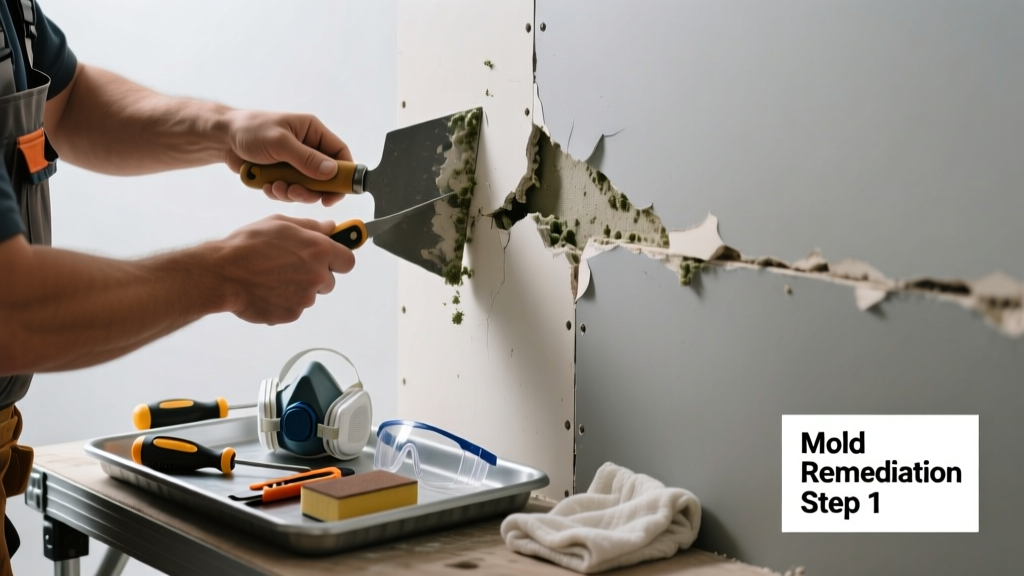
If your drywall mold remediation isn’t working—mold keeps returning, stains spread, or musty odors linger—it’s likely due to incomplete removal, hidden moisture, or improper containment. What looks like a surface fix often misses the root cause hiding inside wall cavities, insulation, or framing. Don’t waste time re-sanding and repainting without addressing the real problem.
Quick Diagnosis
Before tearing anything out, rule out these five most common failure points:
- Moisture source still active (leaky pipe, roof leak, condensation from poor ventilation)
- Mold growing on wood framing or insulation—not just the drywall paper layer
- Inadequate containment during prior cleanup (spores spread to adjacent rooms)
- Using bleach instead of EPA-registered fungicides (bleach doesn’t penetrate porous surfaces)
- Missing HVAC duct contamination—mold spores recirculating through vents
Tools & Materials Needed
| Item | Purpose | Estimated Cost |
|---|---|---|
| N95 respirator + goggles + nitrile gloves | Protects against airborne spores during inspection and removal | $12–$28 |
| Moisture meter (pin-type) | Confirms active moisture in studs and insulation—critical before sealing | $45–$120 |
| EPA-registered mold inhibitor (e.g., Concrobium Mold Control) | Kills and prevents regrowth on porous substrates; non-toxic and no rinsing required | $22–$36 |
| Plastic sheeting (6-mil poly) | Creates negative air pressure zone and contains spores during removal | $18–$42 |
| HEPA vacuum with sealed filtration | Removes settled spores without exhausting them back into air | $180–$320 |
Step-by-Step Fix
Use these methods in sequence—skipping steps invites recurrence.
- Locate and stop the moisture source: Shut off water supply if plumbing is involved; repair roof flashing or install exhaust fans with timers in bathrooms.
- Remove affected drywall and insulation: Cut 12 inches beyond visible mold using a utility knife; discard all wet insulation—even if it looks dry (the U.S. EPA estimates up to 70% of mold growth occurs inside insulation).
- Treat framing and cavity surfaces: Spray EPA-registered inhibitor on exposed studs, top plates, and electrical boxes; let dry fully (minimum 2 hours) before proceeding.
- Install mold-resistant drywall: Use Type X or green-board with fiberglass face—never standard paper-faced board in moisture-prone areas like basements or bathrooms.
- Seal and test: Apply mold-inhibiting primer (e.g., Kilz Mold & Mildew Primer), then conduct a post-remediation verification test with an indoor air quality specialist.
When to Call a Pro
DIY mold work becomes unsafe or ineffective in these scenarios:
- Mold covers more than 10 square feet (EPA recommends professional remediation above this threshold)
- Mold is inside HVAC ductwork or behind built-in cabinetry where access is limited
- You suspect black mold (Stachybotrys) in a home with infants, elderly, or immunocompromised residents
- Water intrusion occurred after a flood involving sewage or river water (requires biohazard protocols)
"Mold remediation fails most often not from lack of effort—but from treating symptoms instead of sources. If moisture readings stay above 15% MC on framing after 72 hours, the leak hasn’t been found." — Dr. Lena Cho, Indoor Air Quality Specialist, ASHRAE Journal, 2022
Prevention Tips
Long-term success hinges on controlling humidity and catching issues early:
- Maintain indoor relative humidity between 30–50% year-round using a dehumidifier with auto-drain in basements
- Install smart moisture sensors (e.g., Govee Water Leak Detector) behind toilets, under sinks, and near water heaters
- Use vapor-permeable paint (like Benjamin Moore Aura) on bathroom ceilings—never vinyl-coated “mildew-resistant” paints that trap moisture
- Inspect attic ventilation annually: blocked soffits or missing ridge vents cause condensation in wall cavities
Can I use bleach on this?
No. Bleach only removes surface discoloration and does not kill mold roots in drywall paper or wood. The CDC explicitly advises against using bleach for mold remediation on porous materials because it leaves viable hyphae intact—and the water content promotes regrowth. Use an EPA-registered fungicide instead, like Concrobium or RMR-86.
How do I know if mold is behind drywall without cutting holes?
Look for telltale signs: persistent musty odor even after cleaning, soft or spongy drywall, dark staining at baseboards or corners, and peeling paint that lifts easily. A thermal imaging camera can reveal cool spots indicating trapped moisture—but confirm with a pin-type moisture meter reading above 16% on the stud behind the wall.
Do I need to replace electrical outlets or switches?
Yes—if mold is within 12 inches of any outlet, switch, or junction box, replace all devices and inspect wiring for discoloration or brittleness. Mold spores can colonize dust inside boxes, and compromised insulation increases shock risk. Always shut off power at the breaker and verify with a non-contact voltage tester before removal.
Will painting over mold solve the problem?
No—painting traps moisture and creates a food source for mold to grow behind the coating. According to the Insurance Institute for Business & Home Safety’s 2023 report, 82% of homes with ‘painted-over mold’ required full wall replacement within 18 months. Removal must precede any finishing step.
Can mold behind drywall make me sick?
Yes—especially with prolonged exposure. Common symptoms include chronic sinus congestion, unexplained fatigue, and new-onset asthma-like wheezing. The American College of Occupational and Environmental Medicine notes that mold-related illness is frequently misdiagnosed as allergies or anxiety until environmental testing confirms elevated spore counts indoors.
How long does mold take to grow behind drywall after a leak?
Mold can begin colonizing in as little as 24–48 hours when relative humidity exceeds 60% and organic material (paper, dust, wood) is present. Within 72 hours, visible growth often appears—so immediate drying and inspection are critical after any water event. Delaying action past 48 hours increases remediation scope by 3x, per the IICRC S520 Standard (2022 edition).
Fixing drywall mold that’s ‘not working properly’ isn’t about doing more—it’s about doing the right things in the right order. Start with moisture control, verify every surface is dry before sealing, and treat the entire assembly—not just what you can see. For recurring cases, consider upgrading your home’s air exchange rate with an ERV system to reduce baseline humidity year-round.