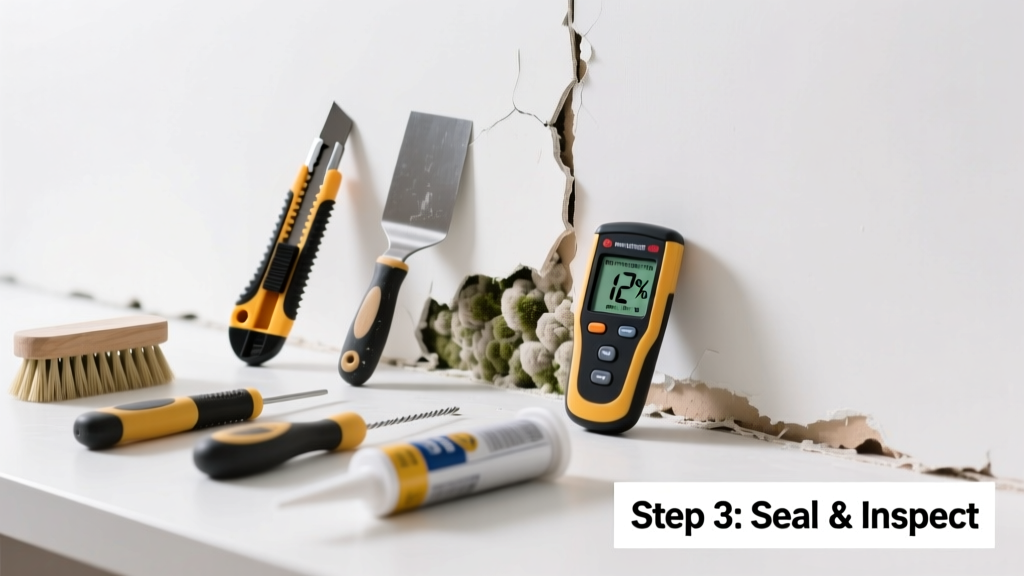
If your drywall is making unexplained popping, crunching, or faint hissing noises—and you’ve ruled out plumbing or pests—it’s likely mold actively degrading the gypsum board and paper backing. This isn’t just an odor or discoloration issue; it’s a structural warning sign. Ignoring it risks airborne spores, compromised wall integrity, and escalating repair costs.
Quick Diagnosis
Mold behind drywall rarely makes noise on its own—but the decay it causes does. Here are the most common culprits:
- Moisture-warping of drywall paper layers separating and rubbing during temperature shifts
- Microbial degradation weakening the gypsum core, causing flex under minor pressure (e.g., HVAC cycling)
- Secondary infestation—mold-damaged drywall attracts carpenter ants or termites, whose movement creates tapping or rustling
- Condensation buildup in wall cavities expanding/contracting insulation or framing, amplified by mold-softened surfaces
Tools & Materials Needed
| Item | Purpose | Estimated Cost |
|---|---|---|
| N95 respirator + goggles + nitrile gloves | Essential PPE to avoid inhaling spores during inspection and removal | $12–$28 |
| Moisture meter (pin-type) | Measures % moisture content in drywall and framing—critical for confirming active dampness | $45–$120 |
| 16-gauge utility knife + extra blades | Cuts precise access panels without damaging studs or wiring | $8–$15 |
| HEPA vacuum with crevice tool | Removes spores from cavities without redistributing them into air | $130–$290 |
| EPA-registered mold inhibitor (e.g., Concrobium Mold Control) | Kills and prevents regrowth on porous substrates—no bleach required | $22–$38 |
Step-by-Step Fix
Do not attempt full remediation without first confirming moisture source and extent. Start small:
- Locate and isolate the sound source: Use a stethoscope or rolled-up paper against the wall while someone taps lightly nearby. Mark the loudest 12”x12” zone with painter’s tape.
- Cut a 6”x6” inspection port: Cut cleanly through drywall only—not into studs or wires—using a utility knife. Insert a borescope or smartphone camera on a selfie stick to assess mold coverage and substrate condition.
- Test moisture levels: Insert pin meter probes into framing behind drywall. Readings above 16% indicate active water intrusion needing correction before any cleaning.
- Remove affected material: If mold covers >10 sq ft or penetrates >½” into gypsum, cut out and replace drywall (minimum 12” beyond visible edges). Bag debris in 6-mil poly before removal.
- Treat and seal: Spray exposed framing and cavity with EPA-registered inhibitor. Let dry 24 hrs. Install mold-resistant drywall (mold-resistant drywall installation) with sealed seams using joint compound containing fungicide.
When to Call a Pro
DIY ends where safety and code compliance begin. Call a certified mold remediator (IICRC-certified) if:
- You detect musty odors across multiple rooms or upstairs/downstairs—indicating duct or attic involvement
- Mold is present behind load-bearing walls or near electrical panels, gas lines, or HVAC ductwork
- Moisture meter readings exceed 20% in framing or persist after fixing visible leaks
- Your home has asbestos-containing joint compound (pre-1980 construction) or vermiculite insulation
According to the Insurance Institute for Business & Home Safety's 2023 report, 72% of mold-related structural failures began as undiagnosed behind-wall moisture events that homeowners attempted to patch without addressing root cause.
"Mold noise is never just about sound—it’s the audible symptom of cellulose digestion. Once you hear it, the paper backing is already failing. Immediate containment—not scrubbing—is step one." — Dr. Lena Cho, Indoor Environmental Consultant, ASHRAE Journal, 2022
Prevention Tips
Stop recurrence before it starts:
- Install exhaust fans with humidity sensors in bathrooms and kitchens (bathroom exhaust fan installation) that run until RH drops below 50%
- Seal exterior wall penetrations (outlets, pipes, windows) with closed-cell spray foam—not caulk alone
- Use smart thermostats with dew point monitoring to prevent condensation inside walls during shoulder seasons
- Inspect attic ventilation annually—blocked soffit vents cause interstitial condensation even in dry climates
Can I use bleach on this?
No. The U.S. EPA explicitly advises against bleach for mold on porous surfaces like drywall. Bleach cannot penetrate paper backing, leaves moisture behind, and degrades gypsum, accelerating deterioration. Use an EPA-registered fungicidal coating instead.
Will cutting a hole make the mold spread?
Only if you don’t contain it first. Seal off the room with plastic sheeting and negative air pressure (use a box fan with a furnace filter taped over the intake). Then cut. Always wear full PPE—even for a 6” hole.
How do I know if it’s mold or just old insulation settling?
Mold behind drywall often appears as fuzzy black, green, or gray patches with a distinct earthy-musty smell. Settling insulation makes dull thuds—not rhythmic pops—and won’t trigger moisture meter spikes above 12%. When in doubt, test with a DIY ERMI kit or hire a hygienist.
Is this covered by homeowners insurance?
Rarely—if mold resulted from long-term neglect (e.g., leaking roof ignored for 6+ months). Most policies cover sudden, accidental water events (burst pipe), but exclude gradual seepage. Document all moisture readings and repair dates immediately.
Can I paint over moldy drywall to silence it?
No. Painting masks symptoms but worsens decay. Latex paint traps moisture, and mold will continue digesting paper backing—often increasing noise as the substrate delaminates further. Replacement is the only safe fix.
What if the noise stops after I run the AC?
This suggests moisture-driven expansion/contraction. AC lowers indoor humidity and cools framing, reducing thermal stress on mold-weakened drywall. But the underlying decay remains—and may accelerate when humidity rises again. Treat the cause, not the symptom.
Addressing noisy mold behind drywall isn’t about silencing a sound—it’s about halting active biological decay before it compromises your wall’s function or your family’s respiratory health. Every pop or creak is data: it tells you where moisture lives, how far decay has spread, and how urgently action is needed. Do the small inspection first, measure before you cut, and never skip source correction—even if the noise goes quiet for now. For deeper issues, water damage restoration costs rise exponentially after week two.