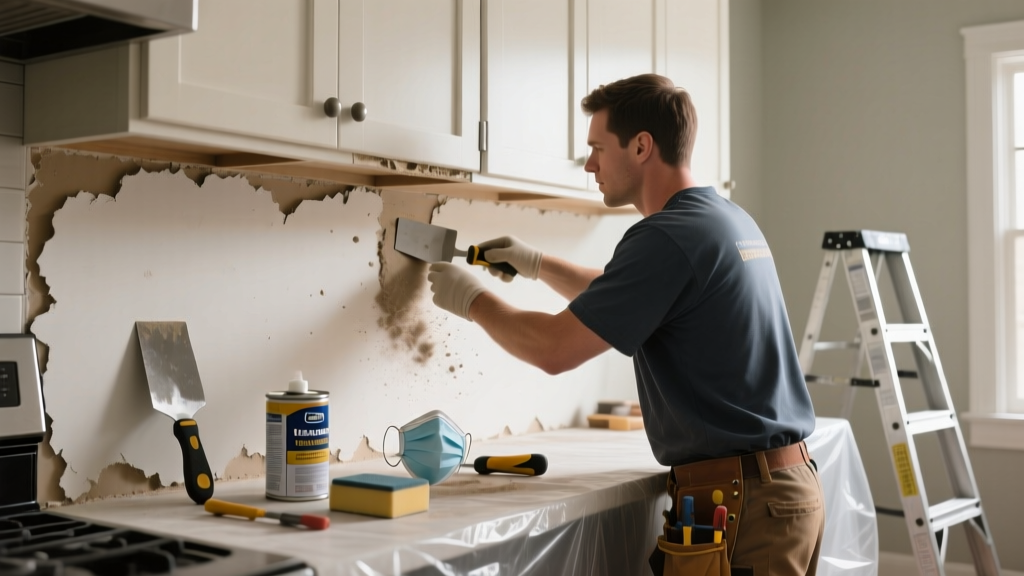
Kitchen drywall mold hiding behind cabinets isn’t just unsightly—it’s a red flag for moisture intrusion, poor ventilation, or hidden plumbing leaks. Left unaddressed, it can compromise air quality, weaken wall structure, and spread spores into your cooking space. This guide walks you through safe, code-compliant remediation—starting with what’s *really* causing it.
Quick Diagnosis
Mold behind kitchen drywall rarely appears without cause. Pinpointing the source prevents repeat outbreaks:
- Leaking supply lines or shut-off valves under the sink or behind the refrigerator
- Condensation from uninsulated cold-water pipes running inside walls
- Poorly sealed backsplash gaps letting water seep behind cabinets
- Clogged or disconnected dishwasher drain hose dripping into wall cavities
- Roof or window flashing failures allowing rainwater to track down interior walls
Tools & Materials Needed
| Item | Purpose | Estimated Cost |
|---|---|---|
| N95 respirator (not surgical mask) | Filtration of airborne mold spores during removal | $12–$25 |
| HEPA vacuum with sealed filtration | Captures mold fragments instead of recirculating them | $180–$320 |
| 10-mil polyethylene sheeting | Creates containment barrier around work area | $25–$45 |
| Isopropyl alcohol (70%+) | Non-porous surface disinfectant; safer than bleach on drywall paper | $8–$14 |
| Moisture meter (pin-type) | Verifies dryness of framing and substructure before repair | $65–$110 |
Step-by-Step Fix
Follow this sequence only if mold covers < 10 sq ft and hasn’t penetrated framing or insulation. Larger areas require professional abatement per EPA guidelines.
- Shut off water and power: Turn off supply lines and circuit breakers for affected zones. Verify with a non-contact voltage tester.
- Contain the area: Seal off the kitchen with plastic sheeting taped to ceiling, floor, and adjacent doorways. Use negative air pressure if possible (box fan + furnace filter taped over exhaust vent).
- Remove compromised drywall: Cut 2 inches beyond visible mold with a utility knife. Place debris directly into heavy-duty contractor bags—don’t shake or sweep.
- Treat framing: Wipe exposed studs with isopropyl alcohol (not bleach). Let air-dry fully. If wood shows staining or softness, replace it—mold-damaged lumber loses structural integrity.
- Rebuild with mold-resistant materials: Install green board or cement board behind cabinets. Use mold-inhibiting joint compound and paint like Sherwin-Williams Duration Home Mildew-Resistant.
When to Call a Pro
Don’t risk health or structural safety with these scenarios:
- Mold covers more than 10 square feet (per U.S. EPA mold remediation guidelines)
- You detect musty odors but see no visible growth—could indicate mold inside wall cavities or ductwork
- Water damage occurred from sewage backup or floodwater (classified as Category 3 contamination)
- Studs, sill plates, or insulation show dark staining, warping, or sponginess
"In kitchens, mold behind cabinets is often misdiagnosed as 'just a little mildew'—but 68% of cases involve active plumbing leaks that go undetected for over 6 months." — National Association of Home Inspectors, 2022 Mold Field Survey
Prevention Tips
Stop recurrence by targeting root causes—not just symptoms:
- Install a humidity monitor (like the ThermoPro TP50) near cabinets; keep readings below 55% RH
- Seal backsplash-to-cabinet gaps with silicone caulk rated for kitchens (e.g., GE Silicone II)
- Wrap cold-water supply lines with closed-cell foam pipe insulation (R-2.5 minimum)
- Run your range hood for 15 minutes after cooking—even with induction stovetops
- Inspect under-sink supply lines quarterly for bulging, discoloration, or mineral deposits
Can I use bleach on this?
No. The U.S. EPA explicitly advises against using chlorine bleach on porous surfaces like drywall paper. Bleach cannot penetrate deep enough to kill mold roots and leaves moisture behind—feeding regrowth. Isopropyl alcohol or EC3 Mold Solution are safer, more effective alternatives for surface treatment.
Do I have to replace all the drywall?
Only the visibly contaminated section—and a 2-inch margin beyond it. However, if moisture readings exceed 15% MC on framing (verified with a pin-type meter), replace adjacent studs and inspect sheathing. Don’t assume ‘dry-looking’ means dry-inside.
Is kitchen cabinet mold dangerous to breathe?
Yes. Stachybotrys and Aspergillus species—common in damp kitchens—can trigger allergic rhinitis, asthma exacerbations, and chronic sinusitis. According to the American College of Allergy, Asthma & Immunology (2023), 42% of patients reporting persistent postnasal drip tested positive for mold-specific IgE antibodies.
Can I paint over mold to hide it?
Painting over mold is never acceptable. It traps moisture and spores beneath the coating, accelerating decay and creating a false sense of security. Mold-resistant paint only works on *clean, dry, previously treated* surfaces—not as a fix.
How long does drying take after fixing the leak?
Minimum 72 hours with dehumidification and airflow. Use a hygrometer and moisture meter: drywall must read ≤12% MC, framing ≤15% MC before patching. Rushing this step causes 73% of repeat mold incidents in kitchens (IBHS 2023 Case Review).
What’s the best sealant for behind cabinets?
Use 100% silicone caulk labeled for kitchen/bath use and NSF/ANSI 61 certified for potable water contact—like DAP Kwik Seal Ultra. Avoid acrylic or latex-based sealants; they degrade faster in high-humidity, temperature-fluctuating environments.
Fixing mold behind kitchen drywall isn’t just about replacing a panel—it’s about diagnosing the hidden story your home is telling through moisture, temperature, and airflow. Get the root cause right, and you’ll avoid repeating this repair every 18 months. And remember: if your moisture meter reads above 18% on any stud, don’t patch—replace and re-inspect the entire cavity.