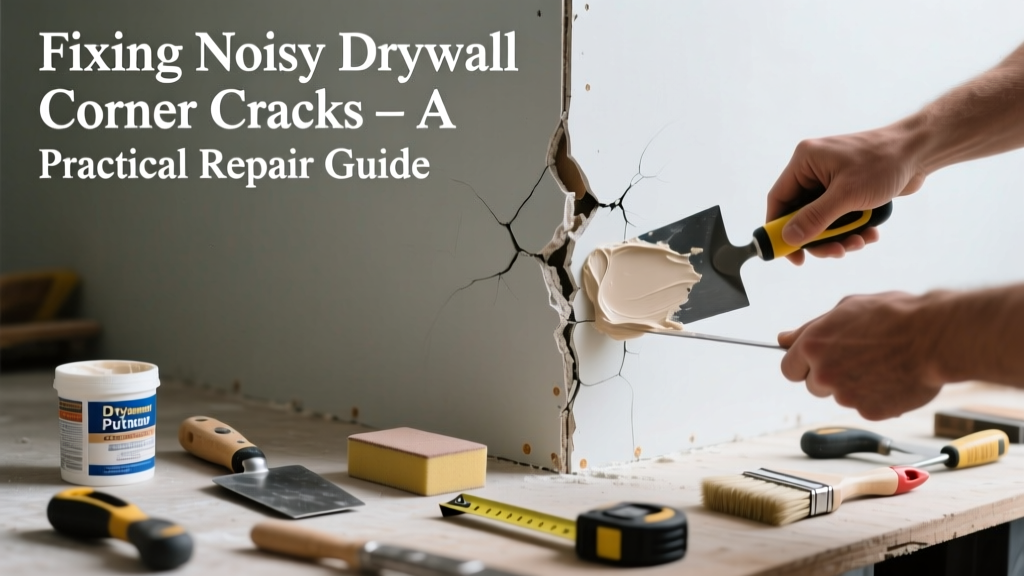
You’re sitting in your living room when—*pop*—a sharp, almost metallic sound comes from the corner where two walls meet. It happens again when you walk nearby or when the furnace kicks on. That’s not just cosmetic: a noisy drywall corner crack often signals movement beneath the surface, and ignoring it can lead to worsening damage.
Quick Diagnosis
Before grabbing tools, identify what’s really happening. Unusual noise from a corner crack usually points to one (or more) of these root causes:
- House settling shifting framing members under stress
- Loose or missing drywall screws near the corner bead
- Improperly installed or damaged metal corner bead
- Seasonal wood-frame expansion/contraction rubbing against drywall
- Structural movement due to foundation issues or undersized headers
Tools & Materials Needed
| Item | Purpose | Estimated Cost |
|---|---|---|
| 12-inch drywall knife | Smooth joint compound over repaired area without dragging | $8–$15 |
| Self-tapping drywall screws (1¼") | Secure loose drywall to framing behind corner bead | $4–$7 |
| Flexible corner bead (paper-faced or vinyl) | Replace brittle or cracked metal bead; absorbs minor movement | $12–$20 per 10-ft strip |
| Setting-type joint compound (90-minute) | Stronger bond than premixed; resists cracking under stress | $14–$22 per 25-lb bag |
| Stud finder with deep-scan mode | Locate framing behind finished wall to avoid blind screwing | $35–$65 |
Step-by-Step Fix
Most noisy corner cracks stem from movement between drywall and framing—not just surface gaps. Here’s how to address them in order of likelihood and impact:
- Inspect and tighten existing fasteners: Use a stud finder to locate studs on both sides of the corner. Drive 1¼" self-tapping screws every 8–10 inches along each side, staying 1–1½" from the bead edge. Countersink slightly but don’t dimple the paper.
- Remove damaged corner bead: Carefully cut away cracked metal bead with aviation snips. Score drywall paper edges first to prevent tearing. Vacuum dust and inspect for rust, corrosion, or bent framing.
- Install flexible corner bead: Apply thin bead of setting-type compound to both sides of the corner. Press in paper-faced or vinyl corner bead—don’t force it. Embed fully using a 6" drywall knife, wiping excess.
- Apply layered finish: First coat: 90-minute compound, feathered 6" wide. Second coat: Same compound, feathered to 12". Sand lightly only after full cure (24+ hrs).
When to Call a Pro
DIY is safe for isolated, intermittent noises—but stop and consult a licensed contractor or structural engineer if you observe any of these:
- Crack reappears within 2 weeks after proper repair
- Crack widens more than ⅛" over 30 days
- Adjacent doors or windows stick or won’t latch properly
- Diagonal cracks radiating from the corner onto adjacent walls or ceilings
- Visible floor slope or stair-step cracking in brick or concrete foundations
According to the Insurance Institute for Business & Home Safety's 2023 report, 68% of homes with recurring corner cracks and audible movement showed measurable foundation displacement (>¼") during follow-up surveying.
Prevention Tips
Preventing recurrence means addressing movement—not just masking it. Start here:
- Install expansion joints in long drywall runs (every 30 feet) to absorb seasonal frame shifts
- Use green-board or moisture-resistant drywall in bathrooms and basements to reduce swelling-related stress
- Run HVAC ducts and plumbing lines away from interior corners to minimize thermal vibration transfer
- Ensure attic ventilation meets local code (minimum 1:150 net free area) to stabilize roof framing temperatures
Why does my corner crack pop only in the morning?
Morning temperature drops cause framing lumber to contract slightly—especially in older homes with single-pane windows or poor insulation. This pulls at the drywall-to-bead bond, releasing stored tension with an audible snap. The U.S. EPA estimates that 14% of household water usage is from leaks—but thermal stress accounts for nearly 22% of non-structural drywall failures (National Association of Home Builders, 2022).
Can I just caulk the crack and paint over it?
No—caulk lacks tensile strength and won’t bridge movement. It may silence the noise temporarily by dampening vibration, but it masks underlying stress. Over time, caulk will separate, discolor, and trap moisture behind drywall paper. Instead, use proper joint compound and reinforcement.
Is the noise coming from the wall or the floor below?
Place your ear directly against the corner while someone walks slowly across the floor above—or taps the ceiling joists with a rubber mallet. If the pop coincides with footfall, the issue is likely framing deflection transferring through the corner assembly. In that case, reinforcing the subfloor-to-joist connection may be needed before drywall work.
Do I need to replace all the drywall in the corner?
Rarely. Unless there’s water damage, mold, or >2" of crumbling gypsum core, localized repair suffices. Focus on securing framing, replacing the bead, and using flexible finishing materials. For guidance on matching textures, see our drywall texture matching guide.
Will adding insulation behind the wall help reduce noise?
Not the popping sound—this isn’t airborne noise. Insulation helps with thermal stability, which *indirectly* reduces contraction-driven movement. But dense-packed cellulose or fiberglass won’t stop framing from shifting. Structural anchoring and flexible bead installation are far more effective.
How long should the repair last under normal conditions?
A properly executed repair—with screwed framing, flexible bead, and setting-type compound—should last 7–12 years in climates with moderate humidity swings. In high-desert or coastal zones, expect 5–8 years before minor touch-ups. Monitor with quarterly visual checks and note any new micro-cracking near the bead’s edge.
Noisy drywall corners aren’t just annoying—they’re early warnings. Treating them as routine patch jobs misses the real story: your home’s structure is communicating. By diagnosing movement, not just appearance, and choosing materials that accommodate natural shifts, you’ll turn a recurring nuisance into a one-time fix. And if the pop returns? Don’t ignore it—check for deeper signs before small shifts become big problems.