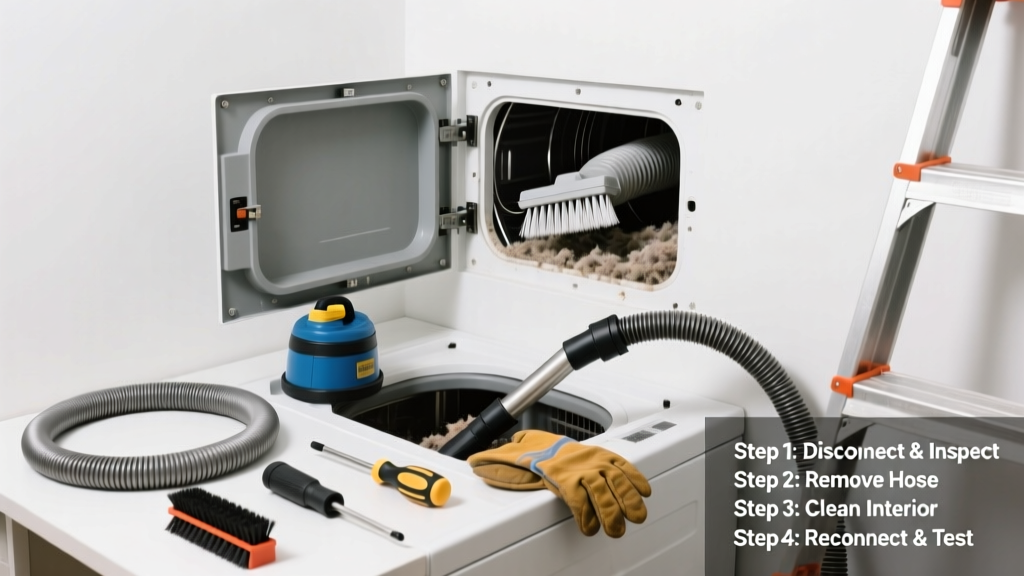
If your dryer takes two cycles to dry a load—or if the exterior vent flap won’t budge when the dryer runs—you’ve likely got a clogged dryer vent. This isn’t just an inconvenience: lint buildup is the leading cause of home clothes dryer fires, responsible for an estimated 2,900 U.S. house fires annually (U.S. Fire Administration, 2022).
Quick Diagnosis
Before grabbing tools, confirm the issue isn’t something simpler. A clogged vent often mimics other problems—but these signs point directly to restricted airflow:
- Dryer drum feels unusually hot during operation
- Clothes come out damp but warm after a full cycle
- Burning or dusty odor during drying
- Exterior vent hood flaps don’t open or vibrate weakly
- Lint visibly accumulates around the dryer’s rear exhaust port
Tools & Materials Needed
| Item | Purpose | Estimated Cost |
|---|---|---|
| Flexible dryer vent brush kit (10-ft) | Reaches deep into rigid or flexible ducts to dislodge compacted lint | $18–$26 |
| Shop vacuum with hose adapter | Creates strong suction at vent termination to pull loosened debris | $65–$120 |
| Replacement aluminum foil or rigid metal duct (if damaged) | Code-compliant replacement for crushed, kinked, or plastic ducts | $8–$22 |
| Phillips and flathead screwdrivers | Removes dryer back panel and exterior vent cover | $5–$12 |
| Lint roller or microfiber cloths | Cleans residual dust from dryer interior and housing | $3–$7 |
Step-by-Step Fix
Work in this order—start inside, finish outside—to avoid pushing lint deeper into the system.
- Unplug the dryer and shut off gas (if gas-powered). Safety first: electricity and gas are both hazards here.
- Remove the dryer’s rear access panel using a screwdriver; vacuum visible lint from the exhaust port and blower housing with a shop vac.
- Detach the flexible duct from both ends (dryer outlet and wall boot), inspect for kinks or damage, and replace if crushed or plastic-lined.
- Insert the vent brush into the wall duct from the exterior vent opening, rotating and pushing gently for 8–10 ft. Repeat 2–3 times, then reverse direction and brush toward the dryer end.
- Reconnect clean ducting, secure with foil tape (not duct tape), and run a test load of towels on low heat while checking for airflow at the exterior vent.
When to Call a Pro
DIY works for standard 25-ft straight or slightly angled vent runs. But call a licensed HVAC technician or certified dryer vent cleaner if you encounter any of these:
- More than 35 feet of total duct length, especially with multiple 90° elbows
- Duct runs through walls, ceilings, or attics where access is blocked or insulation-covered
- Signs of rodent nesting (droppings, chewed ducting) or mold growth inside the duct
- Gas dryer with suspected carbon monoxide leaks—do not operate until inspected
"A dryer vent should be cleaned at least once per year—and every 6 months for households with pets or frequent laundry use." — National Fire Protection Association (NFPA 54, 2023 edition)
Prevention Tips
Long-term maintenance beats emergency fixes. Build these habits into your routine:
- Clean the lint screen before every load—not just when it looks full
- Vacuum the lint trap housing monthly with a narrow crevice tool
- Replace plastic or foil accordion ducts with rigid or semi-rigid aluminum (required by IRC M1502.4.1)
- Install a dryer vent alarm like the DryerEyes sensor to detect airflow loss in real time
- Schedule professional cleaning every 12–18 months if your vent exceeds 20 ft or has 2+ bends
Can I use bleach or chemical cleaners on my dryer vent?
No. Bleach, vinegar, or liquid cleaners can corrode metal ducts, degrade seals, and leave residue that attracts more lint. They also create hazardous fumes when exposed to dryer heat. Stick to mechanical removal only—brushes, vacuums, and compressed air.
Is it safe to clean the vent while the dryer is running?
Never. Operating the dryer during cleaning risks overheating, igniting lint, or damaging the blower motor. Always unplug or shut off the circuit breaker before beginning any work—even visual inspection.
Why does my dryer vent keep clogging even after cleaning?
Frequent clogs usually point to underlying issues: excessive lint from fabric softener sheets (which coat fibers), overloading the dryer, using non-vented portable dryers indoors, or ducting that’s too long, too narrow (<4” diameter), or improperly sloped. Check our guide on dryer venting code requirements for compliant layout.
Can a clogged dryer vent increase my energy bill?
Yes—significantly. A restricted vent forces the dryer to run longer and hotter. The U.S. Department of Energy estimates that clogged vents increase drying time by up to 30%, raising energy use by $15–$25 annually per household.
What’s the difference between a dryer vent and a dryer duct?
“Dryer vent” commonly refers to the entire exhaust path—including the duct (the pipe/tube), the exterior termination hood, and internal components like the blower wheel. Technically, the “duct” is just the conduit itself. Building codes regulate the duct material, slope, and length—but proper venting depends on all parts functioning together. See our dryer duct materials guide for code-approved options.
How do I know if my exterior vent hood is defective?
A working hood opens fully under airflow and closes tightly when idle. If it’s stuck open, warped, or covered in paint or caulk, replace it with a UL-listed, spring-loaded model (like the Dundas Jafine DVH-4). Avoid cheap plastic hoods—they crack in cold weather and restrict airflow by up to 40% (Home Ventilation Institute, 2021).
Keeping your dryer vent clear isn’t just about faster drying—it’s one of the simplest ways to reduce fire risk in your home. Most clogs take under an hour to clear with the right tools, and the payoff includes lower utility bills, longer appliance life, and peace of mind. If you’ve tackled the basics but still notice heat buildup or weak airflow, revisit the duct routing or consult a local technician who uses video inspection scopes to spot hidden blockages. For related help, see our guides on dryer not heating and dryer making grinding noise.