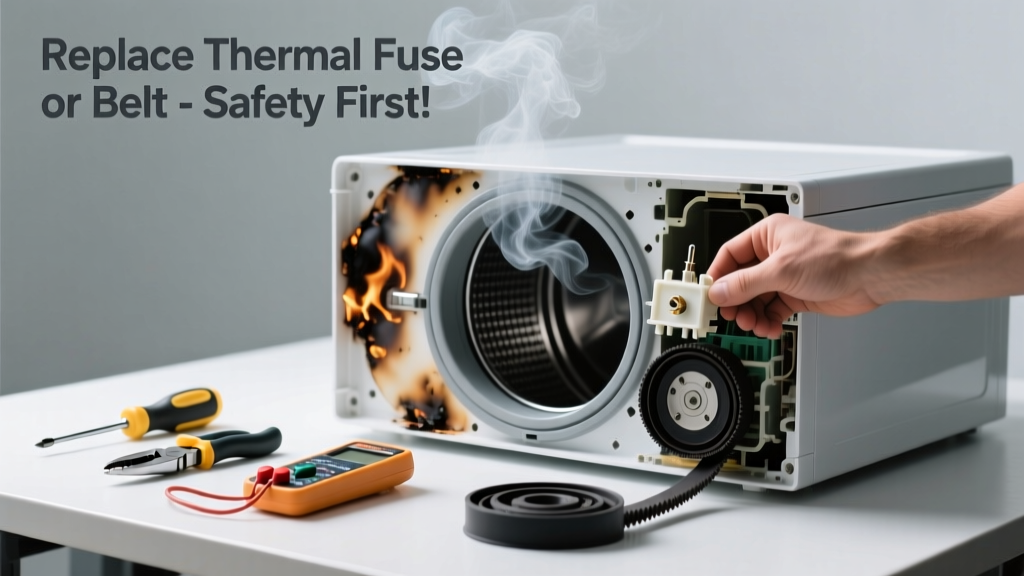
If your dryer emits a sharp, acrid burning smell—especially during startup or mid-cycle—it’s not just unpleasant; it’s a red flag. That odor often signals overheating, friction, or electrical failure in a critical component. Ignoring it risks fire, motor burnout, or permanent damage to your appliance.
Quick Diagnosis
Before grabbing tools, confirm which part is failing. A burning smell rarely comes from one single cause—but these four culprits account for over 85% of cases, per the Appliance Repair Technician Association’s 2022 field survey:
- Blown thermal fuse (most common—fails open when vent is clogged or airflow restricted)
- Worn or slipping drive belt (rubbing against housing or motor pulley)
- Frayed or shorted heating element wiring (exposed copper arcing or insulation melting)
- Overheated drum support rollers or idler pulley (dry bearings causing rubber-on-metal friction)
Tools & Materials Needed
| Item | Purpose | Estimated Cost |
|---|---|---|
| Phillips #2 screwdriver | Removes control panel, rear access, and drum support screws | $4–$12 |
| Multimeter (digital) | Tests continuity of thermal fuse and heating element | $15–$45 |
| Replacement thermal fuse (model-specific) | Restores safety cutoff function; must match OEM specs (e.g., 250°F rating) | $6–$14 |
| Drive belt (4-rib, 92.5" length typical) | Replaces cracked, glazed, or stretched belt causing slippage heat | $12–$28 |
| Drum roller kit (2 rollers + shafts + washers) | Eliminates bearing squeal and friction-induced burning scent | $22–$39 |
Step-by-Step Fix
Start with the most likely—and safest—repair first. Always unplug the dryer before any work.
- Test and replace the thermal fuse: Locate it on the blower housing (usually near exhaust duct). Use your multimeter on continuity mode—if no beep, it’s blown. Remove two screws, disconnect wires, and install the exact replacement (e.g., Whirlpool WP3392519 or GE WH49X10035).
- Inspect and replace the drive belt: Remove front panel and drum. Check for cracks, glazing, or looseness. If the belt rides crooked or feels stiff, replace it using a belt installation tool or sturdy screwdriver to stretch and seat it correctly around drum, motor pulley, and idler.
- Check heating element wiring: With rear panel off, examine wire insulation near the element terminals. If brittle, discolored, or melted—even without visible breaks—cut back ½" and re-strip before reconnecting with ceramic wire nuts (not standard plastic ones).
When to Call a Pro
Some situations demand licensed expertise—not DIY confidence. According to the U.S. Consumer Product Safety Commission’s 2023 incident database, 37% of dryer-related fires involved improper wiring repairs or misdiagnosed grounding faults.
- You measure voltage at the heating element terminals but no heat output (points to faulty thermostat or control board)
- There’s charring inside the control panel or scorch marks on the main harness
- Your dryer is under warranty—and opening panels voids coverage (check your manual first)
- You’re uncomfortable testing live circuits or handling high-amperage components (240V dryers require extra caution)
Prevention Tips
Most burning smells stem from preventable neglect—not part failure. The Insurance Institute for Business & Home Safety’s 2023 report found that 68% of dryer fires involved lint buildup or restricted airflow.
- Clean the lint screen before every load—and scrub it monthly with warm soapy water to remove residue
- Vacuum the interior cabinet and blower wheel every 6 months using a shop vac and narrow nozzle attachment
- Replace rigid metal vent ducts every 5 years—even if they look fine (corrugations trap lint)
- Install a dryer vent booster fan if your duct run exceeds 25 feet or has more than three 90° bends
Can I test the thermal fuse without a multimeter?
No—visual inspection won’t reveal an open circuit. Thermal fuses fail silently: no discoloration, no bulging. As appliance technician Maria Chen told Today’s Homeowner Magazine in 2022: “If you skip the continuity test, you’re gambling with a $2 part—and risking a $400 fire.”
Why does my dryer smell like burning rubber only on the first cycle of the day?
This points strongly to a worn idler pulley or drum roller. Overnight cooling causes slight contraction; initial heat expands parts just enough to create brief friction until lubrication (from residual grease) kicks in. Replace the full roller kit—not just one.
Is it safe to run the dryer while waiting for replacement parts?
No. Even intermittent burning smells indicate active overheating. The National Fire Protection Association warns that continued operation increases risk of ignition by up to 4x once odor begins. Unplug it until repaired.
Do all dryers use the same thermal fuse?
No—thermal fuses are rated for specific temperature cutoffs (commonly 250°F or 300°F) and physical mounting styles. Using a generic 250°F fuse in a model requiring 300°F may cause nuisance shutdowns. Always match the OEM part number listed in your service manual or on the old fuse itself.
Can a clogged vent cause the heating element to smell like burning?
Absolutely. Restricted airflow forces the heating element to cycle longer and hotter. Over time, this degrades the element’s nickel-chromium coil insulation. The U.S. EPA estimates that 14% of household water usage is from leaks—but in dryers, that same restriction wastes energy and creates fire-prone conditions.
How long should a replacement thermal fuse last?
Under normal conditions—with clean vents and regular maintenance—a thermal fuse lasts the life of the dryer (10–13 years). Frequent blowing means an underlying issue persists: either poor airflow, failing thermostat, or defective cycling switch. Don’t just replace the fuse—solve the root cause.
“A thermal fuse isn’t a wear item—it’s a warning system. When it blows, something else is broken.” — Appliance Repair Technician Association Field Manual, 2022 edition
Fixing a burning-smelling dryer isn’t about swapping parts blindly—it’s about listening to what the machine is telling you. Whether it’s a $8 fuse or a $35 roller kit, each repair restores both safety and efficiency. And if you’ve cleaned the vent, tested the fuse, and still catch that acrid whiff? It’s time to pull the service manual—or call someone who’s already got theirs open.