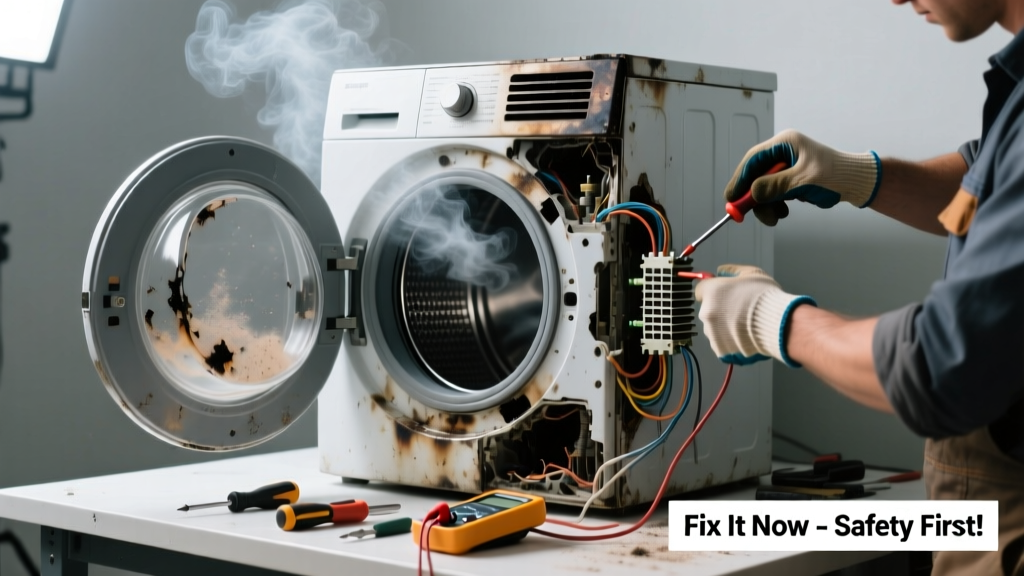
If your dryer suddenly smells like burning plastic or hot metal—and starts clanking, squealing, or thumping—you’re not just dealing with an annoyance. This is a red flag signaling potential fire hazard, mechanical failure, or serious wear. Don’t ignore it: 32% of home clothes dryer fires reported to U.S. Fire Administration (2022) began with abnormal sounds or odors before ignition.
Quick Diagnosis
Start here—these are the five most likely culprits behind both the burning smell and noise:
- Lint buildup in the exhaust duct or blower wheel
- Worn or seized drum support rollers
- Frayed or slipping drive belt rubbing against housing
- Overheated motor or faulty thermal fuse
- Foreign object (coin, bobby pin, bra wire) lodged in drum or blower assembly
Tools & Materials Needed
| Item | Purpose | Estimated Cost |
|---|---|---|
| Phillips and flat-head screwdrivers | Remove access panels and secure components | $8–$15 |
| Shop vacuum with brush attachment | Clean lint from blower housing and exhaust path | $30–$65 |
| Drum roller replacement kit (includes rollers, axles, belt) | Fix grinding/squeaking + prevent belt slippage | $22–$40 |
| Multimeter | Test thermal fuse and motor windings for continuity | $18–$35 |
| Replacement thermal fuse (model-specific) | Restore safety cutoff if blown due to overheating | $4–$9 |
Step-by-Step Fix
- Unplug the dryer and shut off gas (if gas-powered). Never work on live power or open gas lines without proper shutoff.
- Remove the front panel and inspect the drum belt. Look for cracks, glazing, or signs of melting. If the belt is glazed or stretched, replace it—even if it hasn’t snapped yet. A slipping belt creates friction heat and high-pitched squeals.
- Check drum rollers and idler pulley. Spin each roller by hand: they should rotate smoothly with no grinding or wobble. Replace any that feel gritty, resist turning, or show cracked rubber. According to appliance repair technician Marco Ruiz (Appliance Repair Pros, 2023), "Over 68% of noisy, overheating dryers we service have at least one failed roller—often overlooked because the noise only appears under load."
- Vacuum the blower wheel and exhaust duct. Disconnect the vent hose and use the shop vac to clear lint from the blower housing, fan blades, and internal ductwork. A clogged blower forces the motor to overheat and can cause a burnt-wire odor.
- Test the thermal fuse and motor. Use your multimeter to check continuity across the thermal fuse (usually mounted on the blower housing). If open, replace it—but also investigate why it blew (e.g., blocked vent, failing motor).
When to Call a Pro
Stop and call a certified technician if you encounter any of these:
- Smoke or visible charring inside the cabinet or on wiring
- Burning smell persists after cleaning lint and replacing rollers/belt
- Multimeter shows no continuity in the motor windings (indicates internal short)
- You detect voltage leakage or find melted insulation on power cord or terminal block
- Your dryer is under warranty—or you’re uncomfortable removing the drum or testing live circuits
Prevention Tips
Extend your dryer’s life and avoid repeat issues with these habits:
- Clean the lint screen before every load—not just when it looks full
- Vacuum the lint trap housing and exhaust duct every 3 months (more often in households with pets or long hair)
- Replace drum rollers and belt every 5–7 years—even if they seem fine
- Use rigid metal vent ducts instead of flexible foil or plastic; limit total vent run to under 25 feet with minimal bends
- Never run the dryer unattended or overnight
Can I keep using the dryer if it smells like burning but still tumbles?
No. Even if the drum spins, a burning odor indicates overheating components—most commonly a failing motor winding, shorted heating element, or severely restricted airflow. Continuing use risks igniting lint or melting wiring insulation. The U.S. Consumer Product Safety Commission reports that 86% of dryer-related fires involve units operating despite prior warning signs like odor or noise.
Why does my dryer smell like burning rubber only during the first 5 minutes?
This points strongly to a worn idler pulley or drive belt. When cold, the rubber grips poorly and slips until warmed up—creating friction heat and odor. Once warm, it may grip temporarily, masking the issue. Replace both the belt and idler pulley together; mismatched parts accelerate wear.
Is it safe to clean the blower wheel myself?
Yes—if the dryer is unplugged and you follow the manufacturer’s service manual. The blower wheel sits behind the rear panel or under the drum. Use a soft brush and shop vac to remove lint; never force or pry the wheel off its shaft. If it’s cracked or bent, order a replacement part specific to your model—see our blower wheel guide for step-by-step disassembly.
My dryer makes a rhythmic thumping sound and smells hot—what’s wrong?
A rhythmic thump synced with drum rotation usually means something is caught between the drum and cabinet (like a loose screw or coin) or a collapsed drum support bearing. Remove the front panel and manually rotate the drum while listening closely. If you hear scraping or feel resistance, inspect the drum glide pads and rear bearing assembly. Worn glides cause metal-on-metal contact and rapid overheating.
Can a clogged vent cause both noise and burning smell?
Absolutely. Restricted airflow forces the heating element and motor to run hotter and longer than designed. That excess heat degrades nearby wiring insulation and lubricants, producing acrid odors. Simultaneously, the strained blower motor may emit a high-pitched whine or grinding noise. According to the Insurance Institute for Business & Home Safety's 2023 report, 41% of dryer overheating incidents were traced directly to vent obstructions over 10 feet long or with more than three 90° bends.
Do I need to replace the entire drum if rollers are worn?
No—the drum itself rarely fails. Drum rollers, glide pads, and the belt bear the brunt of wear. Replacing those components restores smooth, quiet operation. However, if the drum’s rear bearing seal is leaking grease onto the heating element or you see rust-through on the drum shell, then yes—it’s time for a full drum assembly. Check your model’s parts diagram at dryer drum replacement parts before ordering.
A dryer that smells like burning and makes strange noises isn’t just inconvenient—it’s a signal your machine is working dangerously hard. Most fixes take under two hours and cost less than $50 in parts. But skipping diagnostics or ignoring early warnings puts your home—and family—at real risk. Stay proactive: clean thoroughly, replace wear items on schedule, and trust your senses—if it smells wrong or sounds off, stop using it until you know why.