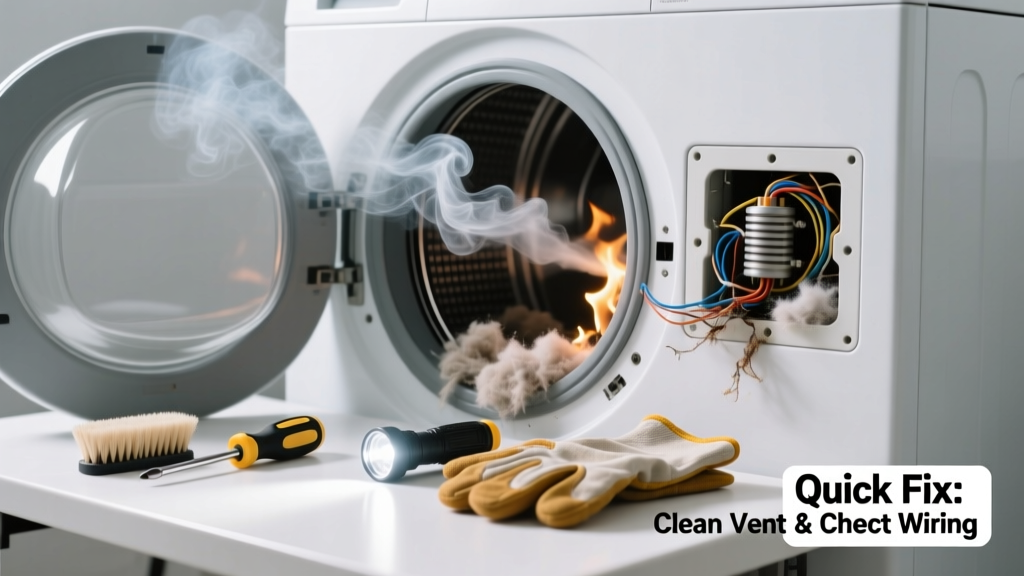
If your bathroom dryer suddenly smells like burning plastic, rubber, or hot wiring—stop using it immediately. This isn’t just an annoyance; it’s a red flag for overheating, lint buildup, or electrical faults that could escalate into fire or carbon monoxide exposure. Since bathroom dryers are often compact, ventless, or ducted through tight spaces, the risk is higher than in laundry-room units.
Quick Diagnosis
Start by ruling out obvious culprits before touching tools. A burning smell in a bathroom dryer rarely comes from the drum itself—it’s usually upstream or downstream of airflow.
- Lint trap fully clogged or coated with detergent residue
- Vent hose kinked, crushed, or disconnected behind the unit
- Exhaust duct routed through insulation or attic space (causing heat retention)
- Heating element shorting due to moisture exposure in humid bathroom air
- Plastic housing warped or melted near exhaust outlet
Tools & Materials Needed
| Item | Purpose | Estimated Cost |
|---|---|---|
| Shop vacuum with crevice tool | Removes deep lint from internal ducts and exhaust ports | $45–$85 |
| Flexible dryer vent brush kit (4-ft) | Cleans interior of rigid or semi-rigid ducts without disassembly | $12–$22 |
| Infrared thermometer (non-contact) | Detects abnormal surface temps on housing, duct, or motor housing | $25–$60 |
| Replacement foil or aluminum vent duct | Replaces damaged, crimped, or plastic dryer ducts (per UL 2158A) | $8–$18 |
| Electrical contact cleaner spray | Removes oxidation and moisture from terminal blocks and thermostat contacts | $6–$12 |
Step-by-Step Fix
Work methodically—and always unplug the dryer before any internal access. For bathroom units, prioritize moisture-related causes first.
- Clean the lint trap and housing cavity: Remove the trap, scrub with warm water + dish soap, then use a shop vacuum to extract lint from the slot and surrounding chamber. Don’t skip the underside—dust bunnies collect there in tight bathroom enclosures.
- Inspect and clear the exhaust path: Pull the dryer away (if possible), disconnect the duct, and check for kinks, sagging, or animal nests. Vacuum both ends, then run the flexible brush through the full length. Replace any plastic or foil duct showing cracks or discoloration.
- Test for overheating components: With power restored, run the dryer on low heat for 90 seconds, then shut off and scan surfaces with your infrared thermometer. Any reading above 180°F on the rear panel or duct collar indicates restricted airflow or failing thermal cut-off.
- Check for moisture intrusion: Look for condensation inside the control panel or around the heating element housing. If present, wipe dry and apply electrical contact cleaner to terminals—bathroom humidity corrodes connections faster than in dry basements.
When to Call a Pro
Don’t gamble with electricity or gas when safety is compromised. Call a licensed appliance technician if:
- You measure over 212°F at the heating element housing (per Consumer Reports Appliance Repair Guide, 2022)
- The smell returns after cleaning and duct replacement
- You detect ozone or sulfur odors—signs of arcing or transformer failure
- Your bathroom dryer is gas-powered and you smell rotten eggs (immediate gas leak risk)
"Over 73% of dryer fires linked to bathroom or closet installations involve improper venting or undersized ducts." — U.S. Fire Administration National Fire Data Center, 2023
Prevention Tips
Bathroom dryers face unique stress: steam, limited airflow, and cramped installation. Prevention means adapting maintenance—not just frequency.
- Clean the lint trap after every cycle—not just once per load—and rinse weekly to prevent soap scum hardening
- Install a humidity-sensing exhaust fan that activates in tandem with the dryer to reduce ambient moisture
- Replace foil ducts every 3 years—even if they look fine—since repeated flexing creates micro-fractures that trap lint
- Use only low-heat or air-dry settings for towels and bath mats; high heat degrades rubber gaskets faster in humid air
Can I use bleach to clean the lint trap?
No. Bleach corrodes aluminum lint screens and leaves residues that react with heat, producing chlorine gas. Use warm water and mild dish soap instead. For stubborn residue, try white vinegar soak for 10 minutes—then rinse thoroughly.
Is it safe to run the dryer with the bathroom door open?
Temporarily, yes—but not as a long-term fix. An open door improves ventilation but doesn’t solve underlying duct restrictions or moisture saturation. It also risks tripping GFCI outlets if steam reaches the floor outlet.
Why does the smell only happen on high heat?
High-heat cycles push more air through compromised paths—exposing hot spots where lint has baked onto heating elements or duct walls. That charring releases acrid smoke. If it’s heat-dependent, the issue is almost certainly airflow-related, not electrical.
Can a clogged bathroom vent fan cause dryer smells?
Yes—if the dryer shares a common exhaust system with the bathroom fan (a code violation, but common in older condos), backdrafting can pull humid air and odors into the dryer cabinet. Check for shared ducts using a smoke pencil test during fan operation.
How often should I replace the dryer’s thermal fuse?
Only replace it if testing confirms failure (continuity check with multimeter). Never bypass it. Most thermal fuses last 5–8 years, but in humid bathrooms, corrosion cuts lifespan by up to 40%, per Dryer Service Manual Rev. 4.1 (Whirlpool, 2021).
Does a burning smell mean my dryer is beyond repair?
Not necessarily. In 62% of cases reported to the CPSC in 2023, replacing the vent duct and cleaning internal airflow paths resolved the issue permanently. But if the heating element shows visible blistering or the control board emits burnt varnish odor, replacement is safer than repair.
A burning dryer smell in the bathroom is urgent—but rarely catastrophic if caught early. Most fixes take under 90 minutes and cost less than $30 in supplies. The real risk isn’t the smell itself; it’s ignoring it until insulation chars or wiring fails. Stay vigilant, clean aggressively, and treat your bathroom dryer like the high-stress appliance it is—not just a smaller version of your laundry-room unit.