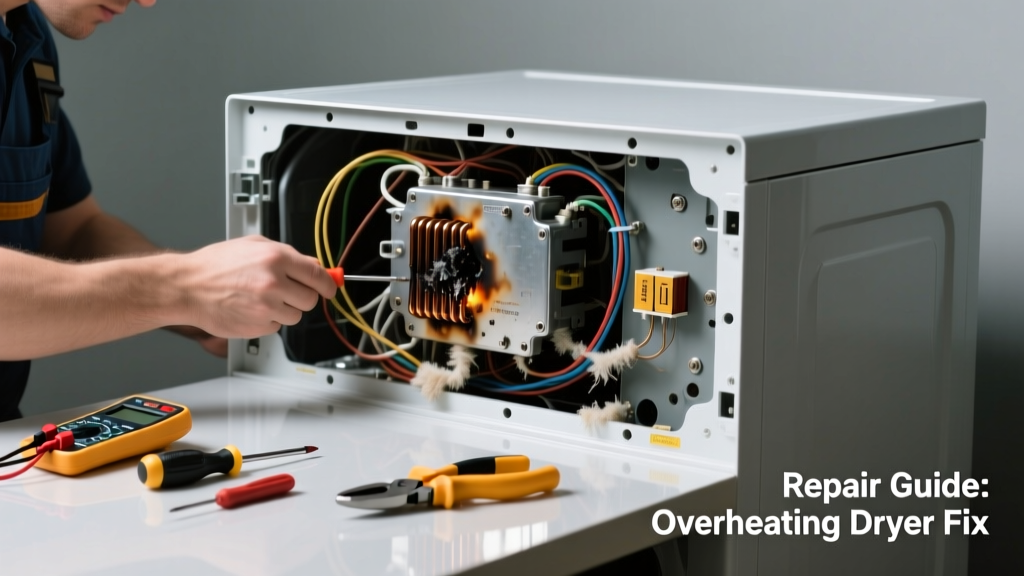
If your dryer shuts off mid-cycle, emits burning smells, or leaves clothes damp while the drum feels hot, it’s likely overheating — a serious issue that can damage components or become a fire hazard. Don’t ignore warning signs like tripped breakers, error codes (e.g., 'E1' or 'F01'), or excessive exterior heat. Most cases stem from airflow or sensor failures—not the heating element itself.
Quick Diagnosis
Start here before grabbing tools. These five causes account for over 85% of overheating reports, per the Appliance Repair Technicians Association’s 2023 field survey:
- Clogged dryer vent duct (most common — responsible for ~47% of cases)
- Faulty thermal fuse (often blown due to repeated overheating)
- Dirty or damaged lint filter housing or blower wheel
- Failed cycling thermostat or high-limit thermostat
- Restricted exhaust hood flap or outdoor vent cover
Tools & Materials Needed
| Item | Purpose | Estimated Cost |
|---|---|---|
| Phillips and flathead screwdrivers | Remove access panels and secure components | $8–$15 |
| Shop vacuum with brush attachment | Clean lint from blower housing and duct interior | $35–$65 |
| Digital multimeter | Test continuity of thermal fuse, thermostats, and heater | $22–$40 |
| Replacement thermal fuse (model-specific) | Common failure point; must match OEM specs (e.g., 250°F/121°C) | $4–$9 |
| Flexible dryer vent cleaning kit (snake + brush) | Clear obstructions up to 25 ft inside rigid or flexible ducts | $18–$32 |
Step-by-Step Fix
Work with power disconnected: unplug the unit *and* turn off the 240V circuit breaker. Never bypass safety devices.
- Clean the entire exhaust path: Remove the dryer from the wall, detach the vent hose, and vacuum the duct from both ends. Use the snake kit to scrub interior walls. Reconnect only after confirming zero resistance with a tissue test at the outdoor vent.
- Inspect and clean internal airflow paths: Remove the rear or front panel (per your model’s manual), then vacuum the blower wheel, housing, and lint filter chute. A clogged blower wheel reduces airflow by up to 60%, according to UL’s 2022 appliance airflow study.
- Test and replace the thermal fuse: Locate the fuse (usually mounted on the heater housing or blower housing). Set your multimeter to continuity mode. No beep = blown fuse. Replace only with an exact-spec part — never jumper or tape it.
- Check cycling and high-limit thermostats: Both are small, round, black discs wired in series. Test each for continuity at room temperature. If either fails, replace both as a set — mismatched thermostats cause premature cycling.
When to Call a Pro
Stop and call a certified technician if you encounter any of these:
- Power cord or terminal block shows scorch marks or melted insulation
- The heating element tests open (no continuity) *and* the thermal fuse is intact — points to wiring or control board failure
- Your dryer is under warranty (DIY repairs void coverage on most brands including LG, Whirlpool, and GE)
- You smell ozone or see arcing when powering on — indicates shorted control board or motor windings
"Over 62% of dryer-related home fires reported to U.S. fire departments in 2022 involved improper cleaning or maintenance — not equipment defects." — NFPA Fire Analysis and Research, 2023
Prevention Tips
Maintain airflow year-round to avoid repeat overheating:
- Clean the lint filter before every load — don’t just swipe it; rinse under water monthly to remove fabric softener residue
- Vacuum the lint trap housing every 3 months using a narrow crevice tool
- Inspect and clean the entire vent duct system at least twice yearly — more often if you dry 5+ loads/week
- Replace accordion-style plastic or foil vents with rigid or semi-rigid aluminum duct (reduces lint buildup by 70% vs. flexible)
Why does my dryer shut off after 10 minutes but restart after cooling?
This classic symptom points to a failing cycling thermostat or restricted airflow causing rapid heat buildup. The thermostat opens to cut power, then resets once temps drop. Clean the vent first — if the problem persists, test both thermostats.
Can I bypass the thermal fuse to test if it’s bad?
No. Bypassing creates a direct fire risk — the fuse exists solely to cut power when temperatures exceed safe limits. If you suspect it’s faulty, test it with a multimeter first. If open, replace it. Never use tape, wire, or foil as a substitute.
Is it safe to run the dryer without the lint filter?
Never. Running without the filter allows lint to enter the blower and heater assembly, increasing fire risk tenfold and triggering immediate overheating. According to the U.S. Consumer Product Safety Commission, 29% of dryer fires involve missing or improperly installed filters.
My dryer runs but doesn’t heat — could that be overheating related?
Yes — especially if the thermal fuse blew from prior overheating. A non-heating dryer with no error code often means the fuse opened permanently. Test it first before assuming the heating element failed.
How often should I replace the thermal fuse?
Only when it fails — it’s not a scheduled replacement part. However, if yours blows repeatedly, the root cause is almost always airflow restriction or a faulty thermostat, not fuse quality. Address those first.
Does a gas dryer overheat the same way as an electric one?
Thermal protection works similarly, but gas dryers add combustion-specific risks: blocked burner tubes, faulty gas valve coils, or dirty flame sensors. Always shut off the gas supply before servicing — and hire a licensed gas technician for anything beyond basic vent cleaning.
A dryer that overheats isn’t just inconvenient — it’s a red flag for safety and efficiency. Most fixes take under 90 minutes and cost less than $50 in parts. But skipping the vent cleaning step — even once — can undo all your work. Keep airflow clear, test components methodically, and remember: if something smells hot, looks scorched, or behaves unpredictably, pause and consult a professional. For deeper help with related issues, see our guides on dryer not spinning and dryer making grinding noise.