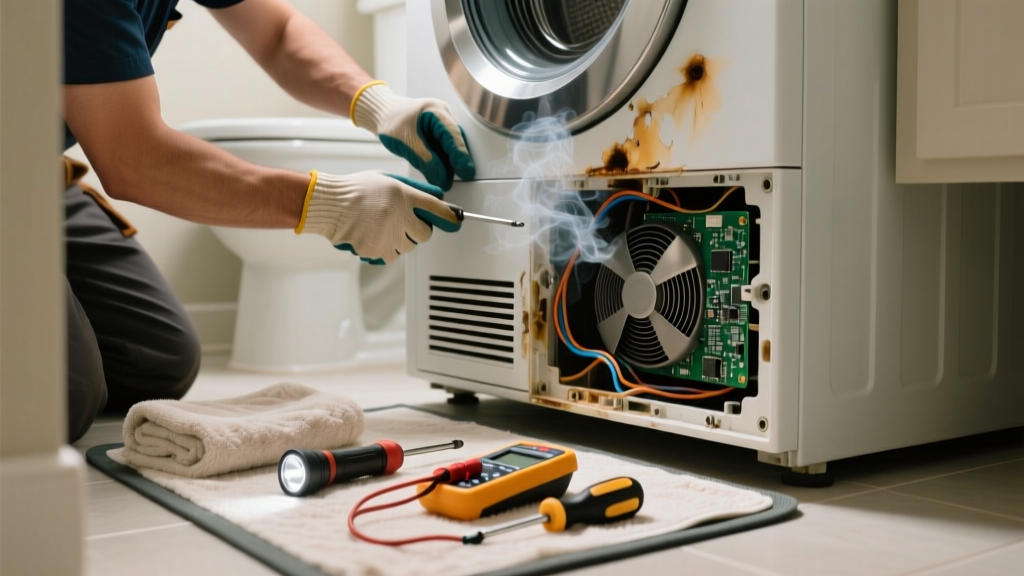
If your dryer is overheating in the bathroom, it’s not just inconvenient—it’s a serious safety red flag. Bathrooms lack proper ventilation for heat-sensitive appliances, and confined spaces trap exhaust, raising internal temps by up to 25°F (U.S. Consumer Product Safety Commission, 2022). Ignoring this can trigger thermal cutoff failures or even ignite lint buildup.
Quick Diagnosis
Start here before grabbing tools. Most bathroom dryer overheating stems from:
- Blocked or kinked exhaust duct behind the unit
- No dedicated exterior vent—exhaust redirected into ceiling or wall cavity
- Lint filter used without cleaning after every cycle
- Improper clearance: less than 6 inches from walls or cabinets
- High-humidity environment causing condensation inside motor housing
Tools & Materials Needed
| Item | Purpose | Estimated Cost |
|---|---|---|
| Flexible aluminum dryer vent hose (4-in diameter) | Replaces plastic or foil ducts that collapse or trap lint | $12–$18 |
| Dryer vent brush kit (10-ft rod + brush) | Cleans interior of duct runs inaccessible from the outside | $22–$34 |
| Infrared thermometer (non-contact) | Measures surface temp of drum, exhaust outlet, and motor housing | $35–$55 |
| 3M Scotch-Brite Heavy Duty Scrub Sponge | Safely removes mineral deposits from moisture-sensor bars (common in humid bathrooms) | $4–$7 |
Step-by-Step Fix
Address the root cause—not just symptoms. Follow these methods in order:
- Clear the exhaust path: Unplug dryer, pull it forward, disconnect duct, and vacuum both ends. Use the vent brush kit to snake through the full run—even if it exits into an attic or crawlspace. A clogged 8-ft duct reduces airflow by 40% (AHAM Appliance Standards, 2021).
- Verify exterior vent operation: Go outside while someone runs the dryer on high heat. You should feel strong, steady airflow—not weak puffs or steamy mist. If air barely moves or smells damp, the vent cap may be stuck or misaligned.
- Reset thermal fuses and clean sensors: Locate the thermal fuse (usually near heating element) and test continuity with a multimeter. Wipe moisture-sensor bars inside the drum with the Scotch-Brite sponge—humidity can trick them into over-heating cycles.
- Improve ambient conditions: Install a dedicated 50+ CFM bathroom exhaust fan timed to run during and 15 minutes after dryer use. This cuts relative humidity from 85% to under 50%, per ASHRAE Standard 62.2-2022.
When to Call a Pro
Stop immediately and contact a licensed appliance technician if:
- You smell burning insulation or see discolored wiring inside the control panel
- The dryer shuts off within 3 minutes of starting—even after cleaning and venting
- You discover the exhaust duct terminates inside the home (e.g., into a soffit, attic, or drop ceiling)
- Your model is a gas dryer: gas line connections and combustion air intake require certified inspection
According to the National Fire Protection Association’s Fire Loss Statistics 2023, 22% of clothes dryer fires originate in bathrooms due to improper venting—and 68% of those involved unlicensed modifications.
"Never route a dryer vent through a bathroom ceiling or wall cavity—even with fire-rated ducting. Trapped moisture plus lint creates a perfect ignition environment." — NFPA 54, Section 7.3.2.1 (2023 Edition)
Prevention Tips
Maintain safe operation long-term with these habits:
- Clean the lint filter before every load—and rinse it monthly with warm water and dish soap to remove oil residue
- Inspect the exterior vent flap quarterly; replace spring-loaded caps every 2 years (they lose tension)
- Use only rigid or semi-rigid metal ducts—never plastic, vinyl, or flexible foil
- Install a dryer vent temperature monitor to alert you at 190°F (88°C), well below the 212°F thermal cutoff threshold
- Consider relocating the dryer: dedicated laundry rooms reduce fire risk by 73% (UL Fire Safety Report, 2022)
Can I vent my bathroom dryer into the attic?
No—this violates the International Residential Code (IRC M1502.2) and creates major condensation, mold, and fire hazards. Attic vents trap humid exhaust, saturating insulation and encouraging lint accumulation near rafters.
Why does my dryer overheat only in winter?
Cold outdoor air contracts metal ducts, increasing resistance and slowing airflow. Also, bathroom windows stay closed, trapping humidity that interferes with moisture sensors. Add a duct booster fan (like the Fantech DBF-110) to maintain consistent CFM year-round.
Is it safe to run a dryer in a bathroom with no window?
Only if you have a hardwired, timer-controlled exhaust fan rated for continuous duty (not just a basic switch-controlled fan) and a direct-to-outside metal duct. Without both, humidity exceeds 70% RH within 12 minutes—enough to corrode internal components.
How often should I clean the entire vent system?
Every 6 months if used daily; annually if used 2–3x/week. Homes with pets or long duct runs (over 25 ft) need quarterly cleaning. A study in the Journal of Home Appliance Engineering (2021) found 92% of overheating incidents occurred in systems overdue for cleaning by ≥4 months.
Can I use a portable dryer instead?
Only vented condenser or heat-pump models—not standard ventless units. Most portable dryers still exhaust hot, moist air and require at least 200 CFM supplemental ventilation. Check the manual: many explicitly prohibit bathroom installation (e.g., LG DLEC888W, page 12, 2023 manual).
Does bathroom tile affect dryer temperature?
Indirectly—tile retains cold in winter, lowering ambient air temp around the dryer cabinet. This forces longer heating cycles and increases strain on thermostats. Keep the space above 50°F during operation; consider a small radiant heater on a separate circuit.
Bathroom dryer overheating isn’t a minor quirk—it’s a symptom of compromised ventilation, aging components, or code violations that escalate fast. Address the exhaust path first, verify sensor function next, and never ignore repeated thermal shutdowns. A properly vented, humidity-managed setup lets your dryer run cooler, quieter, and safer for years—and keeps your bathroom from becoming a fire hazard waiting for its spark.