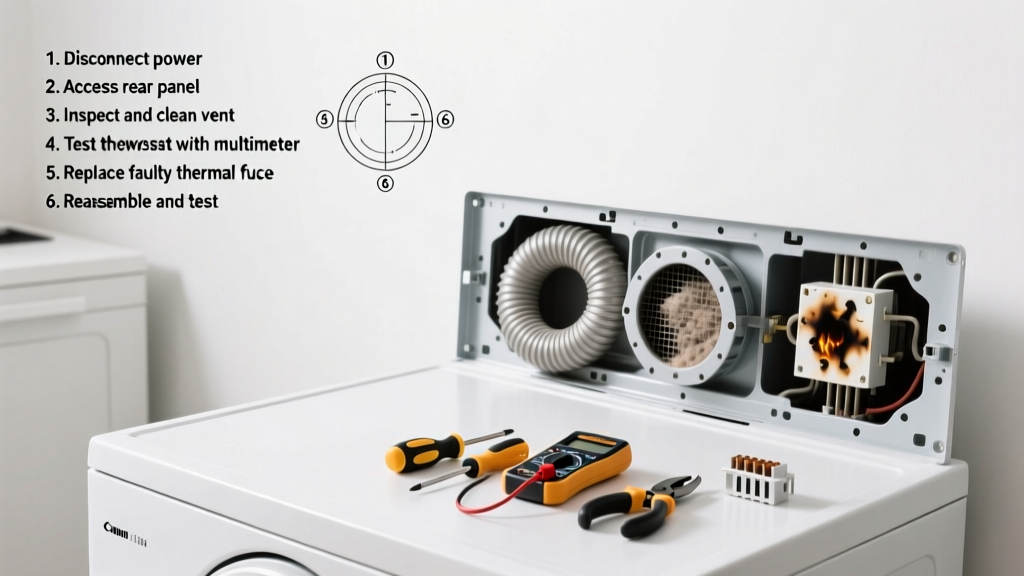
If your dryer shuts off mid-cycle, smells like burning rubber, or leaves clothes scorching hot, overheating isn’t just inconvenient—it’s a fire hazard. Most cases stem from simple, fixable issues like clogged vents or faulty thermostats, not doomed appliances.
Quick Diagnosis
Before grabbing tools, rule out the most common culprits:
- Lint buildup in the vent duct, exhaust hood, or internal blower wheel
- Faulty cycling thermostat (fails open or closed)
- Blocked or kinked 4-inch rigid metal vent pipe
- Worn-out thermal fuse (often triggered by prior overheating)
- Failed high-limit thermostat or heating element short
Tools & Materials Needed
| Item | Purpose | Estimated Cost |
|---|---|---|
| Shop vacuum with brush attachment | Cleans lint from drum housing, blower wheel, and exhaust duct | $35–$60 |
| Thermometer (infrared or probe) | Verifies exhaust temp—should be 120–155°F during operation | $18–$45 |
| Multimeter (digital, continuity mode) | Tests thermal fuse, thermostats, and heating element resistance | $22–$75 |
| Replacement thermal fuse (model-specific) | One-time-use safety device; must match OEM specs (e.g., 250°F) | $6–$12 |
| Flexible lint brush kit (12"–24") | Reaches deep into rigid ducts where vacuums can’t go | $14–$28 |
Step-by-Step Fix
Work with power disconnected (unplug or shut off breaker). Gas dryers require extra caution—shut off gas valve first.
- Clean the entire vent system: Remove the dryer from the wall, detach the vent hose, and vacuum both ends. Use the lint brush to scrub inside the rigid duct (especially elbows and wall caps). According to the U.S. Fire Administration’s 2022 report, 29% of home dryer fires start in the vent system due to lint accumulation.
- Inspect and clean internal components: Remove the rear or bottom access panel. Vacuum lint from the blower wheel housing and around the heating element. Wipe dust from the cycling thermostat (mounted on the blower housing) with a dry cloth—don’t bend its sensor arm.
- Test and replace the thermal fuse: Locate the fuse (usually near the heating element or exhaust duct). Set multimeter to continuity mode. No beep = blown fuse. Replace only with an exact OEM match—never bypass it.
"Bypassing a thermal fuse is like removing the smoke alarm from your dryer—it doesn’t fix heat; it removes the last line of defense." — Appliance Repair Technician Association, 2023 Safety Bulletin
- Check thermostat resistance: Test the cycling thermostat (should read ~0 ohms at room temp) and high-limit thermostat (same). If either reads infinite resistance or fluctuates, replace both—they’re often sold as a pair.
When to Call a Pro
Stop and call a certified technician if:
- You measure exhaust temperatures over 160°F consistently—even after full vent cleaning
- The heating element tests shorted to ground (multimeter shows continuity between terminal and metal chassis)
- Your dryer is under warranty or uses a proprietary control board (e.g., Samsung DV45K, LG DLEX3570V)
- You smell gas (for gas dryers) or see charring/melted wires behind the rear panel
Prevention Tips
Extend your dryer’s life and safety with these habits:
- Clean the lint screen before every load—and wash it monthly with warm soapy water to remove fabric softener residue
- Inspect and vacuum the entire vent path every 6 months (more often if drying heavy loads daily)
- Replace flexible plastic or foil vent hoses with rigid or semi-rigid aluminum duct (per International Residential Code R303.3)
- Never run the dryer while sleeping or away from home—overheating can ignite lint in under 5 minutes
Why does my dryer overheat only on heavy loads?
Heavy loads restrict airflow more than light ones, causing heat to build up faster. If your vent is already partially blocked or your blower wheel is sluggish, the added resistance pushes temps past safe limits. This is why cleaning the blower wheel and checking duct length (max 25 ft, minus 5 ft per elbow) matters most for large families. Dryer vent cleaning should be done annually—not just when problems appear.
Can I replace the thermal fuse myself?
Yes—if you’re comfortable using a multimeter and accessing internal components. But never substitute it with a higher-temperature rating or jumper wire. Thermal fuses are calibrated to fail at precise temps (usually 250°F or 300°F) to protect wiring insulation. Using the wrong part risks melting wire sheathing and starting a fire. Always cross-reference your model number on sites like RepairClinic.com or PartSelect before ordering.
Is it safe to use a dryer without a thermal fuse?
No. The thermal fuse is a non-resettable safety device designed to cut power permanently if temperatures exceed safe limits. Operating without one removes critical protection. Even if the dryer runs fine temporarily, a future blockage or thermostat failure could overheat the heating element to 600°F+—enough to ignite nearby lint or insulation. Replacing a dryer thermal fuse takes under 20 minutes but requires strict adherence to OEM specs.
What temperature should my dryer exhaust reach?
A properly functioning electric dryer exhaust should register 120–155°F at the exterior vent hood during a medium-load cotton cycle. Gas dryers typically run 135–160°F. Temperatures above 160°F indicate restricted airflow or failing controls. Use an infrared thermometer—you’ll spot anomalies faster than waiting for shutdowns. The EPA estimates that 14% of household energy waste comes from inefficient dryers, many due to poor venting.
My dryer overheats but doesn’t shut off—what’s wrong?
This suggests the cycling thermostat or high-limit thermostat has failed in the closed position (stuck on), allowing continuous heating. It may also mean the thermal fuse blew but was improperly bypassed. Either way, the safety system isn’t interrupting power as designed. Unplug immediately and test both thermostats with a multimeter. If either lacks continuity at room temp—or shows continuity when heated past spec—it must be replaced. Don’t delay: continued operation risks igniting accumulated lint inside the cabinet.
Can a clogged lint filter cause overheating even if the vent is clean?
Absolutely. A coated or damaged lint screen reduces airflow by up to 75%, forcing the blower motor to work harder and trapping heat in the drum. Fabric softener residue builds up over time, creating a waxy film that blocks airflow. Wash the screen monthly with vinegar and a soft brush—how to clean a dryer lint screen properly—and replace it every 3–5 years if warped or torn.
Overheating dryers rarely mean it’s time for a new appliance—just time to restore airflow and verify safety controls. Most repairs take under an hour, cost less than $30 in parts, and prevent far costlier hazards. Stay consistent with maintenance, and your dryer will run cooler, faster, and safer for years longer.