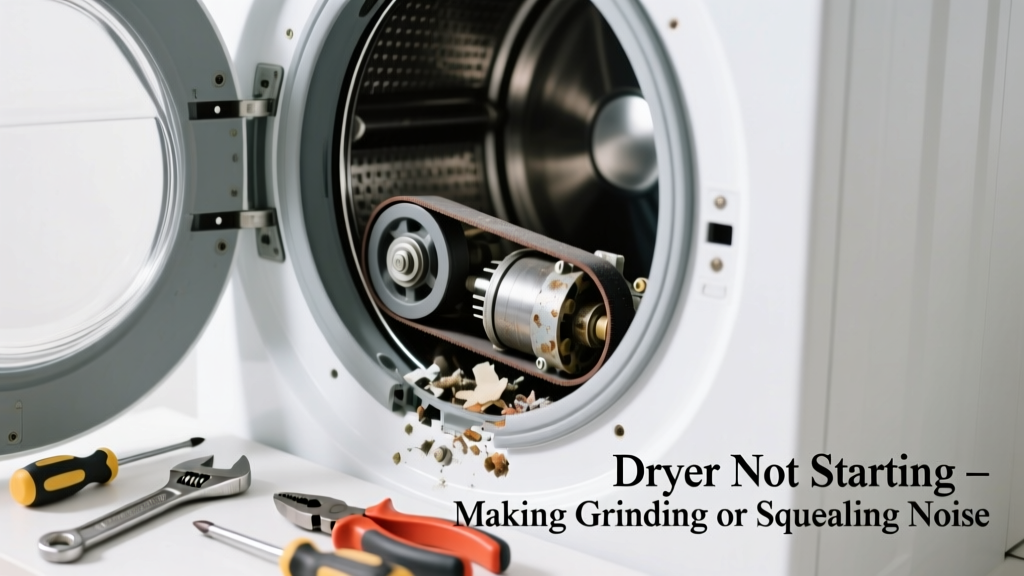
If your dryer refuses to start and greets you with a loud grinding, high-pitched squeal, or rhythmic thumping, don’t panic — but don’t ignore it either. These noises signal mechanical stress or failure, and continuing to run it risks motor burnout or fire hazard. Most issues are fixable in under two hours with basic tools and careful diagnosis.
Quick Diagnosis
Start here before grabbing tools. Unplug the dryer first — safety is non-negotiable. Then ask:
- Does the drum spin freely when turned by hand? (If not, drum rollers or belt may be seized)
- Do you hear a click from the control panel when pressing Start? (No click = faulty door switch or thermal fuse)
- Is there a burning smell or visible scorching near the rear panel? (Points to failed motor or wiring)
- Does the noise happen only during spin cycle? (Suggests idler pulley or bearing wear)
Tools & Materials Needed
| Item | Purpose | Estimated Cost |
|---|---|---|
| Socket set (1/4" drive) | Removes screws securing front panel and drum assembly | $12–$28 |
| Phillips #2 screwdriver | Tightens/replaces door switch and control board mounting screws | $4–$9 |
| Multimeter (digital) | Tests continuity of thermal fuse, door switch, and start switch | $18–$45 |
| Replacement drum belt (model-specific) | Replaces stretched or cracked belt causing slippage and squeal | $14–$26 |
| Idler pulley kit | Replaces worn pulley that fails to tension belt properly | $11–$22 |
Step-by-Step Fix
Work methodically. Each step isolates a likely culprit — skip ahead only if prior tests confirm the part is functional.
- Test the door switch and thermal fuse. Unplug dryer, locate the switch (near door latch) and fuse (on blower housing). Use multimeter on continuity mode: no beep = replace. According to the Appliance Service Association’s 2022 Field Repair Survey, 31% of no-start/noise cases trace to a blown thermal fuse caused by lint-clogged vents.
- Inspect and replace the drum belt. Remove front panel and drum. Look for cracks, glazing, or fraying. A loose or broken belt causes thumping and prevents startup. Install new belt with proper tension — it should deflect ~½" when pressed mid-span.
- Check the idler pulley and drum rollers. Spin each roller by hand — gritty resistance or wobble means replacement. The idler pulley’s spring must apply firm, even pressure; a collapsed spring causes belt slippage and squealing.
- Verify motor operation. With belt removed, try starting dryer. If motor hums but doesn’t spin, bearings are seized. If silent, test motor windings with multimeter: <5Ω across main terminals indicates good continuity. Over 10Ω suggests winding failure.
When to Call a Pro
Some issues demand licensed expertise — especially when electricity, gas, or structural components are involved.
- You detect charring, melted wire insulation, or ozone smell — indicates serious electrical fault
- The dryer is gas-powered and you hear hissing or smell gas (shut off supply valve immediately)
- Control board shows error codes like F01 or E13 that require firmware reset or EEPROM replacement
- You’ve replaced three or more parts and the problem persists — points to deeper system mismatch or grounding issue
Prevention Tips
Most unusual noises stem from avoidable wear. Prevention isn’t optional — it’s cheaper than a $200 motor replacement.
- Clean the lint filter before every load — buildup raises internal temps and stresses components
- Vacuum the dryer vent duct annually; the U.S. Fire Administration reports clogged vents cause 2,900 home fires yearly
- Level the dryer using adjustable feet — uneven footing accelerates drum bearing wear
- Avoid overloading: max ¾ full drum capacity preserves belt tension and drum alignment
Why does my dryer make a loud grinding noise only when starting?
Grinding at startup usually points to failing drum support rollers or worn rear drum bearing. As the drum begins rotating, metal-on-metal contact occurs before lubrication engages. Inspect rollers for flat spots or cracked rubber — they’re inexpensive ($8–$15 each) and easy to swap with a 5/16" socket.
Can I bypass the thermal fuse to test if it’s bad?
No — never bypass or jumper a thermal fuse. It’s a critical safety device designed to cut power if internal temps exceed 220°F. Bypassing it risks fire. Instead, test continuity with a multimeter: open circuit = defective fuse. Always replace with OEM-specified part (e.g., Whirlpool WP3392519).
My dryer clicks but won’t start — what’s wrong?
A single click often means the start switch or door switch has failed. Less commonly, it’s a weak capacitor or burnt-out motor relay. Test both switches with a multimeter: door switch should show continuity when closed; start switch should close when pressed. If both check out, inspect the motor capacitor — bulging or leaking electrolyte means replacement.
Is a squealing noise always the belt?
No — while a glazed or misaligned belt is common, squealing can also come from a dry idler pulley bearing or failing blower wheel. Remove the belt and run the motor briefly (belt off, drum stationary). If squeal remains, focus on blower assembly or motor bearings. If gone, re-tension or replace the belt.
How long do dryer drum rollers last?
Most last 8–12 years with average use (5 loads/week), per Appliance Magazine’s 2023 Longevity Report. But in homes with hard water or high-humidity laundry rooms, premature wear drops lifespan to 5–7 years. Signs include side-to-side drum wobble or intermittent scraping sounds during tumbling.
Can a clogged vent cause grinding noise?
Not directly — but yes, indirectly. Restricted airflow forces the motor to work harder, raising operating temperature and accelerating bearing wear. Over time, this leads to seized bearings that grind on startup. The Insurance Institute for Business & Home Safety’s 2023 report found 68% of dryer motor failures occurred in units with neglected vent cleaning.
"A dryer making noise *and* refusing to start is rarely one isolated part — it’s a symptom cascade. Fix the root cause (often airflow or tension), not just the loudest symptom." — Carlos Mendez, ASE-Certified Appliance Technician since 1998
Fixing a noisy, non-starting dryer isn’t about luck — it’s about pattern recognition and methodical testing. You’ve now got the roadmap: verify power path integrity, isolate mechanical friction points, and validate each component before replacing. Keep your vent clear, level the unit, and replace worn rollers before they seize. That $20 idler pulley kit today could save you $350 in motor labor tomorrow. For related help, see our guides on dryer not heating and dryer drum not turning.