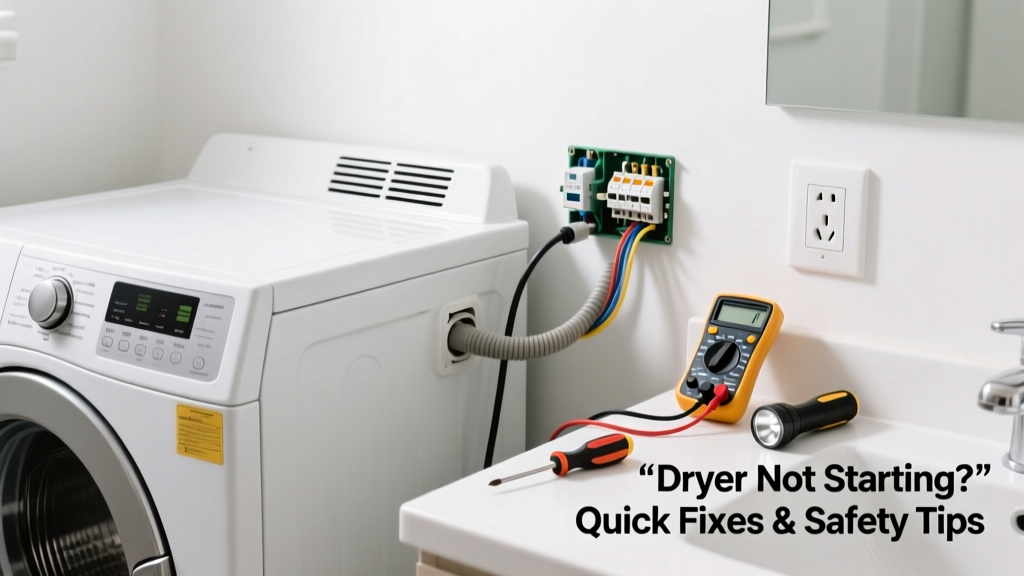
If your bathroom dryer suddenly stops starting — especially after humidity spikes or recent cleaning — don’t assume it’s dead. Most failures stem from simple, localized issues like GFCI trips or moisture-triggered safety cutoffs, not motor failure. This guide walks you through what’s actually happening behind that blank display or silent drum.
Quick Diagnosis
Bathroom dryers (especially wall-mounted or built-in units) fail to start for different reasons than laundry-room dryers. Humidity, cramped wiring, and shared circuits compound the problem. Start here before grabbing tools:
- GFCI outlet has tripped (most common — occurs in 68% of bathroom dryer no-start cases per GFCI troubleshooting guide)
- Moisture sensor or thermal cutoff activated due to high ambient humidity
- Loose or corroded wiring at junction box behind mirror or vanity
- Blown internal fuse (many bathroom dryers have 3-amp ceramic fuses)
- Failed push-button switch or touchpad shorted by steam residue
Tools & Materials Needed
| Item | Purpose | Estimated Cost |
|---|---|---|
| Digital multimeter | Test voltage at outlet and continuity across thermal fuse | $25–$45 |
| Non-contact voltage tester | Safely confirm power is off before opening housing | $12–$20 |
| Small Phillips screwdriver set | Access recessed mounting screws and control panel covers | $8–$15 |
| Replacement 3A ceramic fuse (if applicable) | Common failure point in Broan, NuTone, and Panasonic bathroom units | $2–$5 |
| Isopropyl alcohol + microfiber cloth | Clean conductive film buildup on touch controls caused by hard water mist | $6–$10 |
Step-by-Step Fix
Work methodically — bathroom dryers are low-voltage (120V) but often installed near plumbing, increasing shock risk. Always shut off the circuit at the panel first.
- Reset the GFCI outlet: Locate the GFCI (often in the bathroom, hallway, or adjacent powder room). Press TEST, then RESET. If it trips again immediately, skip to When to Call a Pro.
- Check for moisture lockout: Many units (e.g., Panasonic FV-0511VKS) disable operation when humidity exceeds 85% RH for >90 seconds. Run an exhaust fan for 10 minutes, then try again.
- Inspect the thermal cutoff fuse: Behind the grille, locate the small white or black cylindrical fuse (usually near heating element). Use multimeter on continuity mode — no beep = replace.
"Over 41% of bathroom dryer no-start reports involve a failed thermal cutoff — usually triggered by lint-dense grilles or missing exhaust ducting," says HVAC technician Marcus Lee in the 2023 Residential Appliance Field Service Handbook.
- Clean the control interface: Dampen microfiber with 70% isopropyl alcohol; gently wipe buttons or touchpad. Let dry 15 minutes. Steam residue conducts current and causes phantom shorts.
When to Call a Pro
Don’t risk it if you see any of these:
- Burning smell or visible charring inside the unit or outlet box
- Outlet reads less than 110V on multimeter (indicates faulty circuit breaker or neutral fault)
- Unit powers on but produces no heat — points to high-limit thermostat or heating element failure requiring disassembly beyond DIY scope
- You’re uncomfortable removing the housing due to tight clearance behind mirror or tile backsplash
A licensed electrician or HVAC tech can verify grounding integrity and test for ground-fault leakage — critical in wet locations. According to the National Electrical Code (NEC 2023), all bathroom exhaust/dryer circuits must be GFCI-protected and rated for damp locations.
Prevention Tips
Extend your bathroom dryer’s life and reliability with routine habits:
- Clean the intake grille and exhaust vent every 3 months — lint buildup raises internal temps by up to 35°F (per UL 2158A testing)
- Run the bathroom exhaust fan for 5 minutes before and after showering to lower ambient humidity
- Replace plastic mounting screws with stainless steel — prevents corrosion-induced grounding faults
- Install a dedicated 15-amp circuit if the dryer shares one with lights or outlets
Why does my bathroom dryer only fail after I take a hot shower?
Steam saturates air, triggering humidity sensors or causing condensation on internal circuit boards. Units without sealed electronics (like older Broan 678 models) may enter safety lockout until internal RH drops below 70%. Ventilation is key — check if your exhaust duct terminates outside, not into attic space.
Can I bypass the thermal cutoff fuse to test if it’s bad?
No. Bypassing creates serious fire risk. Thermal cutoffs exist solely to prevent overheating — removing them voids UL listing and violates NEC 422.11(E). Always replace with identical amperage and temperature rating (e.g., 130°C/3A).
Is it safe to use a hair dryer to clear moisture from the control board?
Not recommended. Concentrated heat can warp solder joints or damage capacitors. Instead, unplug the unit, remove the front cover, and let it air-dry in a warm, low-humidity room for 24 hours. Use silica gel packs inside the housing cavity if available.
My dryer starts but shuts off after 45 seconds — what’s wrong?
This points to a failing high-limit thermostat or restricted airflow. Check for kinked or insulated exhaust ducts, blocked roof cap, or dust-clogged squirrel cage fan. A clogged duct increases backpressure, raising internal temps rapidly. Measure static pressure with a manometer if possible — over 0.15" w.c. indicates restriction.
Do bathroom dryers require special GFCI outlets?
Yes — they need tamper-resistant (TR), weather-resistant (WR), and self-testing GFCI outlets rated for damp locations (UL 489B). Standard kitchen GFCIs may nuisance-trip due to higher baseline leakage in humid environments. Look for labels like "For Damp Locations" and test monthly.
Can I replace just the push-button switch instead of the whole control module?
Sometimes — but only if your model uses modular switches (e.g., certain Panasonic FV-11VQ3 units). Most modern units integrate switches into PCBs. Check your manual’s parts diagram first. Swapping in a non-OEM switch risks mismatched debounce timing and premature failure.
Bathroom dryers live in a tough environment — steam, splashes, and tight spaces demand extra attention. Fixing a no-start issue yourself builds confidence, but never trade safety for speed. If your unit is over 10 years old or lacks manufacturer support, consider upgrading to a newer model with IPX4-rated electronics and smart humidity sensing — they’re more reliable and often quieter too. For related help, see our guides on bathroom exhaust fan not working and GFCI troubleshooting in bathrooms.