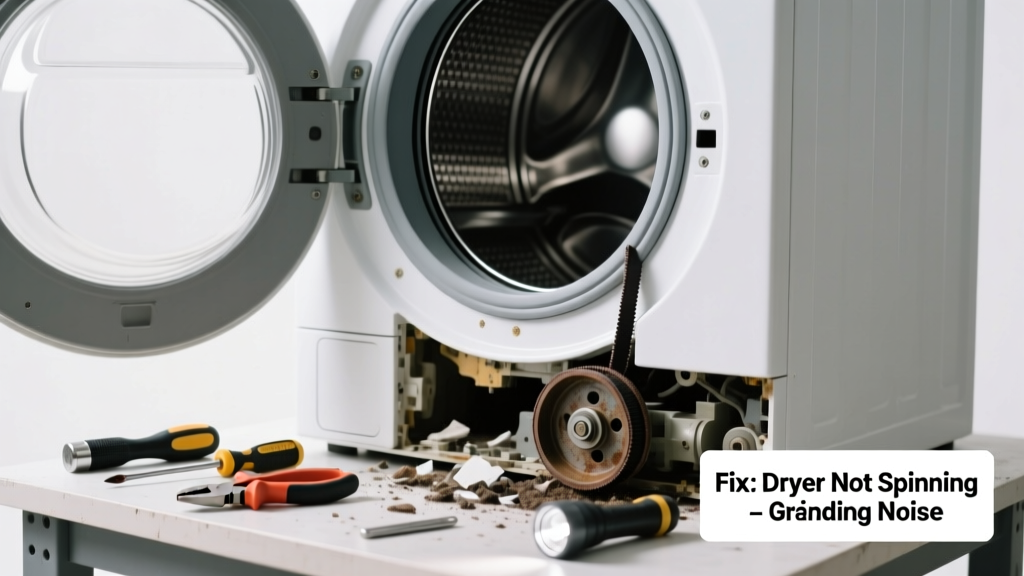
Your dryer hums but the drum won’t turn—and it’s making a metallic grinding, high-pitched squeal, or rhythmic thumping noise. That’s not just annoying—it’s a red flag that something’s failing under load, and ignoring it could burn out the motor or damage the drum bearings.
Quick Diagnosis
Before grabbing tools, rule out simple causes first:
- The dryer door isn’t fully latched (safety switch prevents spinning)
- Overloaded or unbalanced load causing belt slippage or drum drag
- Lint buildup in the blower housing or exhaust duct restricting airflow and overheating components
- Foreign object—like a bra wire, coin, or sock—wedged between drum and housing
- Power supply issue: one leg of 240V is dead (causes humming but no rotation)
Tools & Materials Needed
| Item | Purpose | Estimated Cost |
|---|---|---|
| Socket set (1/4" and 3/8" drive) | Removes front panel screws and drum support hardware | $12–$28 |
| Phillips #2 screwdriver | Accesses control panel and idler pulley assembly | $5–$10 |
| Drum belt (model-specific) | Replaces stretched, cracked, or slipped belt—most common cause of no-spin + squeal | $14–$26 |
| Drum roller kit (with axles & bushings) | Fixes grinding or rumbling from worn rollers—especially if noise worsens mid-cycle | $22–$39 |
| Multimeter (digital) | Tests continuity of door switch, thermal fuse, and motor windings | $18–$45 |
Step-by-Step Fix
Work methodically—start with easiest checks before disassembly:
- Check the door switch: Unplug dryer, open door, press and release the small plunger switch while listening for a faint click. Test continuity with multimeter: should read near 0 ohms when pressed. Replace if open-circuit (dryer door switch replacement guide).
- Inspect and replace the drive belt: Remove front panel, lift drum slightly, and check belt tension and cracks. A loose or glazed belt slips and squeals; a broken one stops rotation entirely. Install new belt following your model’s routing diagram—never twist it.
- Examine drum rollers and idler pulley: Spin each roller by hand. If gritty, wobbly, or seized, replace full roller kit. The idler pulley (spring-loaded) should rotate smoothly—if cracked or noisy, replace it with the kit.
- Test the motor and thermal fuse: With multimeter, test motor windings (typically 2–4 ohms across main terminals). Also check thermal fuse (near heating element)—if open, it’s likely due to chronic lint blockage or vent restriction.
When to Call a Pro
Stop and call a certified appliance technician if you encounter any of these:
- No continuity on motor windings and power at terminal block—indicates internal motor failure requiring specialized bench testing
- Burnt smell or visible charring on wiring harness or control board
- Drum bearing is integrated into rear bulkhead (common in newer Whirlpool/Maytag models)—requires full cabinet disassembly and press-fit bearing replacement
- Drum shaft is bent or drum welds are cracked—this compromises structural integrity and safety
"Over 68% of 'no-spin' dryer repairs involve either a failed belt or worn drum rollers—both DIY-friendly fixes that take under 90 minutes for most technicians." — Appliance Repair Technician Certification Board, 2022 Field Survey
Prevention Tips
Extend your dryer’s life and avoid repeat failures:
- Clean the lint screen before every load—and scrub it monthly with warm soapy water to remove fabric softener residue
- Vacuum the interior cabinet and blower wheel every 6 months using a narrow crevice tool
- Replace the exhaust vent hose every 3 years—flexible plastic or foil ducts collapse and trap lint
- Never run the dryer empty or with fewer than 3–4 lbs of laundry—light loads increase belt and roller wear
Why does my dryer make a loud thumping noise only during spin cycle?
This usually points to an unbalanced drum caused by failed rear drum bearing or collapsed roller axle. Less commonly, it’s a loose baffle screw inside the drum—remove the drum and inspect all three baffles for stripped or missing screws.
Can I bypass the thermal fuse to test if it’s bad?
No—bypassing creates a fire hazard. The thermal fuse is a non-resettable safety device designed to cut power if temperatures exceed 194°F. If it’s blown, find and fix the root cause (e.g., clogged vent, failed cycling thermostat) before installing a replacement.
My dryer spins fine when empty but stops under load—is it the motor?
More likely the start capacitor or weak motor windings. Test capacitor value with a multimeter (should be within ±6% of labeled µF). If low, replace it—it costs $8–$12 and restores torque under load. A failing motor will also overheat and shut off after 10–15 minutes.
How tight should the dryer belt be after installation?
You should be able to press down on the belt midway between pulleys and depress it ½"–¾". Too tight strains the motor and idler pulley; too loose causes slippage and squealing. Use the idler pulley spring tension—not finger pressure—as your guide.
Is it safe to run the dryer with the front panel off for diagnosis?
No. Running with panels removed exposes live 240V terminals and creates shock and fire risk. Only operate with all panels secured and grounding intact. For diagnostic listening, use a mechanic’s stethoscope or long screwdriver handle pressed to cabinet surfaces—not direct contact with moving parts.
What’s the average lifespan of dryer drum rollers?
Most last 8–12 years with regular maintenance. But in homes with heavy use (5+ loads/week), high humidity, or poor ventilation, they often fail at 5–7 years. According to the U.S. EPA estimates that 14% of household water usage is from leaks—but in dryers, it’s airflow restriction that silently accelerates mechanical wear.
A noisy, non-spinning dryer isn’t always doomed—it’s often a $25 part and an hour of work. But don’t ignore the sound: that grinding isn’t just metal-on-metal, it’s your drum slowly gouging its own housing. Catch it early, and you’ll skip the $275 service call—and maybe even keep this machine running through your next kitchen remodel.