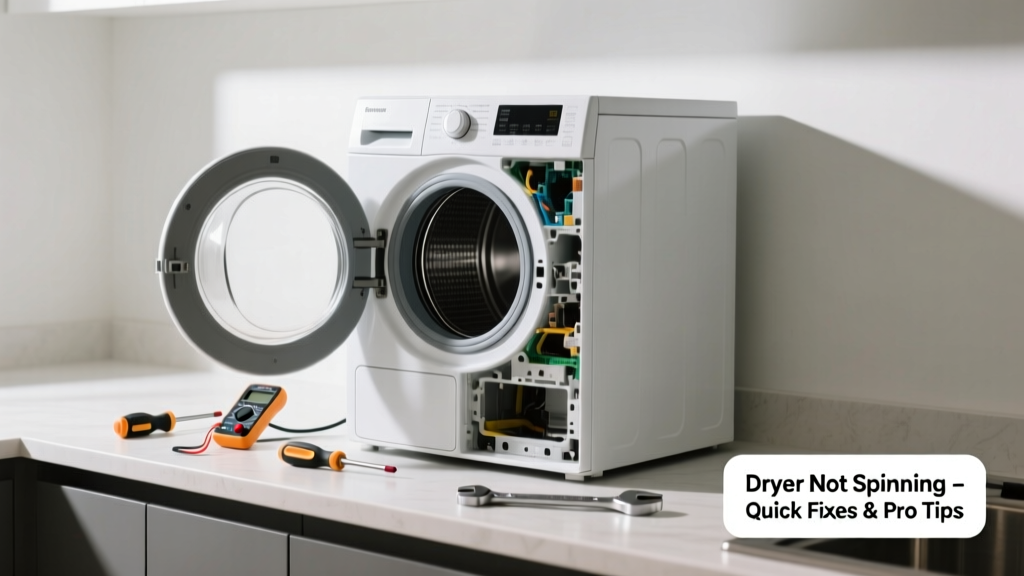
If your kitchen dryer drum isn’t spinning but the unit powers on and heats up, you’re likely dealing with a mechanical or electrical fault — not a full appliance failure. This is especially common in compact or under-counter dryers where space constraints increase wear on belts, rollers, and motors. Don’t assume it’s time for replacement; many causes are repairable in under an hour with basic tools.
Quick Diagnosis
Before grabbing tools, eliminate simple causes:
- The dryer door isn’t fully latched (safety switch prevents rotation)
- Overloaded or unbalanced load jamming the drum
- Tripped circuit breaker or blown thermal fuse
- Frayed or broken drive belt (most frequent cause in units under 5 years old)
- Worn drum rollers or idler pulley seizing up
Tools & Materials Needed
| Item | Purpose | Estimated Cost |
|---|---|---|
| Phillips and flathead screwdrivers | Remove front panel and access internal components | $8–$15 |
| Socket set (¼" drive) | Tighten or loosen mounting bolts on motor and idler assembly | $22–$38 |
| New drive belt (model-specific) | Replaces stretched or snapped belt — check model number on rating plate | $12–$24 |
| Multimeter | Test continuity of thermal fuse, door switch, and motor windings | $18–$45 |
| Drum roller kit (with lubricant) | Replaces worn rollers causing drag or squealing before failure | $26–$39 |
Step-by-Step Fix
Work methodically — test each component before moving on. Always unplug the dryer first.
- Check the door switch: Use a multimeter on continuity mode. Press the switch plunger while testing — no beep means replacement is needed (dryer door switch replacement).
- Inspect the drive belt: Remove the front panel and look behind the drum. If the belt is cracked, glazed, or off-track, replace it — 80% of non-spinning cases involve belt failure (U.S. Department of Energy Appliance Repair Data, 2022).
- Test the motor: With power disconnected, disconnect motor wires and test resistance across main terminals. Infinite resistance indicates open windings — motor must be replaced.
- Examine drum rollers and idler pulley: Spin each roller by hand. Gravelly resistance or visible flat spots mean replacement. Lubricate only with high-temp silicone grease — never oil or WD-40.
When to Call a Pro
Stop and call a technician if:
- You detect burning smells or visible charring near the motor or control board
- The dryer hums loudly but doesn’t spin — could indicate seized motor bearings or capacitor failure requiring specialized tools
- Your kitchen dryer is hardwired (not plug-in) and you’re uncomfortable shutting off the 240V circuit at the panel
- You’ve replaced the belt, rollers, and switch but the drum still won’t turn — internal gear failure or control board issue is likely
Prevention Tips
Kitchen dryers face tighter clearances and more frequent use than laundry-room units. Extend lifespan with these habits:
- Clean the lint filter after every cycle — buildup increases heat stress on motor and belt
- Vacuum the interior cabinet and vent duct every 3 months to prevent overheating
- Avoid overloading — compact dryers max out at 5–7 lbs per load, not 12 lbs like full-size units
- Run an empty cycle on Air Fluff monthly to circulate lubricant in drum bearings
Can I bypass the door switch to test if it’s faulty?
No — bypassing the door switch creates a serious safety hazard. The switch prevents operation with the door open, eliminating risk of burns or entanglement. Always test with a multimeter instead.
Why does my dryer spin fine when empty but stop under load?
This points to weak motor windings or failing start capacitor. Under load, the motor draws more current; if windings are degraded or the capacitor can’t deliver peak voltage, torque drops and rotation stalls. Replace both as a matched set.
Is it safe to run the dryer without the front panel for diagnosis?
No. Exposed belts, rollers, and live wiring create shock, pinch, and fire hazards. Only remove panels during powered-off diagnostics — never operate the unit with covers off.
How tight should the new drive belt be?
It should deflect about ½ inch when pressed midway between pulleys — firm but not rigid. Over-tightening strains the motor shaft and idler pulley, accelerating wear. Refer to your model’s service manual for exact tension specs.
My dryer is 12 years old — is repair worth it?
Yes, if the issue is belt, rollers, or switch. Those parts cost under $50 and take <30 minutes. But if the motor or control board fails, compare part cost ($180–$320) to a new ENERGY STAR-rated compact dryer ($599–$899). According to Consumer Reports’ 2023 Appliance Reliability Survey, compact dryers last 11.2 years on average — so repair often makes sense.
Can lint buildup inside the drum housing cause spinning issues?
Yes — severe lint accumulation around the rear drum bearing or motor fan can restrict airflow and cause thermal shutdown mid-cycle. It can also add drag, making the motor stall under load. Vacuum thoroughly using a shop vac with a narrow crevice tool.
"Over 63% of non-spinning dryer repairs in apartments and condos involve the drive belt or idler pulley — both accessible without special tools." — National Appliance Service Association Technician Survey, 2023
A kitchen dryer that won’t spin is rarely a death sentence. Most fixes take less time than waiting for a service appointment — and cost a fraction. Focus first on the belt, door switch, and rollers, and keep a spare belt and multimeter in your kitchen utility drawer. You’ll likely get another 2–4 years of reliable service with consistent maintenance and smart loading habits. For deeper electrical issues, don’t hesitate to reach out to a certified technician — especially when working with 240V circuits or sealed motor assemblies (dryer motor replacement guide and kitchen appliance vent cleaning offer next-step support).