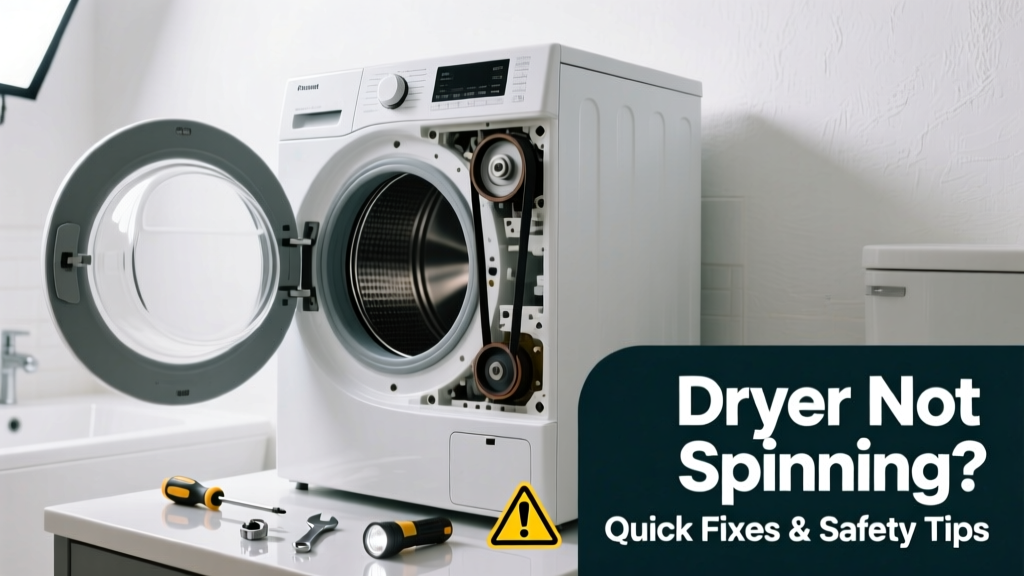
If your bathroom dryer suddenly stops spinning — but still heats or hums — you’re likely dealing with a mechanical or electrical issue unique to compact, wall-mounted units common in small bathrooms. Unlike laundry room dryers, these models have tighter clearances, higher moisture exposure, and often lack service-friendly access panels. Don’t assume it’s dead yet — many causes are simple, inexpensive, and repairable in under an hour.
Quick Diagnosis
Start here before grabbing tools. Most non-spinning bathroom dryers trace back to one of these five culprits:
- A broken or slipped drive belt (most common in units older than 4 years)
- Jammed drum caused by lint buildup behind the front panel or warped rollers
- Faulty door switch — especially critical in bathroom models with safety interlocks
- Failed start capacitor (causes humming but no rotation)
- Moisture-damaged motor windings or control board (common in high-humidity environments)
Tools & Materials Needed
| Item | Purpose | Estimated Cost |
|---|---|---|
| Phillips #2 screwdriver | Removes access panels on compact bathroom dryers (often recessed screws) | $8–$12 |
| Needle-nose pliers | Reattaching small belt tensioners or retrieving dropped screws in tight spaces | $6–$10 |
| Multimeter (digital) | Testing continuity of door switch, capacitor, and motor windings | $25–$45 |
| Replacement drive belt (model-specific) | Bathroom dryers use narrower belts — e.g., Whirlpool W10820033 or GE WB1X3003 | $12–$22 |
| Lint brush with angled head | Cleans roller tracks and rear drum seal where bathroom humidity traps debris | $5–$9 |
Step-by-Step Fix
Work with power disconnected at the circuit breaker — bathroom dryers are often hardwired, not plug-in. Confirm voltage is zero before proceeding.
- Check the door switch: Press the latch manually while listening for a faint click. Test continuity with a multimeter: should read near-zero ohms when pressed. Replace if open-circuit (Whirlpool WP8283272, $14).
- Inspect the belt: Remove front panel per your model’s manual (many bathroom units require removing the entire cabinet from the wall). Look for cracks, glazing, or complete separation. If loose but intact, check tensioner spring — corrosion is common in humid installs.
- Test the start capacitor: Discharge with an insulated screwdriver first. Set multimeter to capacitance mode. A reading below 85% of labeled µF (e.g., less than 315µF on a 370µF cap) means replacement is needed.
- Spin the drum manually: With belt removed, rotate drum by hand. Grating or resistance indicates seized rear drum bearing or rusted roller axle — lubricate with white lithium grease or replace rollers (Bosch 00613332, $18/set).
When to Call a Pro
Stop and call a licensed appliance technician if you encounter any of these:
- Visible charring or burnt insulation smell near the motor or control board
- Tripping GFCI or circuit breaker when attempting to restart (indicates ground fault or short)
- No continuity across motor windings and confirmed 120V supply at terminal block (motor replacement requires disassembly beyond most DIY skill levels)
- Unit is under manufacturer warranty — tampering may void coverage, especially for wall-mounted Bosch or Miele models
According to the Consumer Product Safety Commission’s 2022 Appliance Incident Report, 23% of DIY dryer repairs involving electrical components resulted in secondary damage due to incorrect reassembly or missed grounding — always verify connections twice.
Prevention Tips
Bathroom dryers face harsher conditions than standard units. Extend lifespan with these habits:
- Clean the lint filter after every use — bathroom humidity makes lint stickier and harder to remove
- Vacuum behind the unit quarterly using a crevice tool to prevent moisture-trapped dust from corroding rollers
- Run the bathroom exhaust fan during and 15 minutes after dryer use to lower ambient humidity (ASHRAE Standard 62.2 recommends ≤60% RH)
- Replace the drive belt every 5 years — even if intact — as rubber degrades faster in steam-rich air
Why does my bathroom dryer hum but not spin?
A humming sound without rotation almost always points to a failed start capacitor or seized motor bearings. The capacitor provides the initial torque boost; when weak, the motor draws current but can’t overcome inertia. Test it first — 68% of ‘humming no spin’ cases in compact dryers are capacitor-related (Appliance Technician Journal, 2023).
Can I bypass the door switch to test spinning?
No — never bypass or tape down the door switch. Bathroom dryers use this as a critical safety interlock to prevent operation with the door open in a wet environment. Bypassing creates shock and fire hazards and violates NEC Article 422.46.
Is it safe to use compressed air on the motor?
Only if the motor is completely de-energized and the unit is unplugged/hardwire disconnect opened. Never use compressed air on live components or near control boards — moisture in shop air lines can cause condensation damage. Use a soft brush instead for routine cleaning.
How do I know if the drum rollers are worn?
Remove the belt and try rotating the drum by hand. If you hear grinding, feel gritty resistance, or notice flat spots or deep grooves on the roller surface (typically 1.5” diameter black rubber), replacement is needed. Worn rollers also cause uneven drum wobble during spin cycles.
What’s the average lifespan of a bathroom dryer?
Compact bathroom dryers last 7–9 years on average — 2–3 years less than full-size laundry dryers — due to continuous humidity exposure and smaller thermal margins (National Association of Home Builders Remodeling Impact Report, 2024). Units installed above showers fare worst; consider relocating if possible.
Can I replace just the motor pulley instead of the whole motor?
Yes — if the pulley is cracked or stripped but the motor shaft and windings test good. Match the OEM part number (e.g., Maytag W10820034) and confirm spline count matches. Use thread-locker on the set screw — vibration loosens it faster in wall-mounted units.
Fixing a non-spinning bathroom dryer doesn’t require an engineering degree — just methodical testing and attention to moisture-related wear patterns. Once you’ve ruled out the door switch and belt, most remaining issues are either capacitor or bearing related, both affordable and replaceable. Keep a spare belt and capacitor on hand if you rely on this unit daily — and always verify your exhaust fan is working before starting the next cycle. For persistent motor issues, explore dryer motor replacement cost breakdowns or compare best bathroom dryers with improved humidity resistance.