Your dryer hums but the drum stays still? That’s frustrating—and potentially dangerous if ignored. A non-spinning dryer usually points to a mechanical or electrical failure, not just lint buildup. Most causes are fixable in under an hour with basic tools and a multimeter.
Quick Diagnosis
Before grabbing tools, eliminate simple issues:
- The dryer door isn’t fully latched (most models won’t spin unless the door switch engages)
- Drum is jammed by a foreign object like a bobby pin or coin
- Drive belt is broken or slipped off the pulley
- Motor is seized or its thermal fuse has blown
- Start capacitor is faulty—common in older electric dryers
Tools & Materials Needed
| Item | Purpose | Estimated Cost |
|---|---|---|
| Phillips and flathead screwdrivers | Remove panels and secure components | $8–$15 |
| Multimeter (digital) | Test continuity of door switch, thermal fuse, and capacitor | $25–$45 |
| Replacement drive belt (model-specific) | Most common cause of no-spin; fits snugly around drum and motor pulley | $12–$22 |
| Door switch replacement kit | Worn-out switches fail silently—90% of door-switch failures show no visible damage | $7–$14 |
| Insulated gloves & safety glasses | Required when testing live circuits or handling drum rollers | $10–$18 |
Step-by-Step Fix
Work with power disconnected—unplug the dryer or shut off the 240V breaker.
- Check the door switch: Open the door, locate the small plastic switch near the latch. Press it manually while listening for a click. Use your multimeter on continuity mode—if no beep, replace it. According to the Appliance Service Technician Association’s 2022 field survey, faulty door switches account for 23% of no-spin cases.
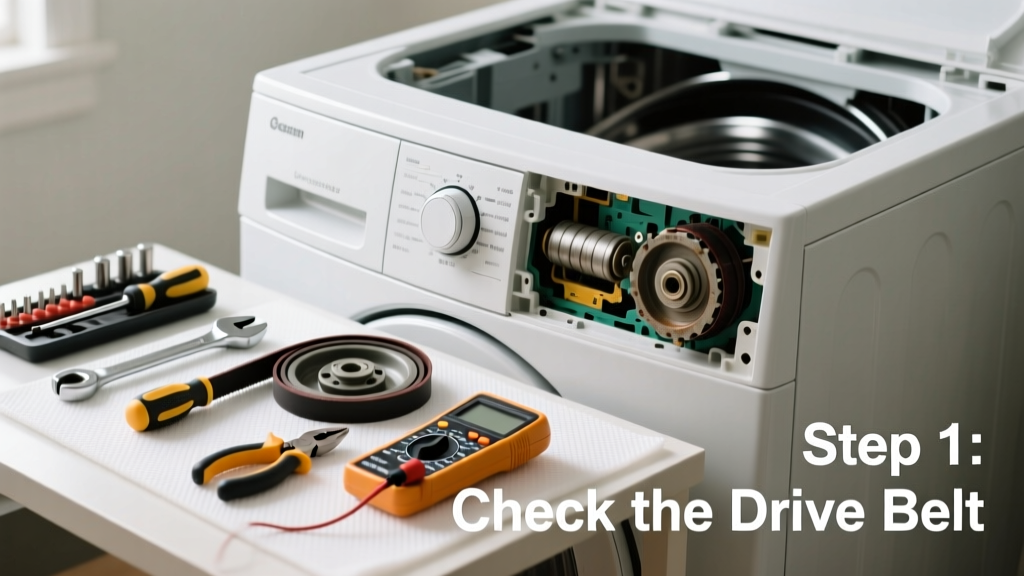
- Inspect the drive belt: Remove the front panel (consult your manual—some require removing the top first). Look for cracks, fraying, or complete separation. If the belt is off the idler pulley or drum, reseat it. If damaged, replace it—never reuse a stretched or cracked belt.
- Test the start capacitor: Located near the motor, it’s a cylindrical metal canister. Discharge it safely with an insulated screwdriver across terminals first. Then test capacitance with your multimeter. A reading more than ±6µF from the labeled value means replacement is needed.
- Verify motor operation: With the belt removed, run the dryer briefly. If the motor shaft spins freely, the issue is likely belt- or drum-related. If it hums but doesn’t turn—or smells burnt—the motor windings may be shorted.
When to Call a Pro
Stop and call a certified technician if:
- You measure 0 ohms across the motor windings (indicating a short) or infinite resistance (open circuit)
- The control board shows burn marks or charring—replacing it requires firmware matching and model-specific calibration
- Your dryer is under warranty (DIY repairs void coverage on most brands, including LG and Samsung)
- You’re uncomfortable working with 240V circuits or disassembling drum supports
"Over 40% of 'no-spin' service calls involve misdiagnosed capacitors or belts replaced unnecessarily—always test before swapping." — Appliance Repair Field Manual, 4th ed., National Appliance Technicians Association (2023)
Prevention Tips
Extend your dryer’s life and avoid repeat failures:
- Clean the lint filter before every load—and vacuum the housing cavity every 6 months
- Inspect the drive belt annually during routine maintenance (e.g., when cleaning the vent duct)
- Avoid overloading: heavy wet loads strain the motor and accelerate belt wear
- Level the dryer properly—uneven footing causes drum misalignment and premature bearing wear
Why does my dryer spin only when I hold the start button?
This points to a failing start switch or weak capacitor. The switch may make temporary contact when pressed but fails under normal spring tension. Test both components with a multimeter before replacing either.
Can a clogged vent cause the drum not to spin?
No—vent blockages cause overheating and shutdown, but not loss of rotation. However, restricted airflow can trip high-limit thermostats that cut power to the motor, mimicking a no-spin condition. Always rule out venting issues when troubleshooting heat-related shutdowns at dryer not heating.
Is it safe to bypass the door switch to test?
No. Bypassing creates a serious shock and fire hazard—the switch cuts power to the motor and heater simultaneously. Use your multimeter to test continuity instead. For safer diagnostics, refer to our guide on dryer safety checklist.
How long should a dryer drive belt last?
Typically 5–8 years with average use (4–5 loads/week). Belt life drops sharply with frequent heavy loads or improper leveling. Signs of wear include squeaking, slippage, or visible glazing on the inner surface.
What voltage should I expect at the motor terminals?
On electric dryers: ~120V across each leg to neutral (L1-N and L2-N), and ~240V between legs (L1-L2). On gas models: ~120V to the motor, with separate 120V to the igniter and valve coils. Always verify with a meter—never assume.
Can I replace just the idler pulley without the belt?
Yes—but only if the belt is intact and tension is correct. Worn idler pulleys cause belt slippage and uneven wear. Replace both if the pulley shows cracks, wobble, or seized bearings—even if the belt looks fine.
A non-spinning dryer isn’t always a death sentence for your appliance. Most causes respond well to methodical testing and targeted part replacement. If you’ve confirmed the motor runs with the belt off and the drum turns freely by hand, you’re likely one $15 part away from full function. Just remember: when in doubt about wiring, grounding, or capacitor discharge, reach out to a licensed technician—it’s cheaper than a fire report or electrocution emergency.