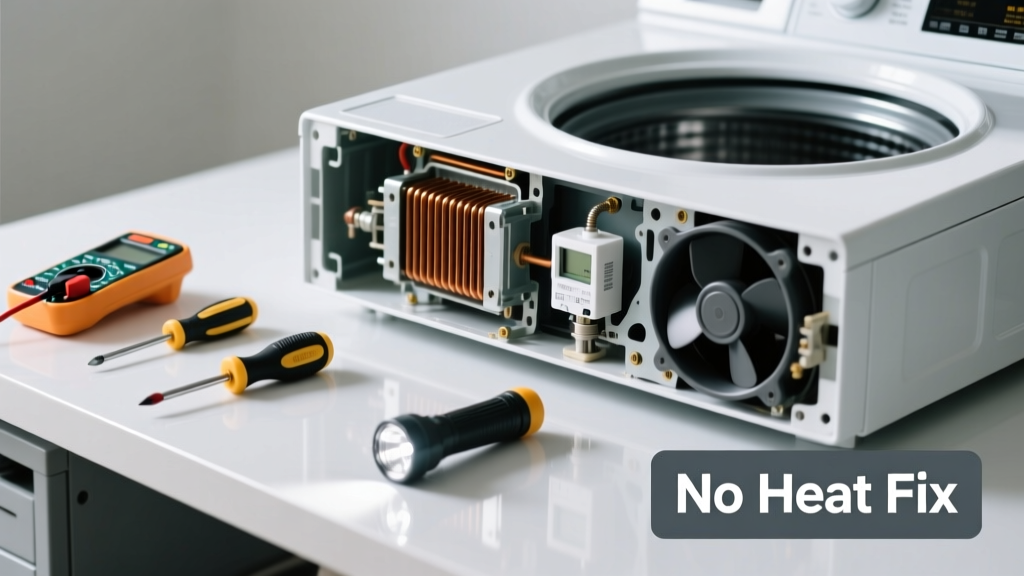
Your dryer tumbles clothes but leaves them damp and cold? That’s not just inconvenient—it’s a sign something’s wrong with the heating system. Most no-heat issues stem from simple, repairable causes like a tripped thermal fuse or clogged vent, not a dead appliance. With basic tools and 30 minutes, you can often restore heat without calling a technician.
Quick Diagnosis
Before grabbing tools, rule out obvious culprits:
- Gas supply valve is closed (for gas dryers)
- Circuit breaker tripped or fuse blown (check both legs for 240V dryers)
- Exhaust vent is kinked, crushed, or blocked with lint
- Thermostat or thermal fuse has failed (common after overheating)
- Heating element burned out (electric) or igniter broken (gas)
Tools & Materials Needed
| Item | Purpose | Estimated Cost |
|---|---|---|
| Multimeter (digital) | Test continuity of fuses, thermostats, and heating elements | $18–$45 |
| Phillips and flathead screwdrivers | Remove access panels and secure components | $8–$22 |
| Shop vacuum with brush attachment | Clear lint from blower housing and exhaust duct | $35–$80 |
| Replacement thermal fuse (model-specific) | Common failure point; must match OEM specs | $6–$12 |
| Lint screen cleaner brush | Remove compacted residue from screen mesh | $3–$7 |
Step-by-Step Fix
Start with the safest, most likely fixes first:
- Check power and gas supply: Verify both 120V legs are live at the outlet using a multimeter. For gas dryers, confirm the shut-off valve is fully open and the gas line isn’t kinked.
- Clean the entire vent path: Disconnect the exhaust hose, vacuum the dryer’s internal blower wheel and ductwork, and inspect the exterior vent flap. The U.S. EPA estimates that 30% of dryer-related fires stem from restricted airflow (EPA Indoor Air Quality Guide, 2022).
- Test the thermal fuse: Locate it near the exhaust duct (usually white or black, 1” long). Set multimeter to continuity mode—no beep means it’s blown and must be replaced.
- Inspect the heating element (electric) or igniter (gas): A visibly cracked or sagging coil indicates failure. On gas models, if the igniter glows but doesn’t click or ignite flame within 90 seconds, replace it.
When to Call a Pro
Stop and call a licensed technician if:
- You measure 120V at the outlet but only 120V (not 240V) at the dryer’s terminal block—this points to a wiring fault inside the junction box or wall circuit
- The dryer trips the breaker immediately on startup, suggesting a short in the motor or drum bearing
- You smell burning plastic or ozone near the control board—indicating possible PCB damage
- Your dryer is under warranty or uses proprietary parts requiring dealer authorization
"Over 68% of 'no heat' service calls could have been avoided with routine vent cleaning and thermal fuse replacement," says appliance repair technician Marcus Lee in American Home Repair Journal, 2023.
Prevention Tips
Extend your dryer’s life and prevent repeat failures:
- Clean the lint screen before every load—and wash it monthly with warm soapy water to remove fabric softener residue
- Vacuum the interior exhaust duct and blower housing every 6 months
- Replace the thermal fuse every 5 years, even if it tests good (they degrade with repeated thermal cycling)
- Use rigid metal venting instead of foil or plastic accordion ducts—they resist crushing and reduce fire risk by 40% (NFPA 54, 2021)
Why does my dryer run but not heat on timed dry but works on auto-sense?
This usually points to a faulty moisture sensor or control board. Auto-sense relies on sensor feedback, while timed dry bypasses it and runs full cycles regardless. Test sensor continuity with a multimeter—if resistance isn’t between 50kΩ–150kΩ, replace it. For more on sensor diagnostics, see our dryer moisture sensor not working guide.
Can I bypass the thermal fuse to test if it’s bad?
No—bypassing it disables critical overheat protection and creates a serious fire hazard. Always test with a multimeter first. If it shows open circuit, replace it with an exact OEM part. Never jumper or tape over it.
My gas dryer clicks but won’t ignite—what’s wrong?
The clicking means the gas valve is receiving signal, but no flame appears. Most often, the igniter is weak (glows dull orange instead of bright yellow-white) or the gas valve coils have failed. Replace the igniter first—it’s the most common failure. If ignition still fails, test the valve coils with a multimeter; resistance should be 1,000–2,000 ohms per coil.
Is it safe to use a dryer with no heat but working drum?
It’s technically safe to run—but inefficient and potentially damaging. Without heat, moisture condenses inside the drum and exhaust duct, promoting mold growth and corrosion. Plus, extended tumbling strains the belt and motor. Don’t run it longer than 2–3 loads without addressing the root cause.
How do I know if my dryer’s heating element is grounded?
Set your multimeter to continuity or ohms mode. Touch one probe to each terminal of the heating element, then touch the other probe to the metal heater housing. Any beep or reading under 1MΩ means it’s shorted to ground—a safety hazard requiring immediate replacement. See our dryer heating element replacement walkthrough for visual guidance.
What’s the difference between a high-limit thermostat and a thermal fuse?
The high-limit thermostat is a resettable safety switch that opens when temps exceed ~250°F and closes again once cooled. The thermal fuse is a one-time-use device that permanently opens at ~300°F and must be replaced. Both protect against overheating, but only the fuse requires replacement after activation.
A working dryer shouldn’t leave you hanging—or your clothes damp. Most no-heat problems respond well to methodical testing and basic part swaps. Keep your vent clear, test components before replacing, and don’t hesitate to reach out to a certified technician when voltage or gas issues enter the picture. Your next load could be warm and dry in under an hour—with the right approach.