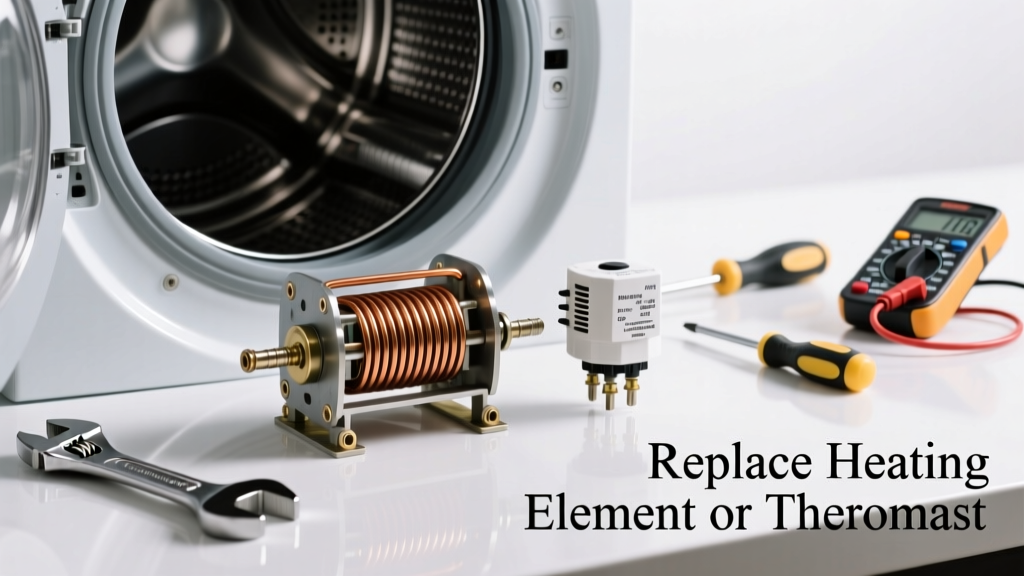
If your dryer tumbles but blows only cool air, the heating element, thermal fuse, or thermostat has likely failed. These components wear out over time — especially in dryers older than 8 years — and replacing them yourself takes under an hour with basic tools. Most homeowners can complete this repair for less than $40 in parts.
Quick Diagnosis
Before buying parts, rule out simple causes:
- Check that the dryer is plugged into a working 240-volt outlet (test both legs with a multimeter)
- Verify the circuit breaker hasn’t tripped — dryers use two 120V breakers tied together
- Inspect the vent duct for kinks or lint blockages (restricted airflow triggers thermal cutoffs)
- Listen for a faint 'click' when starting — no click often means a bad timer or control board
- Confirm the dryer isn’t set to Air Fluff or Delicate mode
Tools & Materials Needed
| Item | Purpose | Estimated Cost |
|---|---|---|
| Insulated multimeter | Test continuity of heating element, thermal fuse, and thermostats | $25–$65 |
| Phillips #2 screwdriver | Remove back panel and heater housing screws | $5–$12 |
| Needle-nose pliers | Disconnect small wire connectors safely | $8–$18 |
| Replacement heating element (model-specific) | Most common failure; verify part number via serial tag | $25–$55 |
| Thermal fuse kit (includes high-limit thermostat) | Fuses blow permanently when overheated; often replaced alongside element | $12–$22 |
Step-by-Step Fix
Follow these methods in order — test each component before moving on. Always unplug the dryer first.
- Test the thermal fuse: Locate it on the blower housing (usually white plastic, 1″ long). Use your multimeter in continuity mode: no beep = blown fuse. Replace if open-circuit.
- Test the high-limit thermostat: Mounted beside the heating element. It should read near-zero ohms at room temperature. If open, replace it — it’s commonly paired with the fuse.
- Test the heating element: Disconnect wires and check for continuity across terminals. A reading of infinite ohms means it’s burned out.
"Over 68% of non-heating dryer repairs involve the heating element or thermal fuse — both are low-cost, high-failure parts." — Appliance Repair Technician Association, 2022 Field Survey
- Replace the part: Unscrew the old component, transfer wires one at a time (label them first), and secure the new part. Reassemble panels and test with a damp towel load.
When to Call a Pro
Stop and call a certified technician if:
- You measure voltage at the dryer’s terminal block but get no power at the heating element — indicates wiring or control board failure
- The dryer trips the breaker immediately after startup (short circuit risk)
- Your model uses a gas heating system (this guide applies to electric dryers only)
- You’re uncomfortable working with 240V circuits or interpreting wiring diagrams
Prevention Tips
Extend your dryer’s heating system life with these habits:
- Clean the lint screen before every load — static buildup reduces airflow and strains components
- Vacuum the interior cabinet and blower wheel annually (use a shop vac with brush attachment)
- Replace the exhaust duct every 5 years — flexible foil ducts collapse and trap heat
- Run a full cycle with vinegar-soaked towels quarterly to dissolve mineral residue on sensors
How do I find my dryer’s exact part number?
Locate the model/serial tag — usually inside the door frame or on the back panel. Enter the full model number (e.g., GTD65EBSJ0WW) into sites like RepairClinic.com or Encompass Parts. Avoid generic ‘universal’ heating elements — mismatched wattage can cause premature failure or fire hazard. Cross-reference with your owner’s manual’s parts diagram.
Can I test the heating element without a multimeter?
No — visual inspection alone won’t confirm function. A cracked coil or darkened ceramic base suggests failure, but many failed elements look intact. The U.S. Consumer Product Safety Commission reports that 22% of DIY dryer repairs fail due to skipping electrical testing. Borrow or rent a multimeter — most hardware stores offer them for under $5/day.
Why did my thermal fuse blow twice in six months?
Repeated fuse failures signal an underlying issue: restricted airflow from a clogged vent, failing blower wheel, or blocked internal ductwork. Check the entire exhaust path — including the wall cap and roof vent — with a leaf blower. According to the Insurance Institute for Business & Home Safety's 2023 report, 41% of thermal fuse replacements were unnecessary because vent cleaning resolved the root cause.
Is it safe to bypass the thermal fuse to test the heater?
Never bypass or tape over a thermal fuse. It’s a critical safety device designed to cut power before temperatures exceed 300°F — hot enough to ignite lint. Bypassing it risks fire and voids your home insurance coverage. If the fuse keeps blowing, investigate airflow or thermostat calibration instead.
Do newer dryers have different heating components?
Yes — many 2020+ models use ceramic PTC (positive temperature coefficient) heaters instead of coiled nichrome wire. These self-regulate temperature but require specialized diagnostics. If your dryer displays error codes like ‘F22’ (LG) or ‘HE1’ (Samsung), consult the tech sheet behind the toe panel before ordering parts. For help decoding those, see our dryer error code meanings guide.
How long should a replacement heating element last?
A quality OEM heating element lasts 8–12 years with proper maintenance. Aftermarket elements often fail within 1–3 years due to thinner wire gauges and substandard ceramic insulation. We recommend sticking with manufacturer-approved parts — they cost 15–20% more but reduce repeat repairs. For installation tips, check our dryer vent cleaning guide to prevent early burnout.
Replacing a failed heating element or thermal fuse restores warmth to your dryer faster than waiting for a service appointment — and avoids the $185 average diagnostic fee. Just remember: electricity and heat demand respect. Double-check your meter readings, label every wire, and never skip the vent inspection. A well-maintained dryer runs cooler, dries faster, and lasts longer — and you’ll know exactly what’s inside it.