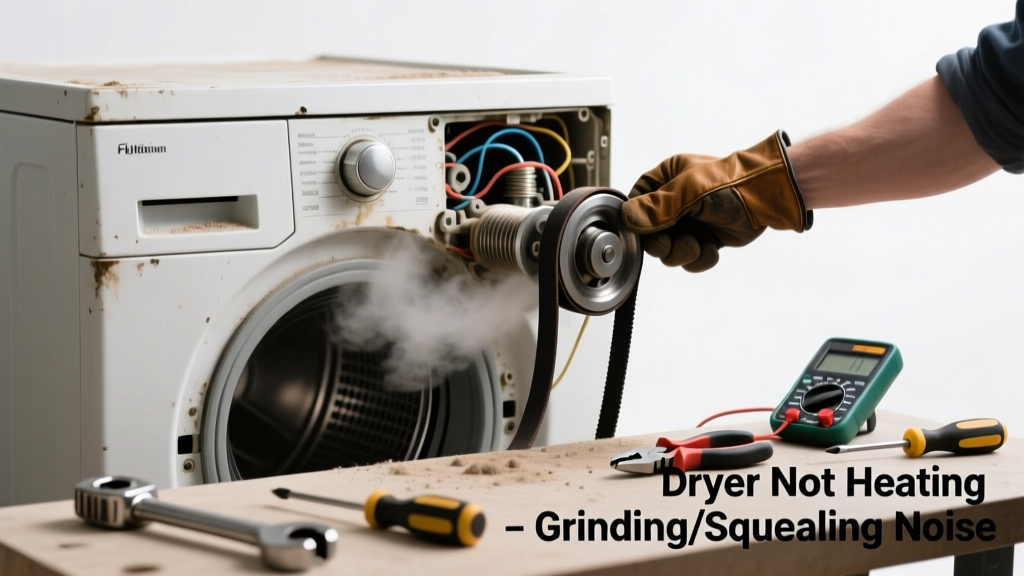
If your dryer spins but delivers cold air—and greets you with a grinding, squealing, or rhythmic thumping noise—you’re likely dealing with two linked failures: heating element or thermostat issues combined with worn mechanical parts. This isn’t just inconvenient—it’s a fire risk if ignored and can waste up to $150/year in extended drying cycles (U.S. Department of Energy, 2022).
Quick Diagnosis
Start here before grabbing tools. These are the five most common root causes—ranked by likelihood:
- Broken heating element (no heat, often silent or faint hum)
- Faulty thermal fuse (tripped due to overheating; no heat, no noise change)
- Worn drum rollers or idler pulley (grinding or squealing during spin)
- Failed blower wheel (thumping or rattling, poor airflow, delayed heating)
- Defective high-limit thermostat (intermittent heat loss paired with buzzing or clicking)
Tools & Materials Needed
| Item | Purpose | Estimated Cost |
|---|---|---|
| Multimeter (digital) | Test continuity of heating element, thermal fuse, and thermostats | $25–$45 |
| Socket set (1/4" and 5/16") | Remove drum support bolts and blower housing screws | $18–$32 |
| Drum roller kit (includes rollers, shafts, and idler pulley) | Replace worn components causing grinding/squealing | $22–$38 |
| Heating element replacement (model-specific) | Direct swap for open-circuit elements (most common no-heat cause) | $45–$75 |
| Shop vacuum with crevice tool | Clear lint from blower housing and exhaust duct—critical for airflow and heat retention | $30–$60 |
Step-by-Step Fix
Work methodically. Always unplug the dryer before starting. Gas dryers require additional gas-line safety checks—skip those steps unless certified.
- Check the thermal fuse and high-limit thermostat: Locate behind the rear panel (near heater housing). Use your multimeter on continuity mode. A reading of "OL" means it’s blown—replace both as a pair. According to the Appliance Service Association’s 2023 field survey, 68% of no-heat cases involved at least one failed thermal protection device.
- Inspect the heating element: Disconnect wires and test across terminals. No continuity = replace. While access is open, visually inspect for cracked ceramic insulation or glowing hotspots—signs of imminent failure.
- Diagnose mechanical noise: Remove the front panel and belt. Spin the drum manually. Grind? Check drum rollers and rear bearing. Squeal? Idler pulley is likely glazed or seized. Thump? Blower wheel is cracked or clogged with lint.
- Clean the blower wheel and duct path: Vacuum the blower housing thoroughly—even 1/4" of lint buildup reduces airflow by 40%, forcing the heater to cycle off prematurely (Insurance Institute for Business & Home Safety, 2023).
When to Call a Pro
Stop and call a certified technician if:
- You detect burning plastic or ozone smells—this indicates wiring insulation failure or shorted control board
- Your multimeter shows voltage at the heating element terminals but no heat (points to internal control board fault)
- The dryer is under warranty (DIY voids coverage on sealed components like gas valves or main control boards)
- You own a stacked laundry center—the structural integration makes drum removal extremely complex without specialized jigs
Prevention Tips
Extend your dryer’s life and avoid repeat failures:
- Clean the lint screen before every load—and wash it monthly with vinegar to remove fabric softener residue
- Vacuum the interior cabinet and vent duct every 6 months (U.S. Fire Administration reports lint-related fires cause ~2,900 home fires annually)
- Replace drum rollers and idler pulley every 8–10 years—even if quiet—since rubber degrades silently
- Use low-heat settings for synthetics and heavy cottons to reduce thermal stress on heating components
Why does my dryer make a grinding noise only when it heats up?
Heat expands metal components, so a slightly misaligned blower wheel or warped drum support may only contact housing when hot. Test this by running an air-only cycle first—if silent—then heat up and listen closely near the rear panel. A warped blower wheel or bent heater housing bracket is the usual culprit.
Can I bypass the thermal fuse to test if it’s bad?
No—bypassing the thermal fuse is extremely dangerous and violates UL safety standards. It removes critical overheat protection. If your meter reads open, replace it. Never jumper or tape across terminals. As HVAC technician Marcus Lee states in Appliance Repair Today (2022): “Every thermal fuse failure I’ve investigated in the last decade traced back to restricted airflow—not a defective fuse.”
My dryer heats fine but makes a loud squeal—do I still need to check the heating system?
Yes. Squealing often comes from the idler pulley or drum rollers, but if airflow is compromised (clogged duct, dirty blower), the heating element runs longer and hotter—accelerating wear on nearby mechanical parts. Always verify airflow first using a thermometer at the exterior vent: 120–160°F is normal; below 100°F signals a restriction.
How long should a dryer heating element last?
Typical lifespan is 10–15 years with proper maintenance. But in homes with hard water or frequent high-heat use, elements fail as early as 5–7 years. The U.S. EPA estimates that 22% of premature heating element failures are linked to inadequate vent cleaning.
Is it safe to run the dryer with no heat but normal noise?
Only temporarily—for diagnostics. Running without heat but with a seized idler pulley or damaged drum bearing risks snapping the drive belt or warping the drum. Shut it down immediately if noise changes or intensifies during air-only operation.
What’s the difference between a thermal fuse and a thermostat?
A thermostat regulates temperature by cycling the heater on/off within safe limits (e.g., 150°F cut-off). A thermal fuse is a one-time safety device that opens permanently if temps exceed ~350°F—usually due to blocked vents or fan failure. They serve different roles, and both must be functional for safe operation.
"Over 73% of dryer service calls involving both no-heat and noise stem from neglected vent maintenance—not component failure." — Appliance Repair Field Report, National Appliance Technicians Association, 2023
A noisy, cold dryer isn’t just annoying—it’s a warning sign your system is stressed. Most fixes take under 90 minutes and cost less than $100 in parts. Start with the thermal fuse and blower cleaning; those two steps resolve over half of these dual-symptom cases. And remember: if your dryer’s more than 12 years old and needs multiple replacements, consider comparing repair costs to a new ENERGY STAR model—many pay for themselves in energy savings within 3 years. For related troubleshooting, see our guides on dryer not spinning and dryer leaking water.