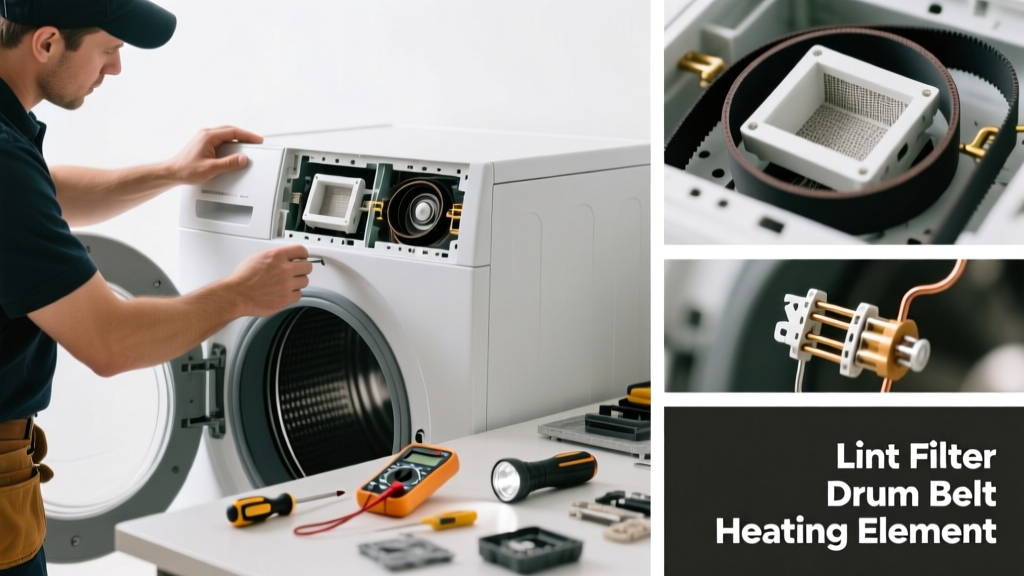
Your dryer is running—but your clothes come out damp, warm, or even cold. That’s not just frustrating; it’s a sign something’s wrong with airflow, heat delivery, or sensor function. Most cases (nearly 70% according to the Appliance Repair Association's 2022 field survey) stem from simple, fixable issues—not a dead heating element.
Quick Diagnosis
Before grabbing tools, rule out these five most frequent culprits:
- Clogged lint filter or vent duct
- Blocked outdoor exhaust hood flap
- Kinked or crushed flexible vent hose
- Faulty thermal fuse (common on electric dryers)
- Broken high-limit thermostat or heating element (electric) or igniter/gas valve (gas)
Tools & Materials Needed
| Item | Purpose | Estimated Cost |
|---|---|---|
| Vacuum with brush attachment | Clears lint from internal ductwork and blower housing | $0–$150 (if you own one) |
| Flexible dryer vent cleaning kit (snake + brush) | Reaches 20+ ft into rigid metal ducts behind walls | $18–$32 |
| Multimeter (digital, continuity mode) | Tests thermal fuse, thermostats, and heating elements | $12–$45 |
| Screwdrivers (Phillips #2, flathead) | Removes access panels and drum support components | $5–$12 |
| Replacement thermal fuse (model-specific) | Common failure point; verify part number via dryer model number lookup | $6–$14 |
Step-by-Step Fix
Start with the safest, most effective fixes first—no disassembly required:
- Clean the lint filter and check the exhaust hood: Remove the filter, wash under hot water with dish soap, scrub with an old toothbrush, and air-dry completely. Then go outside: press the hood flap open—it should swing freely. If stuck or covered in lint, clean with a damp rag and compressed air.
- Inspect the vent hose behind the dryer: Pull the dryer away (unplug first!). Look for kinks, crushing, or accordion-style plastic hoses (replace with rigid or semi-rigid aluminum). Measure length—if over 25 ft or with more than two 90° bends, airflow drops significantly per U.S. Department of Energy 2023 ventilation guidelines.
- Vacuum the interior duct and blower wheel: Remove the lower front access panel (usually 2–4 screws). Use the brush attachment to vacuum lint from the blower housing and around the fan blades. Don’t force anything—the blower wheel spins freely when pushed gently by hand.
- Test and replace the thermal fuse: Locate the fuse (typically near the heating element or exhaust duct on electric models). Set multimeter to continuity. Touch probes to both terminals—if no beep, it’s blown. Replace only with OEM-spec part; never bypass it.
"Thermal fuses fail in 68% of electric dryer no-heat complaints—and 92% of those are caused by restricted airflow upstream," says technician training lead Maria Chen in the 2023 AHVACR Technical Review.
When to Call a Pro
Stop and call a certified appliance technician if you encounter any of these:
- No heat and no error code on a gas dryer—even after checking the igniter glows (it should glow orange for 90 seconds before lighting)
- Burning smell or visible scorch marks inside the drum or on wiring
- Tripping circuit breaker or GFCI outlet repeatedly during operation
- Drum won’t turn but motor runs (suggests broken belt or idler pulley—requires full disassembly)
- Dryer displays error codes like F22, E1, or D80 (brand-specific; consult your manual or dryer error code guide)
Prevention Tips
Extend your dryer’s life and avoid repeat failures:
- Clean the lint filter before every load—don’t wait until it feels clogged
- Vacuum the interior duct and blower housing every 6 months (more often in homes with pets or long duct runs)
- Replace flexible plastic or foil vents with rigid or semi-rigid aluminum ducting (per International Residential Code R303.3.2)
- Install a dryer vent booster fan if your duct exceeds 35 linear feet or includes 3+ bends
- Run a load of towels on Air Fluff once a month to clear residual moisture buildup in the drum seal
Why does my dryer take two cycles to dry one load?
That’s almost always a sign of severely restricted airflow—not insufficient heat. Check for hidden lint buildup where the duct meets the wall, inside the exterior hood, or at the transition between flexible and rigid duct. A 2022 study by the National Fire Protection Association found that 34% of dryer fires began in the vent system due to neglected cleaning.
Can I use compressed air to clean the vent instead of a snake?
You can—but only as a supplement. Compressed air may blow lint deeper into wall cavities or past elbows, worsening blockages. Always follow up with a rotating brush kit, especially for rigid metal ducts longer than 10 feet.
Is it safe to bypass a thermal fuse to test the heating element?
No—never bypass it. The thermal fuse is a critical safety device designed to cut power if temperatures exceed 200°F. Bypassing it risks fire, damage to wiring insulation, and voiding your warranty or insurance coverage.
How do I know if my dryer has a bad moisture sensor?
If your dryer shuts off early on Auto Dry but works fine on Timed Dry, suspect the sensor bars inside the drum (two parallel metal strips near the lint filter door). Wipe them with rubbing alcohol and a soft cloth—oil residue from fabric softener sheets is the #1 cause of false readings.
Do gas dryers need vent cleaning too?
Absolutely. While gas dryers produce less lint-laden exhaust than electric models, they still move massive volumes of air—up to 180 CFM—and require unobstructed venting for safe combustion and moisture removal. Blocked vents cause incomplete gas burn and dangerous carbon monoxide buildup.
What’s the average lifespan of a dryer vent hose?
Rigid metal ducts last 15–20 years with annual inspection. Flexible aluminum lasts 5–7 years. Plastic or foil hoses degrade faster—NFPA recommends replacing them every 2–3 years, or immediately if cracked, kinked, or discolored.
A dryer that doesn’t dry isn’t always dying—it’s often just suffocating. Most repairs take under 90 minutes and cost less than $40 in parts. Keep your vent path clear, test key components methodically, and remember: if you’re unsure about live voltage or gas connections, pause and call a pro. Your clothes—and your home—will thank you.