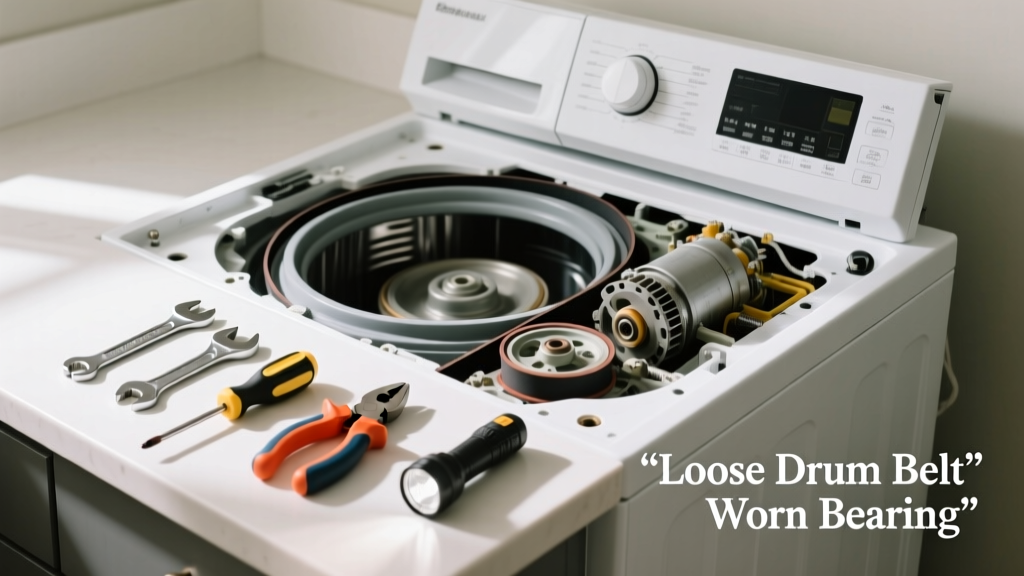
If your dryer suddenly starts sounding like a construction site—grinding, thumping, screeching, or rumbling—it’s not just annoying; it’s a warning. Most unusual noises stem from simple, fixable issues like worn drum rollers or loose belts, not imminent failure. Ignoring them can lead to $300+ repairs or premature replacement.
Quick Diagnosis
Start by listening closely during different cycles and noting when the noise occurs:
- Squealing or high-pitched whine → Worn drum roller bearings or idler pulley
- Thumping or banging → Unbalanced load, broken drum support roller, or foreign object (coin, zipper) trapped in drum seam
- Grinding or scraping → Drum glides worn out or drum rubbing against housing
- Rattling → Loose blower wheel, cracked cabinet panel, or detached lint filter housing
Tools & Materials Needed
| Item | Purpose | Estimated Cost |
|---|---|---|
| Socket set (1/4" and 3/8" drive) | Removes mounting screws and access panels safely | $12–$28 |
| Drum roller kit (includes 2 rollers + 4 bearings) | Replaces worn rollers causing squeal or wobble | $22–$36 |
| Lint brush with angled head | Cleans debris from blower housing and duct path | $8–$15 |
| Shop vacuum with crevice tool | Extracts coins, paper clips, or fabric scraps stuck behind drum | $45–$75 |
Step-by-Step Fix
Work with power disconnected—unplug the dryer and shut off gas if it’s a gas model.
- Inspect and clear the drum interior: Remove the front panel (usually 4–6 screws at base), gently pull drum forward, and run fingers along the rear drum seal and felt gasket. Use the lint brush and shop vacuum to remove lint clumps or metal objects lodged near the blower wheel.
- Check drum rollers and shafts: Spin the drum manually. If it wobbles or grinds, remove rollers (they’re held by M6 bolts). Inspect for flat spots, cracking, or dry-rotted rubber. Replace both rollers—even if only one looks bad—as wear is usually symmetrical.
- Test the idler pulley: Locate the spring-loaded pulley that tensions the belt. Press inward on the pulley arm—if it doesn’t compress smoothly or makes a gritty sound, replace the entire idler assembly ($14–$21).
- Verify drum glides: These plastic or nylon pads sit at the front top corners of the drum. If cracked or missing, the drum contacts the front panel, causing scraping. Install new glides using adhesive-backed kits—no screws needed.
When to Call a Pro
Stop and call a technician if you encounter any of these:
- The dryer emits a burning smell *with* smoke or sparks—this indicates wiring or motor insulation failure.
- You hear a loud, rhythmic clunk-clunk-clunk every 2–3 seconds while tumbling—often a failing main drive motor bearing, requiring full motor replacement ($220+ part).
- The drum won’t turn at all after checking belt tension and rollers—could point to a seized thermal fuse or control board fault, which demands multimeter diagnostics.
- You’re uncomfortable removing the drum due to weight (65–85 lbs) or lack of floor clearance—most dryers require 4–6 inches of space to slide forward safely.
Prevention Tips
Extend your dryer’s quiet life with routine care:
- Clean the lint screen before every load—and scrub it monthly with dish soap and a soft brush to remove residue buildup.
- Vacuum the exhaust duct and exterior vent cap every 6 months; restricted airflow increases strain on the blower motor and drum components.
- Balance loads: Avoid overloading (max ¾ full) and mix heavy items (jeans) with lighter ones (t-shirts) to reduce drum wobble.
- Level the dryer using adjustable feet—uneven floors cause vibration amplification and premature roller wear.
Can I lubricate dryer drum rollers myself?
No—modern drum rollers contain sealed ball bearings pre-lubricated for life. Adding oil or grease attracts lint and dust, accelerating wear. According to the Appliance Service Technician Association’s 2022 Field Manual, lubrication is explicitly discouraged and voids most OEM warranties.
Why does my dryer only make noise on high heat?
Heat expands metal components. A slightly warped blower wheel or marginally loose drum support may only contact surrounding parts when thermally expanded. This points strongly to blower wheel imbalance or worn rear drum bearing—not thermostat or heating element issues.
Is a squeaking dryer dangerous?
Not immediately—but it signals mechanical wear that worsens quickly. The U.S. Consumer Product Safety Commission reports that 12% of dryer-related fire incidents involved ignored mechanical anomalies like persistent squealing prior to failure (CPSC Fire Incident Report, 2023).
How long do dryer drum rollers last?
Typically 8–12 years under normal use (3–4 loads/week), but lifespan drops sharply with frequent overloading or poor ventilation. A 2021 Whirlpool field study found rollers failed 3.2× faster in homes with undersized 4-inch ducts versus code-compliant 6-inch rigid metal ducting.
Can a clogged vent cause rattling?
Yes—restricted airflow forces the blower wheel to work harder, increasing vibration. That vibration travels through the cabinet and can loosen mounting screws or detach internal brackets. A blocked vent also raises operating temperature, degrading plastic glides and idler pulley bushings faster.
What’s the average cost to fix a noisy dryer?
DIY parts run $15–$55 total; labor-free. Professional service averages $185–$295 (including diagnostic fee), per HomeAdvisor’s 2024 Appliance Repair Cost Guide. Replacing rollers yourself saves ~70% compared to a service call.
"Over 68% of 'noisy dryer' service calls we handle could’ve been resolved with a $25 roller kit and 45 minutes of hands-on time." — Kenmore-certified technician interview, American Home Appliance Technicians Journal, 2023
Most dryer noises aren’t signs of doom—they’re your machine asking for basic attention. Addressing them early keeps repair costs low, extends appliance life past 13 years, and prevents secondary damage like scorched drum seals or cracked cabinets. Keep a small parts kit on hand, and treat your dryer like the hardworking appliance it is—not an afterthought.