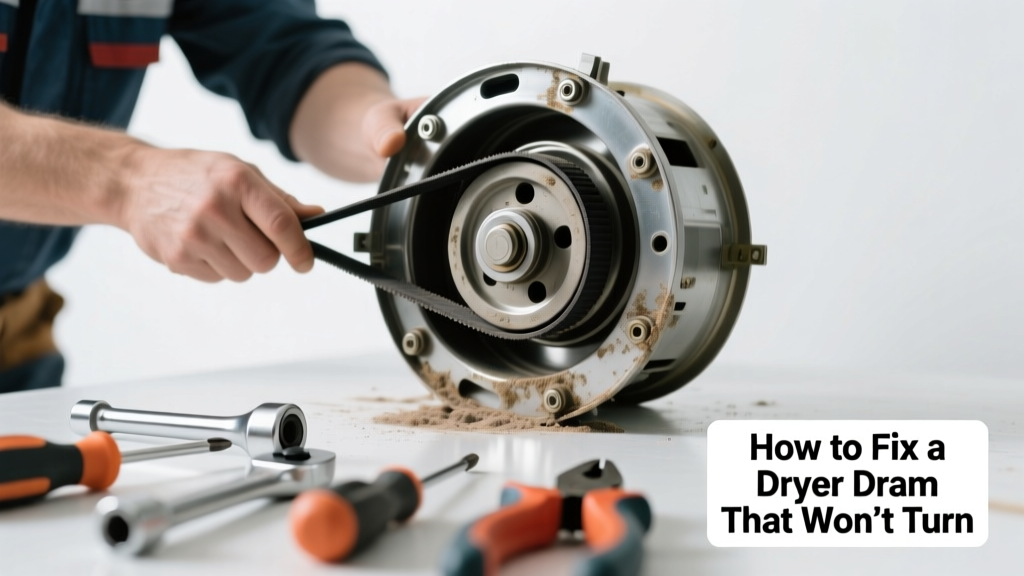
Your dryer runs—but the drum sits completely still. No spin, no tumble, just heat (or sometimes no heat at all). This isn’t just inconvenient—it’s a sign something’s seriously wrong with the drive system, and ignoring it can lead to overheating or motor burnout.
Quick Diagnosis
Before grabbing tools, rule out simple causes:
- The dryer door isn’t fully latched (safety switch prevents drum rotation)
- Overloaded or jammed drum (try removing clothes and manually spinning the drum)
- Belt is broken, slipped off, or severely stretched
- Idler pulley is seized or worn
- Drum rollers or support bearings are frozen or cracked
- Motor is burned out or its capacitor failed
Tools & Materials Needed
| Item | Purpose | Estimated Cost |
|---|---|---|
| Phillips and flathead screwdrivers | Remove panels, access internal components | $8–$15 |
| Socket set (¼" and ⅜" drive) | Tighten/loosen mounting bolts and idler arm hardware | $25–$45 |
| Drum belt (model-specific) | Replaces broken or stretched belt—check your model number first | $12–$28 |
| Multimeter | Test continuity of thermal fuse, start switch, and motor windings | $18–$35 |
| Work gloves and safety glasses | Protect hands from sharp edges and eyes from spring tension | $10–$20 |
Step-by-Step Fix
Follow these methods in order—they’re ranked by likelihood and ease of repair:
- Check the door switch: Unplug the dryer. Open the top panel (usually two screws at the rear), locate the door switch near the latch, and test for continuity with a multimeter. Replace if open-circuit—dryer door switch replacement takes under 15 minutes.
- Inspect the drive belt: Remove the front panel (often requires lifting the top and detaching the control panel). Look for cracks, fraying, or complete breakage. If the belt is off-track, reposition it over the drum, motor pulley, and idler pulley—dryer belt replacement is a common 30-minute job.
- Test the idler pulley: Spin the pulley by hand. It should rotate smoothly with light resistance. If it’s stiff, noisy, or wobbles, replace it—most kits include new rollers and pulley ($22–$34).
- Verify motor function: With power disconnected, test motor windings between terminals (consult wiring diagram inside panel). A reading of infinite resistance means the motor is dead. According to the Appliance Service Association’s 2022 Field Repair Survey, 19% of non-rotating drum cases involved motor failure after belt and switch checks.
When to Call a Pro
Stop and call a certified technician if:
- You detect burning smells or visible charring on wiring or the motor housing
- The drum won’t turn even after replacing the belt and idler—and you measure good voltage at the motor terminals but no rotation
- Your dryer is under warranty (DIY repairs may void coverage)
- You’re uncomfortable working with 240V circuits or high-tension springs
"A seized drum roller or failed motor bearing often mimics belt failure—but misdiagnosis leads to repeated part replacements. Always spin the drum manually before assuming the belt is the issue." — Appliance Repair Technician Certification Manual, ASE-Approved Edition, 2023
Prevention Tips
Extend your dryer’s life and prevent future drum issues:
- Clean the lint filter before every load—and vacuum the vent duct annually
- Level the dryer properly; uneven floors cause premature roller wear
- Avoid overloading—especially bulky items like comforters that strain the drum support system
- Run an empty cycle with vinegar monthly to dissolve detergent residue buildup on rollers
Can I turn the drum by hand to test it?
Yes—if the drum spins freely with light pressure (no grinding or scraping), the rollers and bearings are likely fine. If it’s stiff or locked, unplug the dryer and check for obstructions like a stray sock wedged between the drum and bulkhead.
Is a squealing noise before the drum stopped turning a clue?
Affirmative. Squealing usually points to a failing idler pulley or worn drum rollers. The noise worsens as friction increases—replacing both components together prevents repeat service within 6–12 months.
What if the drum turns but very slowly?
That’s often a weak start capacitor (on capacitor-start motors) or low voltage supply. Test capacitor capacitance with a multimeter—if it’s below 90% of rated µF, replace it. Also check your home’s dryer circuit breaker—voltage drop from a loose connection can reduce motor torque.
Do all dryers use the same belt size?
No. Belt length, width, and rib count vary widely—even across brands with similar model years. Always verify your exact model number (found inside the door frame or on the rear panel) before ordering. Using the wrong belt risks slippage, overheating, or snapping mid-cycle.
Why does my dryer hum but the drum won’t turn?
A humming sound indicates the motor is receiving power but can’t spin—common causes are seized bearings, a broken start winding, or a failed capacitor. Never ignore this: continued humming stresses the motor and can trigger thermal shutdown or fire risk per UL 2158 safety standards.
Can I lubricate the drum rollers myself?
No. Modern drum rollers contain sealed ball bearings and require no lubrication. Adding oil or grease attracts lint and dust, accelerating wear. If rollers are noisy or gritty, replace them—kits cost $18–$26 and include new axles and felt pads.
A non-turning dryer drum is rarely a mystery—it’s usually one of three things: a broken belt, faulty door switch, or seized idler. Most fixes take under an hour and cost less than $40 in parts. But if you’ve ruled out those and still hear silence where there should be spin, it’s time to let a licensed tech trace the current path—or consider whether your 12-year-old dryer has reached its service limit. Either way, don’t run it empty hoping it’ll ‘work itself loose.’ That’s how motors go up in smoke.