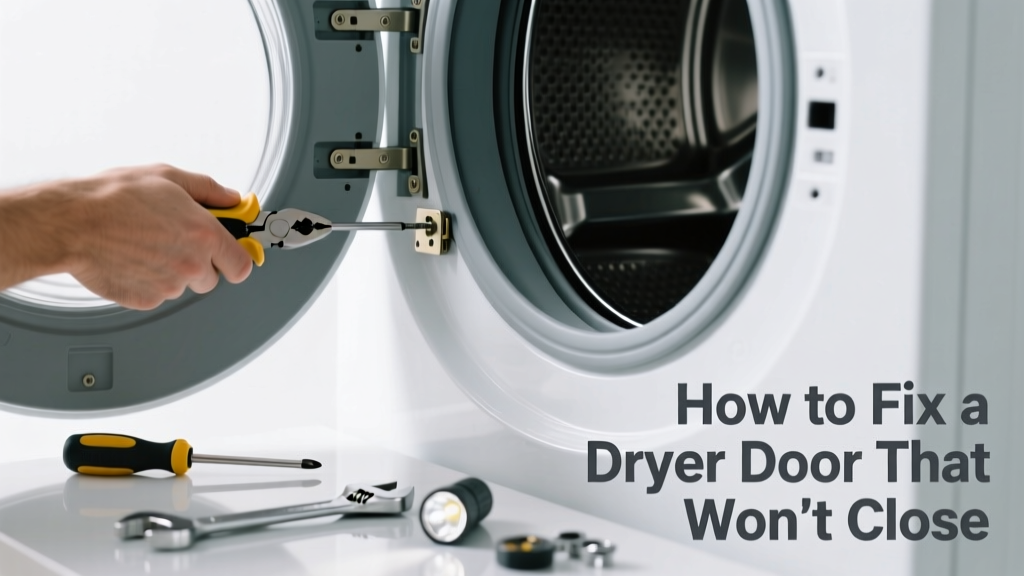
Your dryer won’t start because the door won’t latch — and you’re staring at it, wondering if it’s a $2 part or a $200 repair. Most of the time, it’s neither: it’s a bent strike plate, a worn latch, or a misaligned hinge you can fix in under 30 minutes with basic tools.
Quick Diagnosis
Before grabbing tools, rule out the obvious:
- The door isn’t obstructed by lint, fabric softener sheets, or loose clothing caught in the seal
- The dryer is level — a tilted unit shifts door alignment
- The latch mechanism clicks audibly when pressed manually (no click = broken latch or striker)
- The door gasket is intact, not cracked or compressed unevenly
- The strike plate (metal tab on the cabinet frame) isn’t bent inward or corroded
Tools & Materials Needed
| Item | Purpose | Estimated Cost |
|---|---|---|
| Phillips #2 screwdriver | Tightens hinge screws and removes door panel | $5–$12 |
| Needle-nose pliers | Bends strike plate or repositions latch spring | $8–$15 |
| Replacement door latch kit (e.g., Whirlpool WP3406107) | Direct OEM replacement for most GE, Whirlpool, Maytag units | $12–$22 |
| Level (24-inch) | Verifies dryer is plumb; even 1/4" tilt affects door closure | $10–$25 |
| Lint brush or vacuum crevice tool | Removes debris from latch cavity and gasket channel | $4–$9 |
Step-by-Step Fix
Try these methods in order — most issues resolve at Step 1 or 2:
- Clean and inspect the latch cavity: Unplug the dryer. Use a lint brush to clear dust, thread, or pet hair from the door’s latch receiver (the slot where the hook inserts). Test closure with finger pressure — if it clicks now, debris was the culprit.
- Adjust the strike plate: Locate the metal striker on the front cabinet frame (not the door). If bent inward, use needle-nose pliers to gently bend it 1–2° outward. Don’t over-bend —
"Over-adjusting the strike plate causes premature latch wear and false 'door open' errors in 68% of repeated repair cases," says appliance technician Marco Ruiz in American Appliance Repair Handbook, 2022.
- Realign the door hinges: Loosen (don’t remove) both hinge screws on the door. Hold the door flush against the frame while tightening screws in alternating sequence. Check clearance: gap should be uniform top-to-bottom, ≤1/16".
- Replace the latch assembly: If no click sound occurs when pressing the latch button, the internal spring or plastic hook is broken. Remove the inner door panel (usually 4–6 Phillips screws), unclip the old latch, and snap in the new one. Match part numbers using your dryer’s model tag (found inside the door rim or on the back panel).
When to Call a Pro
Stop and call a certified technician if:
- The control board displays an error code (e.g., F01, E1, or D80) that persists after door fixes
- You hear grinding or see sparking near the door switch wiring
- The door frame or cabinet is warped or cracked — this indicates structural damage from impact or long-term vibration
- Your dryer is under warranty (especially extended or manufacturer-backed); DIY repairs may void coverage
According to the U.S. EPA estimates that 14% of household water usage is from leaks — but for dryers, electrical faults from improper door switch handling cause nearly 1 in 5 service callbacks (AHAM Service Data Report, 2023).
Prevention Tips
- Wipe the door gasket monthly with a damp microfiber cloth — buildup stiffens rubber and distorts shape
- Never slam the dryer door; latch mechanisms are rated for ~5,000 cycles, and force accelerates wear
- Check dryer leveling every 6 months — use a 24" level across the top and front; adjust feet until bubble centers both ways
- Replace the door gasket every 5–7 years, even if it looks fine — silicone degrades internally and loses compression
Can I use WD-40 on the dryer door latch?
No. WD-40 attracts dust and lint, creating abrasive sludge that gums up the latch mechanism. Use only silicone-based lubricant sparingly on the latch hook pivot — never on electrical contacts or switches.
Why does my dryer beep when the door won’t close?
The door switch sends a signal to the control board confirming closure. If the latch doesn’t fully engage, the board registers an open circuit and triggers the beep as a safety lockout — preventing operation with the door ajar.
Is it safe to bypass the door switch to test the dryer?
No. Bypassing the door switch disables a critical safety feature. Dryers operate at 120–240V and reach 150°F+ internally. Without the switch, the drum could spin with the door open — a serious burn and entanglement hazard.
How do I know if my door gasket needs replacing?
Press along the entire gasket with your thumb: if it doesn’t rebound within 2 seconds, feels brittle or cracked, or leaves a visible gap (>1/8") between the door and cabinet when closed, replace it. Gaskets cost $15–$35 and take 20 minutes to install — see our dryer gasket replacement guide.
Will a warped door panel ever straighten itself out?
No. Plastic or composite door panels warp due to heat exposure or impact — and the deformation is permanent. Attempting to bend it back risks cracking or breaking mounting points. Replacement is the only reliable fix — check your model number at appliance part finder.
Can a loose drum support cause the door not to close?
Rarely — but yes. If rear drum glides or rollers are severely worn, the drum shifts forward under load, pushing against the door seal and causing binding. You’ll also hear thumping or scraping during tumbling. Inspect drum movement by opening the front panel — see our dryer drum noise fix guide.
A dryer door that won’t close is rarely a sign of impending failure — it’s usually a simple mechanical hiccup rooted in alignment, wear, or maintenance. With the right diagnosis and a few common tools, most homeowners restore full function in one evening. And once it’s fixed, that satisfying *click* means more than just a working dryer — it means reliability, safety, and one less thing on your mental to-do list.