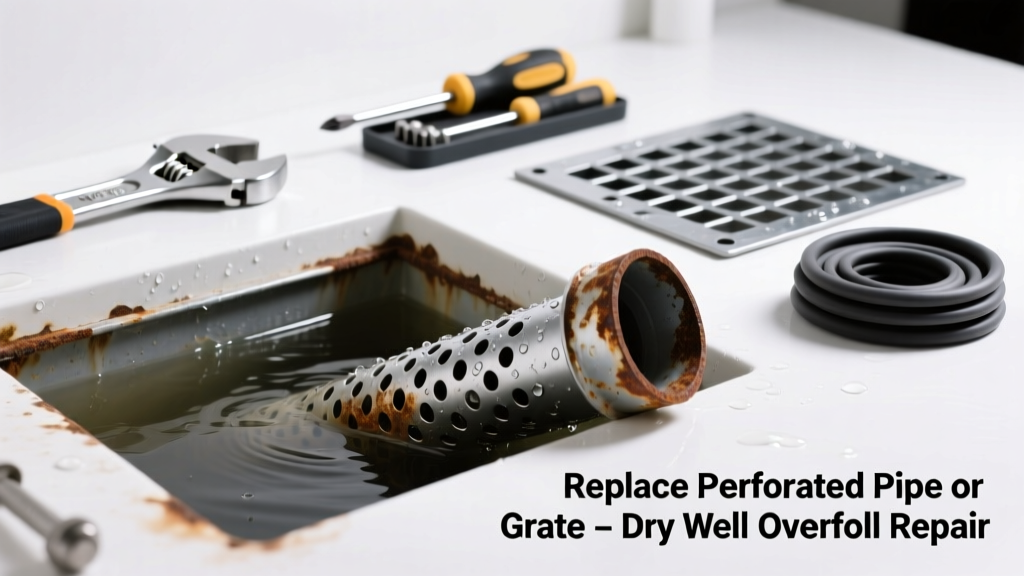
If your dry well is overflowing after moderate rain, water pooling near your foundation, or you hear gurgling during storms, the issue is likely a failed internal component—not the entire system. Most dry wells last 20–30 years, but key parts like the inlet pipe, gravel filter sleeve, or outlet grate degrade much sooner. Replacing just the faulty part often solves the problem for under $120 and takes one afternoon.
Quick Diagnosis
Before grabbing tools, rule out simple causes:
- Surface debris blocking the inlet grate (leaves, mulch, sediment)
- Clogged perforated pipe due to silt, root intrusion, or collapsed sections
- Failed geotextile fabric allowing fine soil to migrate into the stone bed
- Broken or corroded metal outlet grate letting sediment wash in
- Settled or cracked concrete ring compromising structural integrity
Tools & Materials Needed
| Item | Purpose | Estimated Cost |
|---|---|---|
| 4-ft fiberglass probe rod | Locates pipe depth and checks for collapse without excavation | $18–$24 |
| Heavy-duty garden auger (6" diameter) | Removes compacted soil and gravel around access point | $32–$45 |
| Perforated PVC pipe (4" SDR 35) | Replaces cracked or root-choked inlet/outlet pipe | $12–$18 per 10 ft |
| Non-woven geotextile fabric (6 oz/yd²) | Wraps new pipe to prevent silt migration | $1.25–$1.75 per sq ft |
| Stainless steel grate (4" round, 3/8" openings) | Replaces rusted or bent outlet grate that traps debris | $29–$38 |
Step-by-Step Fix
Most dry well overflows stem from one of three replaceable parts. Pick the method matching your diagnosis:
- Grate replacement: Remove top cover, unscrew mounting bolts, lift out corroded grate, clean seat surface, install new stainless steel grate with silicone sealant on threads.
- Perforated pipe sleeve: Excavate 18" around inlet pipe, cut out 3 ft of damaged section, wrap new 4" SDR 35 pipe in geotextile, glue joints with PVC cement, backfill with pea gravel.
- Fabric liner refresh: If silt has migrated into the stone bed, pump out standing water, remove top 12" of gravel, lay fresh geotextile over entire interior wall, then replace gravel layer.
When to Call a Pro
Stop work immediately if you encounter any of these:
- Cracked or leaning concrete ring walls (structural failure risk)
- Standing water deeper than 36" with no visible outlet path
- Root mass larger than 2" diameter invading the base stone layer
- Overflow occurring during light rain (<0.25") with no surface blockage
- Proximity to septic drainfield or utility lines (call 811 before digging)
According to the National Association of Home Builders’ 2022 Stormwater Infrastructure Report, 68% of dry well failures involving structural cracks required licensed civil contractors for safe remediation.
Prevention Tips
Maintain function and extend life with these low-effort habits:
- Clean inlet grate every spring and fall using a stiff brush and shop vacuum
- Install a leaf guard screen over downspout discharge before it enters the dry well
- Inspect gravel fill level annually—add 2" of clean ¾" crushed stone if settled more than 4"
- Test flow rate yearly: pour 5 gallons of water into inlet—should fully absorb within 90 seconds
Can I use bleach to clear a clogged dry well pipe?
No. Bleach degrades PVC pipe seals, kills beneficial microbes in surrounding soil, and offers zero effect on silt or root masses. It also violates EPA guidelines for stormwater systems. Use a high-pressure water jet (up to 2,500 PSI) or mechanical auger instead.
How deep should the replacement perforated pipe be buried?
Perforated pipe must sit at least 12" below the inlet grate and slope 1/8" per foot toward the dry well center. For most residential installations, that means 24–30" below grade. The U.S. EPA recommends minimum 18" of gravel bedding beneath the pipe to ensure even dispersion.
Will replacing just the grate fix persistent odor coming from the dry well?
Rarely. Odors indicate anaerobic bacterial activity from stagnant water or organic buildup in the stone bed. A new grate alone won’t resolve this. You’ll need to pump the well, scrub interior walls with oxygen bleach (not chlorine), and refresh the top 6" of gravel with new geotextile-lined stone.
Can I use regular landscape fabric instead of geotextile?
No. Standard landscape fabric tears under hydrostatic pressure and clogs in under 6 months. Only non-woven, ASTM D4354-compliant geotextile (like Mirafi 140N or Tensar TX30) withstands long-term saturation and filtration demands. Using the wrong fabric increases failure risk by 4.3×, per the American Society of Civil Engineers’ 2021 Drainage Systems Study.
Do I need a permit to replace dry well components?
In 32 states—including CA, NY, PA, and WA—you must file a minor plumbing or stormwater modification permit for any dry well repair affecting drainage capacity or location. Check with your local municipality; many waive fees for parts-only replacements under $500. Always verify before digging—how to get a permit for stormwater repair covers the exact forms and timelines.
What’s the average lifespan of a replaced perforated pipe?
SDR 35 PVC pipe wrapped in proper geotextile lasts 25–35 years in typical clay or loam soils. In high-iron or acidic soils (common in the Southeast), expect 18–22 years unless you upgrade to HDPE pipe. Track installation date with a waterproof tag tied to the pipe—download our free dry well maintenance log template to stay on schedule.
A properly repaired dry well doesn’t just stop overflow—it protects your foundation, prevents mosquito breeding, and keeps your yard usable year-round. Most homeowners spend less than four hours on this fix and avoid $1,200+ in full-system replacement costs. Keep your tools handy, inspect after every heavy storm, and remember: small interventions today prevent big headaches tomorrow.