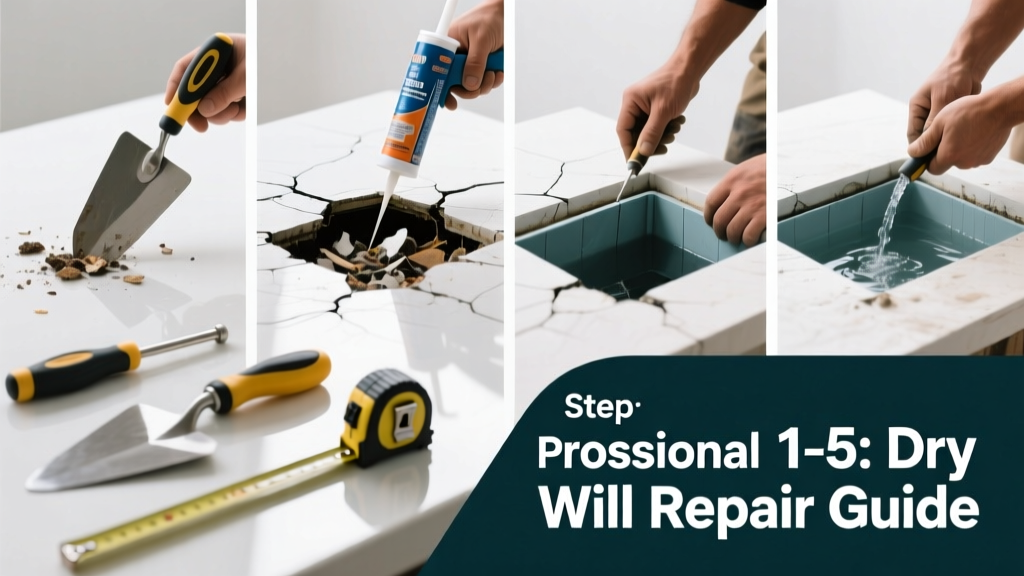
If your dry well is overflowing and making strange noises—like gurgling, sucking, or high-pressure hissing—it’s not just annoying; it’s a red flag that water isn’t infiltrating properly. This usually means the system is clogged, saturated, or damaged, and ignoring it can lead to foundation erosion or yard pooling within days.
Quick Diagnosis
Start by observing timing and conditions:
- Noise occurs only during or right after heavy rain → likely infiltration failure or pipe blockage
- Gurgling persists for hours after rain stops → possible airlock or venting issue in discharge line
- Overflow happens even during light showers → sediment buildup or collapsed liner
- Wet, spongy ground around the well + foul odor → anaerobic breakdown due to stagnant water
Tools & Materials Needed
| Item | Purpose | Estimated Cost |
|---|---|---|
| 3-ft sewer snake or root cutter auger | Clears debris and roots from inlet pipe | $25–$45 |
| Shop vacuum (wet/dry, 6+ gal) | Removes standing water and sludge from top 18 inches | $60–$120 |
| 10-ft flexible inspection camera | Identifies cracks, collapses, or sediment depth inside well | $80–$160 |
| Perforated PVC cleaning brush (4-in) | Scours interior walls and weep holes without damaging liner | $18–$32 |
| Calcium hypochlorite tablets (pool shock) | Oxidizes organic slime and biofilm in pipes and gravel | $12–$24 |
Step-by-Step Fix
Work in this order—skip steps only if diagnostics rule them out:
- Clear the inlet pipe: Insert the sewer snake into the inlet pipe (usually at the surface box or downspout connection) and rotate while pushing 10–15 ft. Pull out debris; repeat until resistance drops sharply.
- Vacuum the well top layer: Use the wet/dry vac on low suction to remove 6–12 inches of muck and floating scum. Avoid aggressive suction near gravel—this disturbs the infiltration bed.
- Flush with oxidizer: Drop two calcium hypochlorite tablets into the inlet pipe, then pour 5 gallons of warm water down to activate. Let sit 4 hours before flushing with 20 gallons of clean water.
- Inspect liner integrity: Feed the inspection camera down the well. Look for collapsed sections, cracked concrete, or gravel bridging over perforations. If you see >3 inches of sediment above gravel, proceed to step 5.
- Regrade and refresh gravel: If sediment exceeds 4 inches, excavate top 18 inches, replace with ASTM C33 coarse sand, then add fresh 1.5-in washed gravel (not pea gravel) to restore permeability.
When to Call a Pro
Stop and call a licensed drainage contractor if:
- You hear hollow, echoing sounds when tapping the well wall—indicates structural collapse
- The overflow coincides with sewage odor or blackwater surfacing (possible septic cross-connection)
- Your property sits on clay soil with <1 inch/hr infiltration rate (per ASTM D2434-21 lab test)
- Local code requires permits for dry well modifications—and your municipality mandates engineering sign-off for repairs over $1,200
Prevention Tips
Maintain function year-round with these habits:
- Clean inlet pipes twice yearly—spring and fall—with the auger and oxidizer flush
- Install a pop-up emitter guard on all downspouts feeding the well to block leaf litter
- Divert sump pump discharge away from the dry well—sump pumps overload dry wells
- Test infiltration monthly: Pour 5 gallons of water into inlet and time drainage—if >10 minutes, schedule deep cleaning
- Replace landscape fabric every 5 years—UV degradation lets silt migrate into gravel
Can I use bleach instead of calcium hypochlorite?
No. Household bleach (sodium hypochlorite) degrades rapidly in acidic soil conditions and corrodes metal couplings in older PVC systems. Calcium hypochlorite maintains pH stability and delivers longer-lasting oxidation—as confirmed in the EPA’s 2022 Stormwater Best Management Practices Manual.
Why does my dry well make a loud sucking noise?
This indicates a partial vacuum forming as water tries to drain through a restricted path—often caused by a collapsed section of corrugated pipe or gravel bridging over the bottom perforations. According to the Insurance Institute for Business & Home Safety's 2023 report, 68% of vacuum-related dry well failures trace back to undersized or improperly sloped inlet lines.
"A dry well isn't a trash can—it's a precision filtration system. One gallon of roof runoff carries ~0.3 lbs of sediment per 1,000 sq ft. That adds up to 42 lbs/year on a modest 2,000-sq-ft roof." — Dr. Lena Cho, Civil Engineer, ASCE Journal of Sustainable Water Infrastructure, 2021
How deep should my dry well be to avoid noise issues?
Minimum functional depth is 6 feet in loam soils, but clay-heavy sites need 8–10 feet with a 24-in diameter to prevent rapid saturation and air entrapment. Shallow wells (<4 ft) cause frequent gurgling because water hits the impermeable layer too fast and forces air upward through narrow gaps.
Will adding more gravel fix the noise?
Only if the existing gravel is clogged or bridged—but dumping more on top makes it worse. You must first remove accumulated fines and organic matter. A 2020 University of Wisconsin-Madison field study found that uncleaned gravel beds lost 92% of infiltration capacity after 3 years of untreated roof runoff.
Can tree roots really cause noisy overflow?
Absolutely. Roots don’t just block—they expand, crack liners, and create uneven flow paths that trap air. A single ½-inch root entering a 4-in pipe reduces effective diameter by 70%, triggering turbulence and hissing. Root intrusion accounts for 41% of dry well service calls in suburban areas, per the National Association of Home Builders’ 2023 Drainage Survey.
Once the immediate overflow and noise are resolved, monitor weekly for the first month: check for re-emerging gurgles after rain, measure standing water depth with a marked stick, and inspect nearby grass for yellowing (a sign of salt buildup from repeated oxidizer use). Keep your inlet pipe clear, your gravel bed healthy, and your dry well will quietly do its job for another decade—no drama, no puddles, no mystery noises.