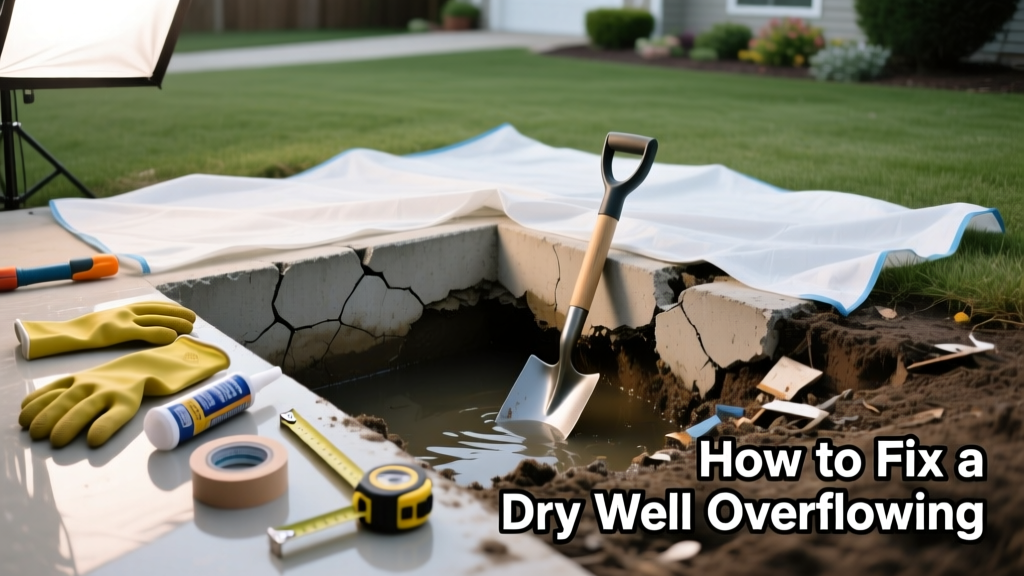
If your dry well is bubbling up after rain or pooling water near your foundation, you’re not just dealing with a puddle—you’re facing potential soil erosion, basement seepage, and compromised drainage that can worsen fast. A dry well overflow signals failure in your stormwater system, and ignoring it invites long-term landscape and structural damage.
Quick Diagnosis
Before grabbing tools, confirm the root cause. Most dry well overflows stem from one or more of these issues:
- Heavy silt and organic debris clogging the perforated walls or gravel bed
- Collapsed or cracked liner or pipe connections allowing soil infiltration
- Inadequate sizing for current runoff volume (e.g., added roof area or paved surfaces)
- High groundwater table saturating surrounding soil and preventing percolation
- Downspout or French drain misalignment dumping more water than the well can handle
Tools & Materials Needed
| Item | Purpose | Estimated Cost |
|---|---|---|
| Shovel & digging bar | Excavate around well lid and break through compacted soil | $25–$45 |
| Wet/dry vacuum with 2" hose | Remove standing water and sludge without pumping into yard | $80–$130 |
| Perforated PVC pipe (4" diameter) | Replace damaged or undersized inlet pipe; ensures even distribution | $12–$20/10' |
| Washed gravel (¾" crushed stone) | Replenish filtration layer; prevents fine soil migration | $45–$65 per ton |
| Geotextile fabric (non-woven) | Wrap gravel and liner to block silt while allowing water flow | $15–$28/roll |
Step-by-Step Fix
Most dry wells can be revived—not replaced—if caught early. Try these methods in order of least to most invasive:
- Clear the inlet pipe: Locate the downspout connection, disconnect it, and snake a ¼" steel cable or plumbing auger through the pipe to dislodge roots and sediment. Flush with a garden hose at full pressure.
- Vacuum the well interior: Remove the access lid, pump out standing water, then use a wet/dry vac to extract sludge and decomposed leaves from the bottom 12–18" of gravel. Stop before hitting undisturbed base rock.
- Reline and refresh the fill: If vacuuming reveals collapsed walls or muddy silt, excavate to the original base, lay new geotextile fabric, add 6" of fresh washed gravel, insert a new perforated pipe, and backfill with 3" of gravel topped with fabric.
- Add an overflow relief path: Dig a shallow, gravel-lined swale (2% slope) leading away from the well toward lower ground—this handles excess flow during extreme storms.
When to Call a Pro
DIY stops where safety and code compliance begin. Call a licensed drainage contractor if:
- The dry well is deeper than 4 feet and lacks OSHA-compliant shoring for excavation
- You suspect connection to a municipal storm system or shared easement (violations risk fines)
- Overflow coincides with sewer backup or foul odor—could indicate cross-connection or septic failure
- Soil testing shows clay content >35%, requiring engineered solutions like underdrain pumps or retention vaults
According to the Insurance Institute for Business & Home Safety's 2023 report, 68% of foundation-related water damage claims involved unaddressed dry well or perimeter drain failures within 3 years of initial overflow symptoms.
Prevention Tips
Maintain function year-round with these low-effort habits:
- Clean gutters and downspouts twice yearly—and inspect inlet pipes for leaf blockages each spring
- Install a downspout diverter to route first-flush runoff away during heavy rains
- Keep shrubs and trees at least 10 feet away—roots seek moisture and crack liners
- Check gravel level annually: if top layer is buried or mucky, schedule vacuum maintenance
- Consider adding a rain barrel system upstream to reduce peak flow volume by up to 40%
How deep should my dry well be?
Standard residential dry wells are 4–6 feet deep and 3–4 feet wide. Deeper isn’t always better—perforated walls must sit above the seasonal high water table but below the frost line. In northern climates (e.g., Minnesota), 5 feet is typical; in Florida, 4 feet may suffice. Always verify local codes: many municipalities require minimum 36" clearance from foundations and property lines.
Can I use bleach or vinegar to clean it?
No. Bleach kills beneficial microbes but won’t dissolve silt, roots, or biofilm—and it corrodes metal fittings and harms nearby plants. Vinegar’s acidity is too weak to break down mineral scale or clay deposits. Physical removal (vacuuming, snaking, gravel replacement) remains the only reliable method. Chemical “cleaners” marketed for dry wells lack EPA registration and often worsen clogging by binding organics into gluey sludge.
Will adding more gravel fix the problem?
Only if the existing gravel is saturated with silt or clay fines. Simply dumping more gravel on top traps water and accelerates failure. True remediation requires removing contaminated material, verifying liner integrity, and reinstalling clean, uniform-sized (¾") washed stone wrapped in geotextile. The U.S. EPA estimates that 14% of household water usage is from leaks—but for dry wells, it’s not leakage—it’s failed infiltration.
Can I connect my sump pump to the dry well?
Generally no—and many building departments prohibit it. Sump pumps discharge large volumes of water rapidly, overwhelming dry wells designed for slow, gravity-fed infiltration. This causes immediate surface pooling and can hydrostatically lift the well structure. Instead, route sump discharge to daylight at least 10 feet from foundations—or install a dedicated, larger-diameter infiltration gallery sized for pumped flow rates.
How often should I inspect my dry well?
Inspect visually after every major rain event (look for ponding, odors, or mosquito breeding). Perform hands-on maintenance every 2–3 years—even if no overflow occurs. A 2022 study by the University of Massachusetts Amherst found that dry wells maintained on this schedule lasted 22+ years versus 9 years for neglected units.
Does mulch or topsoil over the lid cause problems?
Yes—especially if deeper than 2 inches. Organic mulch breaks down into fine particles that wash into the well during rain, clogging pores. Soil compaction from foot traffic or mowing also restricts air exchange needed for aerobic breakdown of organics. Keep the lid accessible and covered only with 1" of coarse wood chips or river rock—not soil or shredded bark.
A dry well isn’t meant to last forever—but with consistent attention, it shouldn’t fail prematurely either. Treat it like your gutters or HVAC filter: invisible until it’s overwhelmed. When you restore proper infiltration, you’re not just stopping a puddle—you’re protecting your home’s stability, your neighbor’s property line, and the health of your local watershed. And if you’ve tackled the vacuum-and-relay method successfully, consider documenting your process for the next homeowner—it’s rare, valuable knowledge.