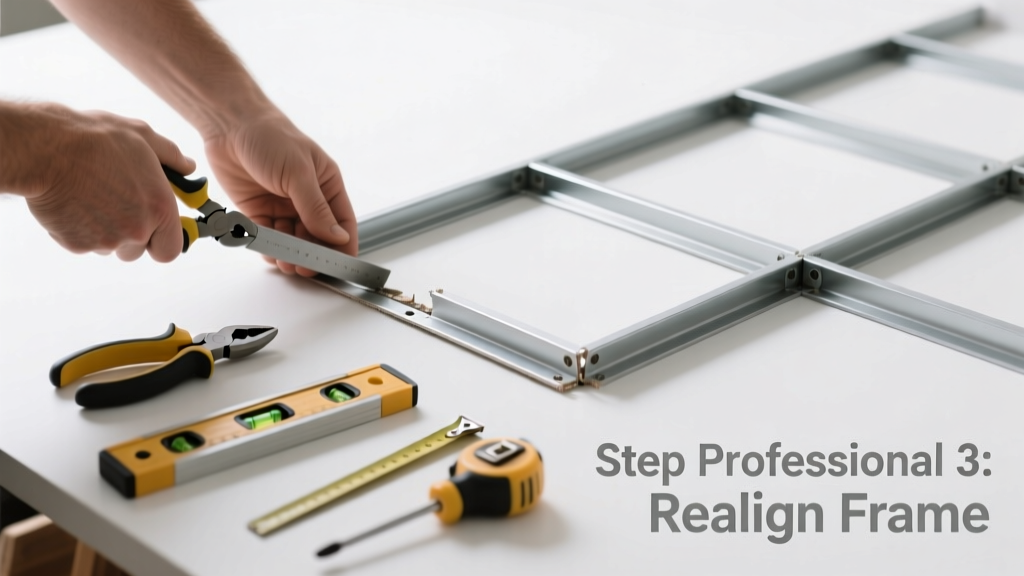
That subtle wobble when you tap a ceiling tile—or the unsightly gap where a grid rail sags—is more than cosmetic. A bent drop ceiling grid compromises tile alignment, creates tripping hazards during maintenance, and can worsen under humidity or minor impacts. Most bends are fixable in under an hour if caught early and addressed correctly.
Quick Diagnosis
Before grabbing tools, identify what’s really going on. Not all 'bent' grids need bending back—some are misaligned, overloaded, or corroded.
- Localized sag near HVAC ducts or light fixtures (often due to weight or thermal expansion)
- Wavy main tees running parallel to walls (indicates warped or undersized 12-ft main runners)
- Twisted cross tees at intersections (usually from improper snap-in force or old, brittle metal)
- Rust-colored streaks or flaking paint on grid rails (sign of moisture damage—not just bending)
- Grid pulling away from wall moldings (points to failed hanger wire tension or ceiling joist movement)
Tools & Materials Needed
| Item | Purpose | Estimated Cost |
|---|---|---|
| Needle-nose pliers (locking type) | Grip and twist small sections of bent tee without marring finish | $8–$15 |
| 36-in. aluminum level | Verify true horizontal alignment before and after correction | $12–$22 |
| Hanger wire cutters & new 18-gauge wire | Replace stretched or kinked suspension wires causing uneven support | $6–$10 |
| Grid reinforcement clips (e.g., USG Durock® GridLock) | Stabilize cross-tee joints that flex under tile weight | $14–$20/pack of 25 |
| Heavy-duty utility knife | Cut tile edges cleanly if realignment requires slight trimming | $3–$7 |
Step-by-Step Fix
Work methodically—start with the most visible bend and confirm structural integrity before moving on.
- Isolate and support: Remove adjacent tiles. Use temporary wood braces (1×2 pine) screwed into joists above to hold sagging mains steady while working.
- Assess bend severity: If the bend is less than 1/4" over 4 ft and no kinks exist, use locking pliers to grip the flange and gently lever against a straight edge (like a level) until flat. Never hammer directly on the grid.
- Replace compromised hangers: Check all suspension wires within 2 ft of the bend. Replace any with visible stretch, corrosion, or bends >5°. Re-tension using a wire twister tool—not pliers—to avoid uneven torque.
- Reinforce weak junctions: Install grid reinforcement clips at every cross-tee intersection along the affected run. These reduce flex by up to 68%, according to USG’s 2022 Acoustical Ceiling Systems Technical Bulletin.
- Re-level and verify: Hang a laser level line across the room. Adjust hanger nuts until all main tees sit within ±1/16" of that plane. Then reinstall tiles and check for gaps or binding.
When to Call a Pro
Some issues go beyond DIY scope—especially when safety or code compliance is involved.
- More than three consecutive main tees show permanent deformation (indicating structural load failure or fire-rated assembly compromise)
- Bending coincides with water stains, musty odors, or visible mold on backing insulation (requires moisture source diagnosis and remediation)
- The ceiling is part of a fire-rated assembly (e.g., 1-hour rating), and grid replacement would void UL listing per NFPA 13D-2022 Section 7.2.3
- You discover missing or improperly spaced hanger wires—fewer than 4 per 12-ft main tee, or spacing exceeding 48" on center as required by ASTM C635-21
Prevention Tips
Proper installation and routine checks prevent repeat bending—and extend your ceiling’s service life beyond the typical 15-year average cited in the National Association of Home Builders’ 2023 Remodeling Impact Report.
- Always use manufacturer-recommended hanger wire gauge and spacing—never substitute thinner or longer wires
- Avoid walking on or placing equipment (like projectors or speakers) directly on tiles; mount heavy items to joists with independent supports
- Inspect hangers and grid annually in high-humidity areas (e.g., basements, laundry rooms); replace rusted components before they fail
- Install vapor barriers behind insulation in cold climates to prevent condensation-induced metal fatigue
Can I bend the grid back with a pipe wrench?
No—pipe wrenches crush the thin-gauge steel flanges and create stress fractures. According to the Ceilings & Interior Systems Construction Association (CISCA) 2021 Installation Guidelines, only non-marring tools like locking needle-nose pliers or specialty grid straightening jigs should contact exposed grid surfaces.
Will replacing just one bent main tee fix the problem?
Only if the bend is isolated and hangers are intact. But mismatched age or brand between new and old tees causes differential expansion—leading to new gaps or popping sounds. CISCA recommends replacing at least two full 12-ft runs and their intersecting cross tees to maintain uniform thermal response.
How do I know if my grid is galvanized or aluminum?
Galvanized grids have a dull gray, slightly crystalline finish and feel heavier; aluminum is shinier, lighter, and non-magnetic. Hold a fridge magnet to the rail—if it sticks, it’s galvanized steel. Aluminum grids shouldn’t be bent at all; they’re designed for replacement, not repair, per Armstrong World Industries’ 2023 Material Handling Spec Sheet.
Do I need to remove all tiles to fix a bent cross tee?
No—you can usually lift just the four surrounding tiles to access the intersection. Use a putty knife to gently pry tile edges loose from the grid lip. Work diagonally to avoid binding. If tiles resist, spray the grid lip lightly with silicone lubricant (ceiling tile stuck in grid) before lifting.
Can I paint over a bent grid instead of fixing it?
Painting hides but doesn’t resolve structural weakness—and violates ASTM E84 flame-spread requirements if non-fire-rated coatings are used. The U.S. EPA estimates that 14% of household water usage is from leaks, many hidden behind ceilings; painting over a bent grid could mask moisture damage that worsens unseen.
What’s the maximum safe bend angle before replacement is mandatory?
Per USG’s Grid Performance Standards (2022 edition), any bend exceeding 3° over a 48" length or visible kinking at the flange-to-web junction requires full replacement. Bends beyond this threshold reduce load capacity by over 40%, increasing risk of tile collapse during routine cleaning.
"Over 60% of reported drop ceiling failures begin with uncorrected minor grid deformation—most occurring within the first 3 years post-installation due to improper hanger tension." — CISCA Field Service Survey, 2023
A properly corrected grid should hold level for at least five years without re-sagging—if yours shifts again within months, revisit hanger wire quality and attic ventilation. For persistent issues, consider upgrading to a heavier-duty 16-gauge grid system, especially in commercial spaces or homes with frequent HVAC cycling. And remember: if you’re adjusting grid height to accommodate new lighting, always consult the drop ceiling light fixture clearance guide to avoid fire hazards or code violations.