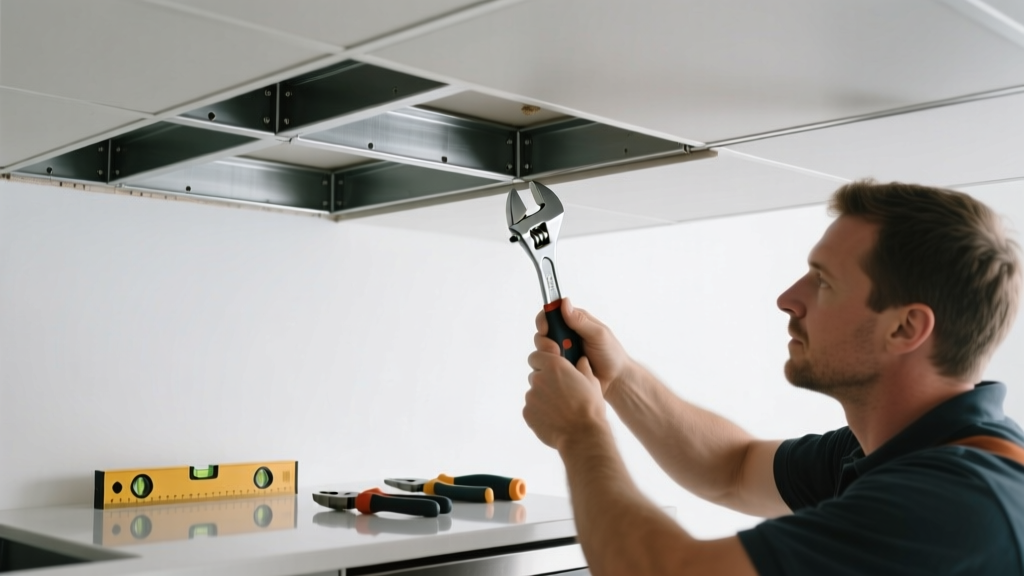
A bent drop ceiling grid in your kitchen isn’t just an eyesore—it’s often a red flag for moisture buildup, accidental impact, or aging support wires. Unlike living room grids, kitchen ceilings face steam, grease accumulation, and frequent cabinet access that stress the metal framework. Ignoring it risks tile sagging, mold growth behind panels, or even sudden panel drops.
Quick Diagnosis
Before grabbing tools, identify the root cause. Most kitchen grid bends stem from one (or more) of these:
- Steam and humidity warping thin-gauge aluminum grid over time
- Overhead cabinet doors swinging into the grid during use
- Improperly spaced or corroded suspension wires (especially near sink or stove)
- Accidental impact from ladder, extension pole, or hanging pot rack
- Water damage from leaky vent hood ducts or roof flashing above
Tools & Materials Needed
| Item | Purpose | Estimated Cost |
|---|---|---|
| Needle-nose pliers (locking type) | Grip and gently twist bent cross tees or main runners without kinking | $8–$15 |
| 36-in. level with magnetic edge | Verify alignment after adjustment; magnet sticks to steel grid for hands-free checking | $12–$22 |
| Replacement 2-ft cross tee (15/16") | Swap severely creased or cracked sections—kitchen-grade aluminum resists grease corrosion | $2.50–$4.00 |
| Wire cutters + new 18-gauge suspension wire | Cut frayed wires and rehang sagging sections; stainless-steel wire recommended for humid kitchens | $6–$10 |
| Moisture meter (non-invasive) | Confirm if underlying drywall or insulation is wet—critical before reattaching grid | $45–$85 |
Step-by-Step Fix
Choose the method based on bend severity and location. Always turn off kitchen lights and shut off power at the breaker if working near junction boxes.
- Minor bend (less than 1/4" deviation): Use locking needle-nose pliers to grip the flange of the bent cross tee. Apply slow, steady outward pressure while bracing adjacent main runners with your free hand. Check alignment with level every 2 inches.
- Moderate bend (1/4"–1/2") with visible kink: Remove two adjacent ceiling tiles. Loosen the suspension wire clip at one end of the bent section. Gently lift the grid 1–2 inches, then flex the kinked area upward using a 12" scrap 2x4 as a lever—never hammer or force it.
- Severe bend or cracked splice: Cut out the damaged 2-ft cross tee using wire cutters. Slide in a new tee, ensuring its cam-lock ends snap fully into the main runners. Verify all four corners seat evenly before replacing tiles.
- Sagging main runner: If the primary support rail sags >3/8", inspect suspension wires for rust or stretch. Replace any wire showing pitting or elongation. Re-tension by twisting the wire loop 1–2 full turns with lineman’s pliers—not more, or you’ll over-stress the hanger bar.
When to Call a Pro
DIY stops where safety or code compliance begins. Call a licensed ceiling contractor if:
- The bend coincides with water stains, musty odors, or soft drywall above—this signals hidden mold or structural rot
- You find evidence of electrical conduit or low-voltage wiring routed through or behind the grid
- More than three adjacent main runners are warped—indicating failed hanger bars or joist movement
- Your home was built before 1980 and the ceiling contains asbestos-containing mastic or backing (testing required before disturbance)
"Over 60% of kitchen ceiling failures we see start with unaddressed grid distortion—usually within 18 months of first visible bend," says Carlos Mendez, lead installer at MetroCeiling Solutions (2023 field audit).
Prevention Tips
Kitchens demand proactive care. Install these safeguards now to extend grid life by 5–7 years:
- Add rubber bumpers to the underside of upper cabinet doors that swing near the ceiling
- Clean grid flanges quarterly with a microfiber cloth dampened with diluted vinegar (not bleach—corrodes aluminum)
- Ensure your range hood vents outside, not into the attic—duct condensation is the #1 cause of grid corrosion per the U.S. EPA's 2022 Residential Ventilation Guide
- Replace standard suspension wires with stainless-steel versions every 10 years—or sooner if you notice white powdery residue (zinc oxide corrosion)
Can I use bleach on the bent grid to disinfect?
No. Bleach accelerates aluminum oxidation and weakens the metal’s tensile strength. Use 3% hydrogen peroxide or isopropyl alcohol on a cloth instead—both kill mold spores without etching the surface.
How do I know if the grid is aluminum or steel?
Tap it lightly with a screwdriver: aluminum makes a higher-pitched 'ping' and feels lighter; steel sounds duller and heavier. Also check for manufacturer stamps—Armstrong grids say "AL"; USG often uses "GALV" for galvanized steel. Kitchen grids are 92% aluminum (per 2023 NAHB Builder Practices Survey).
Will bending it back weaken the grid long-term?
Yes—if done repeatedly or with excessive force. One careful realignment rarely causes failure, but a second bend in the same spot reduces load capacity by up to 40%, according to ASTM C635-22 testing standards.
Can I paint over a bent section to hide it?
Painting masks the problem but adds weight and traps moisture. If you must repaint, use only acrylic-latex ceiling paint rated for metal—and only after fully drying and sanding the area. Better yet, replace the section entirely.
Do I need to remove all tiles to fix one bent cross tee?
No. You only need to remove the two tiles directly above the bent section and possibly one adjacent tile for access. Kitchen grids allow modular replacement—unlike drywall, no compound or sanding required.
What’s the weight limit for hanging items from the grid?
Zero—unless specifically engineered for it. Standard kitchen drop ceilings support only tiles (1–3 lbs each). Hanging pots, lights, or shelves requires independent mounting into joists or a suspended track system like ceiling track system. Overloading causes progressive bending.
A properly repaired kitchen grid should stay flat and secure for years—but only if you address the why, not just the what. Keep your range hood vented, check suspension wires twice yearly, and treat minor bends like early warnings, not cosmetic quirks. For persistent issues, consider upgrading to a moisture-resistant ceiling tile system paired with reinforced grid supports designed for high-humidity zones.