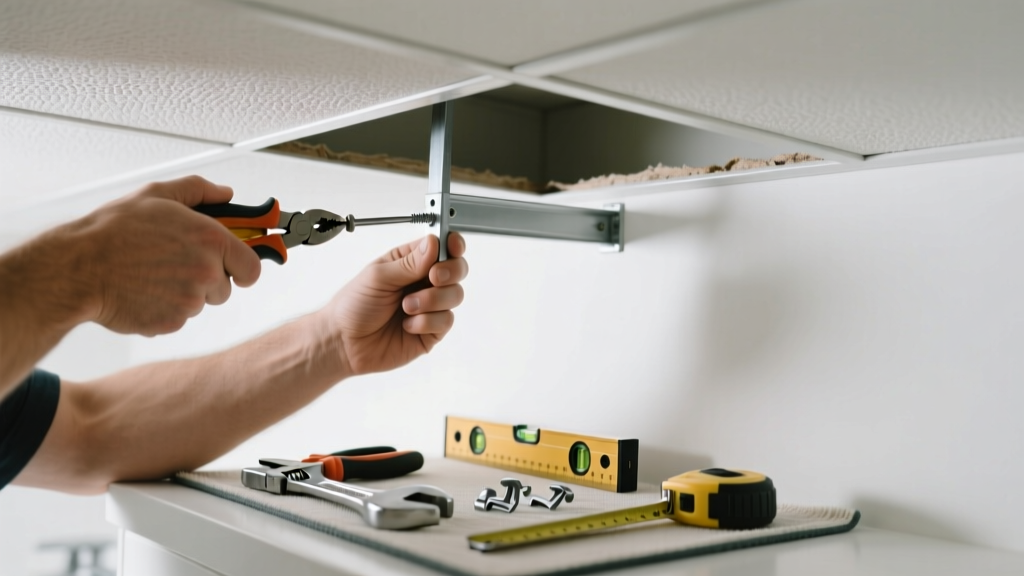
Bathroom drop ceilings warp faster than anywhere else in the house — humidity, steam, and occasional accidental bumps from ladders or storage make grid bending common. If your grid looks like a wavy ribbon above the shower, don’t assume it’s just cosmetic: sagging can trap moisture, encourage mold, and compromise fire-rated assemblies.
Quick Diagnosis
Before grabbing tools, confirm why the grid bent:
- Moisture absorption in aging aluminum or rust-prone steel grid (especially near exhaust vents)
- Improper tile support — lightweight tiles sagging over time and pulling grid down
- Water damage from leaky shower valves or roof flashings above the ceiling
- Physical impact from stored items, cleaning poles, or ladder contact
- Insufficient hanger wire spacing (more than 24" apart violates ASTM C635 standards)
Tools & Materials Needed
| Item | Purpose | Estimated Cost |
|---|---|---|
| Needle-nose pliers (locking) | Grip and twist bent cross tees without marring finish | $8–$15 |
| 12-gauge galvanized hanger wire | Replace corroded or stretched suspension wires | $4–$7 per 100 ft |
| Adjustable ceiling grid leveler tool | Apply even pressure to restore alignment across 4' spans | $22–$34 |
| Moisture-resistant ceiling tiles (e.g., USG Donn® DXT) | Prevent future sag; rated for RH up to 95% | $3.20–$5.80 per tile |
| Hygrometer with data logging | Verify bathroom humidity stays below 60% post-repair | $18–$29 |
Step-by-Step Fix
Choose the method based on severity and location:
- Minor bend (≤1/4" deviation): Use locking needle-nose pliers to grip the flange of the bent tee, then gently twist while bracing adjacent main runners. Work from center outward — never force beyond metal’s yield point.
- Moderate bend (1/4"–3/8") with intact hangers: Loosen two adjacent hanger wires, insert a 1x2 pine shim between grid and joist, and slowly tighten wires to lift and realign. Check level with a 4' torpedo level.
- Corroded or kinked section: Cut out damaged 2' segment using aviation snips. Replace with new 2' cross tee — ensure ends snap fully into main runners. Seal cut ends with clear acrylic sealant to inhibit future oxidation.
- Recurring sag near shower stall: Install supplemental hanger wires every 12" along main runners in that zone, anchoring into solid framing (not drywall anchors). Use corrosion-resistant toggle bolts if attaching to concrete backer board.
When to Call a Pro
DIY stops where safety or code compliance begins:
- The grid supports recessed lighting fixtures with non-IC-rated housings — disturbing wiring or thermal barriers risks fire hazard
- You spot black staining or musty odor behind tiles — indicates hidden mold growth requiring containment and remediation per IICRC S520-2021
- Hanger wires are embedded in plaster lath or attached to compromised joists (e.g., termite-damaged or water-softened wood)
- Your bathroom ceiling is part of a fire-resistance-rated assembly (common in condos or multi-family buildings), and the grid system is listed as part of the UL design
Prevention Tips
Stop recurrence before it starts:
- Run your bathroom exhaust fan for at least 20 minutes after each shower — the U.S. EPA estimates this cuts relative humidity by up to 30% during peak steam periods
- Replace standard fiberglass tiles with moisture-resistant mineral fiber tiles rated for high-humidity spaces
- Inspect hanger wires and grid connections every 6 months — look for white powdery corrosion (aluminum oxide) or reddish rust flecks
- Install a hygrometer inside the ceiling cavity (accessible via service panel) to catch creeping humidity before visible damage occurs
Can I use bleach on the bent grid to kill mold?
No. Bleach does not penetrate aluminum oxide layers and leaves behind salts that accelerate corrosion. According to the CDC’s Clean Water, Healthy Homes guide (2022), hydrogen peroxide-based cleaners (3%) are safer and more effective for surface mold on metal substrates.
Will tightening hanger wires fix a bowed main runner?
Not reliably. Main runners bow when overloaded or undersupported. Tightening wires alone increases tension unevenly and may cause joint separation. You must add intermediate hangers or replace the runner entirely if curvature exceeds 1/8" per linear foot.
Can I paint the grid to hide discoloration?
Only with water-based acrylic enamel labeled for metal and high-moisture areas — avoid oil-based paints, which trap moisture and blister. Sand lightly first, then apply two thin coats. Note: Painting voids most manufacturer warranties on corrosion resistance.
How do I know if my grid is aluminum or steel?
Aluminum is non-magnetic and lighter (a 4' cross tee weighs ~0.4 lbs); steel is magnetic and heavier (~0.9 lbs). Check for stamped markings: "AL" or "6063-T6" means aluminum; "ASTM A653" indicates galvanized steel. Older bathrooms (pre-1995) often used steel; newer builds favor aluminum for weight and corrosion resistance.
Do I need to remove all tiles to fix one bent cross tee?
No — carefully lift only the 2×2 or 2×4 tiles directly above and adjacent to the bend. Use a plastic putty knife to gently pry tile edges free from grid flanges. Avoid metal tools that scratch or deform the grid lip.
Is it safe to step on the grid to reach a leak?
Never. Even reinforced grids aren’t designed for human load. The National Association of Home Builders’ Bathroom Construction Guide (2023) states that stepping on any suspended ceiling component risks catastrophic collapse and voids structural liability coverage. Always use a proper scaffold or step ladder with stabilizer bar.
"In high-humidity zones, 72% of premature grid failures trace back to inadequate ventilation—not material defects." — USG Technical Bulletin TB-114, 2021
A properly repaired bathroom ceiling shouldn’t just look level — it should breathe right. Replacing a bent grid segment takes under an hour, but pairing that fix with consistent humidity control and quarterly visual checks keeps your ceiling flat, safe, and mold-free for years. If you’ve tackled similar repairs, check out our guides on bathroom exhaust fan noise fix and replacing ceiling tile without removing grid for next-level maintenance.