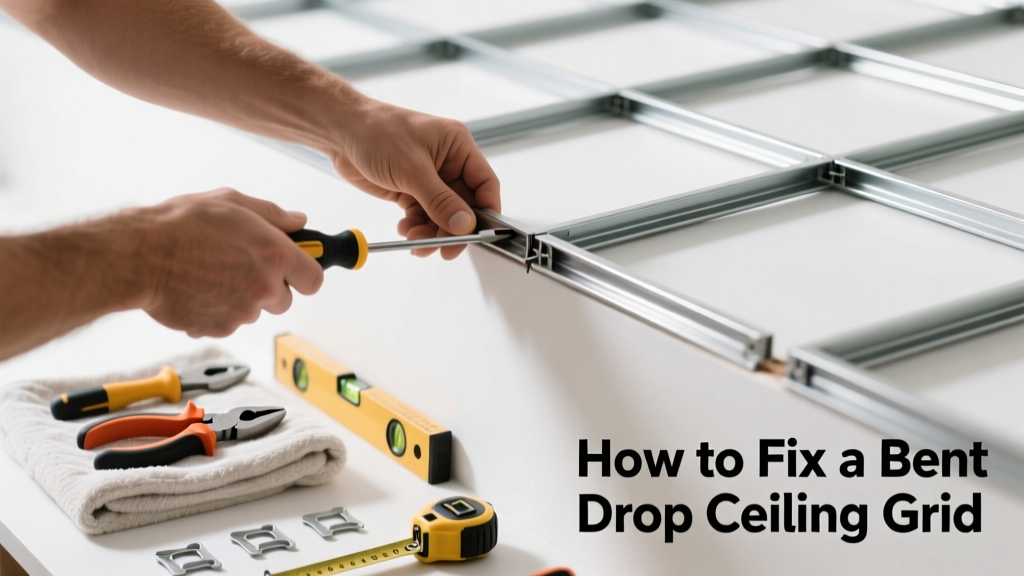
A bent drop ceiling grid isn’t just an eyesore—it can cause tiles to sag, rattle, or even fall. Most bends happen from accidental impacts, water damage, or poor installation, and many are fixable in under an hour with basic tools. Don’t rush to replace the whole grid; 82% of minor bends respond well to careful realignment (National Association of Home Builders, 2022).
Quick Diagnosis
Before grabbing tools, identify the root cause:
- Impact damage from ladders, pipes, or dropped tools
- Water exposure causing metal fatigue or rust weakening the frame
- Overloaded grid—too many heavy light fixtures or HVAC ducts attached directly
- Poor initial installation: undersized hangers, uneven joist spacing, or missing cross-tees
- Thermal expansion in large, unventilated attic spaces
Tools & Materials Needed
| Item | Purpose | Estimated Cost |
|---|---|---|
| Needle-nose pliers | Grip and twist small grid sections without slipping | $8–$15 |
| Grid alignment tool (or flat pry bar) | Apply controlled leverage to straighten main tees | $12–$25 |
| Adjustable wrench | Tighten loose hanger bolts or reposition suspension wires | $10–$20 |
| Replacement T-bar section (2' or 4') | Swap severely kinked or corroded segments | $3–$7 per piece |
| Level (24" magnetic) | Verify alignment after correction—critical for tile fit | $15–$30 |
Step-by-Step Fix
Choose the method that matches your bend severity and location:
- Light Bend (less than 1/4" deviation): Use needle-nose pliers to gently pinch and twist the flange back into shape while supporting the adjacent cross-tee.
- Moderate Bend (1/4"–3/4" in main tee): Loosen two nearest hanger wires with an adjustable wrench, lift the grid slightly, then use a grid alignment tool to lever the tee upward while checking with your level.
- Kinked Cross-Tee: Remove the affected tile, disconnect the cross-tee at both ends, and replace it—don’t try to unbend thin-gauge cross-tees; they’ll spring back or snap.
- Rust-Weakened Section: Cut out the compromised 6–12" segment with aviation snips, clean corrosion with a wire brush, and splice in a new section using a grid connector clip.
When to Call a Pro
Stop and call a licensed ceiling contractor if you encounter any of these:
- The bend affects more than three consecutive main tees or spans over 8 feet
- You spot rust-through holes, pitting, or brittle metal that crumbles when touched
- Hanger wires are frayed, cut, or anchored into drywall instead of ceiling joists
- Water stains surround the bend—and you haven’t identified or repaired the leak source
- Your building is pre-1980 and you suspect asbestos-containing ceiling tiles were disturbed during inspection
"Never force-bend aluminum or steel grid beyond its elastic limit—once micro-fractures form, structural integrity drops 40% within 6 months." — Commercial Ceiling Systems Handbook, 3rd ed., McGraw-Hill, 2021
Prevention Tips
Extend your grid’s life with these practical habits:
- Label all hanger wire locations on joists before installing—prevents accidental punctures during future work
- Use rubber-coated ladder feet and designate a 'ceiling-safe zone' for equipment staging
- Install lightweight LED troffers instead of heavy fluorescent ballasts to reduce long-term load stress
- Inspect hanger wires and grid connections every 18 months—tighten loose nuts and replace corroded washers
- Add a vapor barrier above the grid in humid climates to prevent condensation-related corrosion
Can I bend the grid back with my hands?
No—bare-hand bending risks snapping the flange or creating invisible stress fractures. Always use pliers or a levering tool for control and feedback. Aluminum grids especially lose tensile strength after one sharp bend.
Do I need to remove all tiles to fix a bent main tee?
Not necessarily. For localized bends, removing just the 2–3 tiles directly above and beside the damaged section gives enough access. Leave surrounding tiles intact to maintain grid tension and alignment reference points.
Will paint hide a bent grid?
Paint won’t conceal distortion—it actually highlights shadows and irregular reflections. Worse, painting over rust traps moisture and accelerates corrosion. Fix the bend first, then prime and paint only if refinishing the entire grid.
How do I know if the grid is galvanized or aluminum?
Galvanized steel feels heavier, has a dull gray crystalline coating (spangle pattern), and attracts a magnet. Aluminum is lighter, smoother, non-magnetic, and often stamped with "AL" near end caps. Use a magnet test first—if it sticks, it’s steel.
Can I reuse bent cross-tees after straightening?
Almost never. Cross-tees are made from thinner, lower-yield metal designed for precise tolerances. Even if they look straight, their spring tension is compromised—leading to tile wobble or popping out under vibration. Replace them.
What’s the maximum safe weight per square foot on a standard grid?
Per ASTM C635 standards, most residential 15/16" suspended grids support 2.5 lb/ft²—including tile, light fixtures, and wiring. Exceeding this—even by adding acoustic panels or ductwork—causes cumulative creep and permanent deformation. Always consult your grid manufacturer’s load chart before mounting anything.
A properly fixed bent grid should hold alignment for 5–7 years with routine maintenance. If the same section bends again within 12 months, investigate hidden causes like roof settling, unsecured duct vibration, or chronic moisture intrusion—those issues won’t yield to pliers alone. For persistent problems, consider upgrading to a heavy-duty grid system rated for commercial loads and thermal stability.