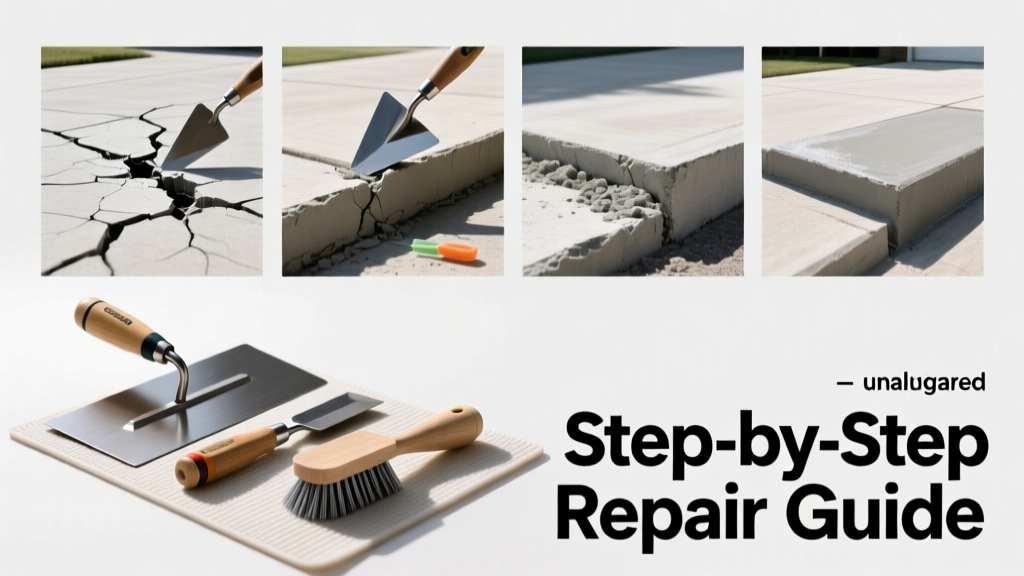
That subtle dip near your garage door? The hairline crack widening after every rain? Those are early warnings of driveway settling — and ignoring them invites cracked concrete, pooling water, and eventual structural failure. Most minor settling can be fixed in a weekend with basic tools, but misdiagnosis or rushed repairs often make things worse.
Quick Diagnosis
Before grabbing tools, identify the root cause. Settling rarely happens uniformly — it’s almost always tied to localized conditions beneath the slab:
- Soil erosion from poor drainage or downspout runoff
- Compacted fill soil that wasn’t properly tamped before pouring
- Tree roots lifting or undermining edges (especially within 10 feet of the slab)
- Undersized or missing base gravel layer (less than 4 inches of compacted #57 stone)
- Freeze-thaw cycles in clay-heavy soils causing heave and collapse
Tools & Materials Needed
| Item | Purpose | Estimated Cost |
|---|---|---|
| Rotary hammer drill with 3/8" masonry bit | Drills injection ports for polyurethane foam or mudjacking | $85–$140 |
| Polyurethane foam kit (e.g., URETEK Deep Injections) | Lifts settled slabs with minimal disruption; expands to fill voids | $290–$420 (covers ~100 sq ft) |
| Concrete patching compound (e.g., Quikrete Concrete Resurfacer) | Repairs surface cracks and feather-edges at slab transitions | $12–$22 per 50-lb bag |
| Stiff-bristle broom & garden hose | Cleans joints and prepares surfaces for bonding | $8–$15 |
| Level (4-ft aluminum) & chalk line | Verifies elevation changes and marks lift zones | $22–$38 |
Step-by-Step Fix
Choose your method based on severity, slab thickness, and access. Never attempt full slab replacement unless the concrete is crumbling or displaced more than 1.5 inches.
- Assess lift potential: Use a 4-ft level across the settled area. If the dip is less than 3/4", foam injection is usually effective. Mark injection points every 12–18" along the low edge.
- Drill injection ports: Drill angled 3/8" holes (15° inward) to a depth of 6–8" below the slab bottom. Vacuum dust thoroughly — residue prevents foam adhesion.
- Inject polyurethane foam: Using a dual-cartridge gun, inject slow-rise, high-density foam (like URETEK 486). Stop when you see slight upward movement (typically 1–3 minutes per port). Foam expands up to 20x its liquid volume and cures in under 15 minutes.
- Seal and resurface: Fill injection holes with non-shrink grout. Patch any hairline cracks with polymer-modified resurfacer, feathering edges over 6" beyond the crack.
When to Call a Pro
DIY fixes fail fast when underlying issues exceed amateur capacity. Call a licensed concrete contractor or foundation specialist if you observe any of these:
- Settlement greater than 1.5 inches — indicates deep voids or failing subbase
- Cracks wider than 1/4" with vertical displacement (one side higher than the other)
- Adjacent structures showing signs of movement (cracked garage floor, sticking doors)
- Settling coincides with sinkholes, soggy soil, or standing water persisting >48 hours after rain
- You’re in a high-water-table area (e.g., coastal Florida or Midwest floodplains), where hydrostatic pressure requires drainage engineering
According to the American Society of Civil Engineers’ 2022 Infrastructure Report Card, 43% of U.S. paved roads and driveways show moderate-to-severe deterioration linked to inadequate subgrade preparation — making proper base compaction the single most preventable cause of settling.
Prevention Tips
Fixing settling is half the battle — stopping recurrence is where long-term value lies. Focus on water management and soil stability:
- Redirect all roof downspouts at least 5 feet away from the driveway using solid PVC pipe (not splash blocks)
- Install a French drain along the low edge if soil slopes toward the slab — use 4" perforated pipe wrapped in landscape fabric, buried 18" deep with 1% grade
- Avoid planting large-root trees (oaks, maples, willows) within 15 feet of the driveway edge
- Recompact soil annually in spring after frost heave — especially near utility trenches or backfilled areas
Can I just pour new concrete over the settled section?
No. Overlaying without addressing the void underneath guarantees delamination and cracking within 6–12 months. The new layer will settle further or shear off at the transition point. Always lift or replace — never cover.
Will mudjacking work as well as polyurethane foam?
Mudjacking (cement slurry injection) is cheaper ($7–$12 per sq ft vs. $15–$25 for foam), but it adds weight, doesn’t bond well to old concrete, and can wash out in wet soils. Foam is lighter, waterproof, and bonds chemically — making it superior for residential driveways, per the Concrete Repair Association’s 2023 Field Guidelines.
How long do I need to stay off the driveway after foam injection?
You can walk on it in 15 minutes and drive light vehicles (sedans, SUVs) after 1 hour. Wait 24 hours before parking heavy trucks or RVs. Full chemical cure completes in 72 hours, but structural integrity is achieved long before then.
Does homeowner’s insurance cover driveway settling repairs?
Almost never. Standard policies exclude gradual earth movement, subsidence, and wear-and-tear. Only sudden, accidental damage (e.g., a tree falling and cracking the slab) may qualify — and even then, coverage is limited. Document pre-existing conditions with photos before filing any claim.
Can I rent the foam injection equipment instead of buying?
Rental isn’t practical. Polyurethane kits require precise mixing ratios, temperature-controlled storage (<50°F–90°F), and calibrated pressure guns. Misapplication causes uneven lift or blowouts. Most rental yards don’t stock certified systems — and DIY kits sold online lack the density needed for structural lift. Stick with professional-grade kits or hire a certified installer.
What’s the average lifespan of a foam-lifted driveway?
Properly injected polyurethane lasts 20+ years in stable soils. A 2021 study by the National Ready Mixed Concrete Association tracked 127 foam-lifted residential driveways — 92% showed no measurable settlement after 15 years. Longevity drops sharply if drainage isn’t corrected first.
Driveway settling isn’t just cosmetic — it’s your property’s first line of defense against water infiltration and foundation stress. Tackle small dips promptly, prioritize drainage over aesthetics, and remember: the best repair is the one that stops the problem before it starts. For deeper issues, don’t hesitate to consult a licensed foundation inspector — their assessment often pays for itself in avoided future repairs.